Live by the Sword, die by the Sword, so the saying goes, but Revolution boss Charles Cecil has taken a somewhat different view over the past decade. Having spent the best part of the last 25 years making adventure games, he's clearly not listening to those who continue to write off the genre.
"People talk about the decline of the adventure, [but] we sold the same for Broken Sword 3 as we did for Broken Sword 2, and Broken Sword 1. The market is still very much there, and it's not declining; there's still plenty of room for adventures."
Which is all good news for those of us that fancy a bit of point-and-clickery to go with our action-adventures and first-person shooting. In fact, next month sees the release of Broken Sword: The Angel of Death - the fourth in the long-running series and the first since 2003's The Sleeping Dragon.
With The Angel of Death approaching, we caught up with the man behind the much admired series and grilled him on the "mistakes" of The Sleeping Dragon, what to expect from number four, whether a sequel to Beneath a Steel Sky will ever see the light of day, and the challenges facing developers in this era of spiraling costs.
George turns psycho?
Eurogamer: What have you learned from the feedback you got from The Sleeping Dragon?
Charles Cecil: I'm always enormously flattered that we have a really solid fanbase. And by God, while they're happy to tell you what they like, they're happy to tell you what they don't like! That's incredibly useful, because most industries pay all this money for market research; we get it for free, which is wonderful.
I think that the adventure community is splitting into two groups - those that like 2D and think that it should never change, and those that are embracing 3D. What we're trying to do is drive a path in between the two, so we're creating games that have a 2D look, but we take advantage of 3D.
In writing Broken Sword 3, I felt it was important to put in puzzles that use 3D to really bring the scenes to life. I don't want to write 2D point-and-click adventures where the world is absolutely dead and it reacts to what the player does. When I said point-and-click is dead, that's what I was referring to.
So what did we learn? I was very proud of Broken Sword 3, but clearly it had mistakes; mistakes that we made because we did an awful lot moving from 2D to 3D. I think we did a lot right, but we did some things wrong.
There were too many crate puzzles. The reason I put crate puzzles in - and I defend that, and indeed you can move the environments round in Broken Sword 4 - was because moving into 3D, I felt it was important we embraced that in terms of some of the puzzles. Being able to move objects within the environment with simple physics was very much a part of that.
But that then got extrapolated, to the extent that we had very complex puzzles at points in the game where the player expected to be able to move very fast. We stopped the player from progressing at points at which the narrative was implying that they should be able to advance quickly. That frustrated people, and I don't blame them. We certainly haven't made that mistake again.
Stealth - again, the reason I included that in Broken Sword 3, and to a much lesser extent in Broken Sword 4, is that it's important in the Broken Sword games that the games have a level of pacing. So there are parts where it's static, there are parts where you're under pressure, there are parts where it's exciting, there are parts where you can sit back and take as long as you want.
By putting stealth in, we're putting the player under pressure, and I think that's really important. What we didn't do particularly well in Broken Sword 3 was indicate to the player the areas of light and dark. Nor did we indicate particularly well how the guards would react. So the problem was an interface problem, rather than something specific to the idea of stealth.
The third area that we received lots of feedback on was the decision to abandon point-and-click. In hindsight, I think that was probably a mistake. In Broken Sword 4, we allow the player to either use point-and-click or direct control. It's very interesting. A lot of people prefer direct control; I personally have gone back to point-and-click, but both control methods work really, really well.
What we're very much trying to do is embrace the old and the new. While games like Fahrenheit are very much turning into interactive movies, we're moving more towards our roots - in the way that the control system works, the way that the puzzles are designed... I'm very interested to see the way a lot of adventures are going, but we certainly aren't embracing that. We're embracing the classical elements that made the genre popular.
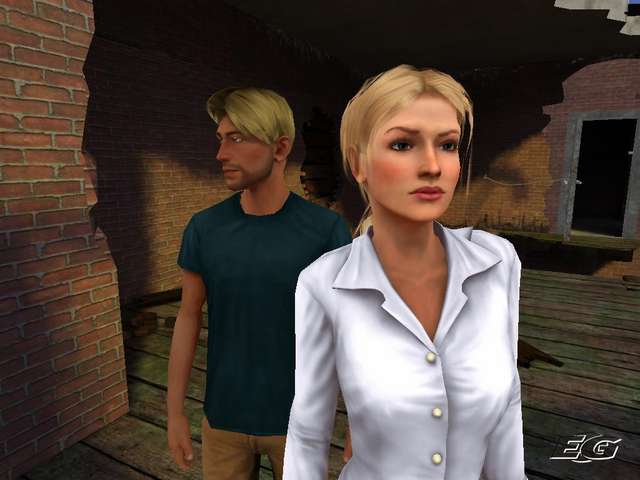
George still sporting that trademark '90s curtain look.
Eurogamer: After the success of The Sleeping Dragon, did you get a bigger budget this time around?
Charles Cecil: No. We absolutely accept that adventure is a niche genre. We're trying to create something that has enormous cinematic values. But then again, we work within a budget.
Eurogamer: Are the voiceovers less parochial this time?
Charles Cecil: Hahaha! Right. Eurogamer was pretty much the only review that I read where they felt that the characters were stereotypical. [Editor's note: Kristan's review can be found over yonder.] I always say that the characters are archetypal, and I think it's important that they're archetypal. The reason is that the moment you see them, you know what to expect from them.
Certainly, there were characters in Broken Sword 3 that were designed specifically for puzzles, rather than as part of the main story. I would say that the characters are a lot more interesting in Broken Sword 4 - we don't have any peripheral characters.
Last time around, apart from Eurogamer, people liked the fact that we had archetypal characters. It's important for the game, because it means we don't need to explain too much, and you can just get on with the game rather than having to explain exactly who these characters are and what to expect from them.
We have a lot of characters, 30 to 40 - many more than you'd expect in a movie. So we just don't have time, nor would the player want us, to go into great detail about who these people are. That's why we make them fairly archetypal.
Eurogamer: Are there less contrived action sections now? Is this a return to pure puzzling, or has the action side of things been given an overhaul?
Charles Cecil: The action is very different. Before, we had the equivalent of the quick time event, and that didn't work as well as I'd expected. The reason that we had those was, again, to put the player under pressure, so we had a range of pacing.
I've very much turned my back on that, but we do want to keep the pressure on, so right from the very beginning you have these blokes trying to kick the door down, and you've got to decide what to do. In that particular case, they don't actually ever break through, but there is a sense of being under pressure. We don't have the same requirements for instant reactions.
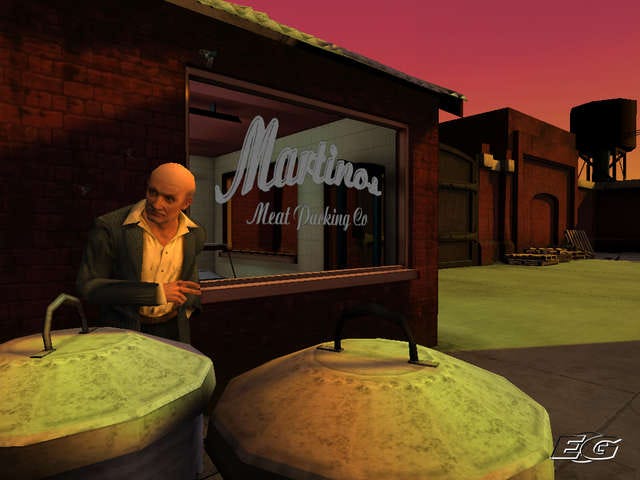
Never trust a man who hangs around bins.
Eurogamer: Were you encouraged by the success of Fahrenheit? What did you think of it?
Charles Cecil: Fahrenheit was very, very interesting. A really, really good game. I thought the fact that they simplified the interface, they didn't have an inventory, meant that actually it was extremely simple. There was no way that it could be anything but simple to complete, and while that was great for Fahrenheit, in Broken Sword we still embrace the inventory.
I want a puzzle to be solved because the player has to think about what the solution is, rather than putting a puzzle in the way as a temporary block for the narrative to advance. Dreamfall, in particular, was very much an interactive movie, and we've taken a different stance.
People talk about the decline of the adventure. Between 1985 and 1995, it declined enormously. But I don't think it's declined since 1995. We sold the same for Broken Sword 3 as we did for Broken Sword 2, and Broken Sword 1. The market is still very much there, and it's not declining; there's still plenty of room for adventures.
Eurogamer: How long is the game this time? Is there any replay value?
Charles Cecil: Broken Sword 1 was based in Paris, and there were a number of locations you could jump between, and things would change. I've embraced that in the design this time, so there's a map system and you can go to cities, and things have changed. One of the things that frustrates me about adventures is that if you go back to a location and things have moved forward, if it looks exactly the same as it did before, and it feels the same, then the suspension of disbelief is broken.
As for gameplay length - the game isn't much longer than Broken Sword 3, but because we've changed the structure, because you return to locations, there's quite a lot more gameplay. Probably about 50 per cent. If, for example, Broken Sword was 12 to 14 hours, this would be 18 to 20 hours.
Eurogamer: Arguably, puzzling in videogames has dumbed down over the years. Games like Resident Evil and Silent Hill have become more action focused, and The Sleeping Dragon moved in that direction. Why do you think that is?
Charles Cecil: That's a really good question. I think we've tried to appeal to a more mainstream audience, and that audience wants instant gratification. With our Broken Sword games, we embrace the fact that it's an adventure, and we're proud of that.
Maybe with Broken Sword 3, there was some pressure... I wanted to move it more towards mainstream, and maybe embrace some of this instant gratification and instant drama. With Broken Sword 4, we're much more confident - we're saying, it's an adventure, we're proud of the fact that it's an adventure, we're not pretending it's anything else.
An in many ways, we're returning to our roots. Broken Sword 4 is a lot more like 1 and 2, in terms of the gameplay, than Broken Sword 3.
Eurogamer: Have you signed up to produce any more games with THQ?
Charles Cecil: With all of these games, you see how well it does. I have no idea whether there's going to be another Broken Sword. I'm not working on one at the moment. If the game is successful, then it would be great to write another one. If people feel we've reached the end of the road, then we'll accept that.
I'm not attempting to do a Final Fantasy, where you start writing the sequel half way through the original. I think Broken Sword 4 will come out three years after Broken Sword 3. Two years would be a better time scale, but if you keep churning them out on a regular basis, people get bored.
One of the things that's really flattering is that we have an enormous amount of loyalty, and part of that comes from the fact that we don't churn them out. We think very hard about each one, we put a lot of effort and energy into the stories.
Eurogamer: What about your other franchises? Is a revival of Beneath A Steel Sky still on the cards?
Charles Cecil: Beneath A Steel Sky is very interesting. I have an enormous amount of admiration for Scumm VM, who wrote an emulator so that the game could be played on a range of machines. The game was released in about 1993, so it's extremely old, and it just wasn't working on up to date operating systems.
Scumm VM came along, we gave them the source code, they wrote an emulator, and they made it work. As far as I'm concerned, they're offering their software for free; I thought there's no reason why we shouldn't offer Beneath A Steel Sky for free. I wish I could say that as a marketing genius I planned it, but that would be a dreadful lie.
The result is that literally millions of people have played the game for free on a very wide range of devices. We're coming under enormous pressure from people saying, 'When's there going to be a Steel Sky 2?', so from a commercial perspective, there's a great deal to suggest that the game could be very well received. There's a lot of interest in it.
The only thing is, if we were to do a Steel Sky 2 - and this is something that I'm looking into - then I'd dearly love to work with Dave Gibbons again, because his input last time around was great. Dave and I communicate from time to time, and he's always expressed an interest in working on a sequel.
But if we were to do it, I think it would have to be a different approach. It would have to be either an episodic game, or there has to be some other way of getting it to market in a new and interesting way. So that's something that's very much on the horizon, but not something I'm actively working on at the moment.
For me, working on a combination of original titles to which we own the IP and other people's titles works very well, and that's what I intend to continue to do. I am about to go onto another project which is an existing IP.
George admiring the 'special' added ingredients from afar.
Eurogamer: Are going to take on more consulting roles, as you did with The Da Vinci Code?
Charles Cecil: Yes, absolutely. I enjoy it enormously, and it allows me to see the ways other developers are working. One of the problems with Revolution as it stood was that for two years I was in a little bubble, as was my team, and I did nothing but work on Broken Sword. At the end of it, I had to go straight onto a new project; there was no time to catch a breath.
We had some really good guys, a terrific team, but we were writing one project at a time. And at the end of that project, if we didn't have something else to go on to, we had to make people redundant - so people had gone through an incredible crunch period, and that was their reward. It was terrible.
We had a project canceled, and I had no choice but to scale right back. In hindsight, it was an extremely good thing to do. Now I partner with larger developers - in the case of Broken Sword 4, we're working with Sumo, who have a team of about 60 to 70 people, and they have the flexibility to move people between projects.
Obviously, if you're only working on one title, you have no flexibility whatsoever. The model at Revolution worked up until 2003 when we released Broken Sword 3 - actually, I would argue that it stopped working some time before then, it was absolutely unsustainable.
Working with Sumo has allowed me to see how other people work, to get new ideas; frankly, as well as being a much more productive and efficient way of working, it's also much more fun.
Eurogamer: Do you think it's harder for smaller developers to survive in the industry these days?
Charles Cecil: The key thing is that it's actually more difficult to be creative when you have enormous overheads, because of the pressures that you're put under. Revolution now has a miniscule overhead, so it doesn't matter if an idea doesn't get signed for three, six or nine months. Previously, it would matter desperately.
We're in a much stronger position now - I'm very happy to work on the project and design it, with very low overheads, until the point at which it gets taken on. Then we'll work with a partner, like Sumo, who will be able to react very quickly and build a team up.
Eurogamer: Would you recommend that as a business model to other small developers?
Charles Cecil: Absolutely. For Broken Sword 4, we've pulled a team of people together, the best people that I could find, and the game will be much better for it.
Eurogamer: Have you started work on your first next-gen project yet?
Charles Cecil: No.
A proper point a click game! Woo!
Eurogamer: Is that because it's an area you're not interested in?
Charles Cecil: I think the industry is being split between the massive budgets that people are talking about for next-gen, and if you go to the other end, DS titles, which are still - in comparison - extraordinarily cheap to write. I would be delighted to contribute to next-gen, but if there's a project that I'm going to handle, I'd much prefer a smaller budget.
Not least because you're much more likely to recoup royalties. If a game costs $10 million to write, the chances of actually recouping and earning a royalty is tiny. If a game is costing, at the DS level, several hundred thousand pounds, then it becomes much more viable economically. I write a game in the hope that it's going to be creatively successful, but also financially successful, and that royalties get paid out.
Eurogamer: Are game budgets too big now? Is it all getting a bit silly?
Charles Cecil: Absolutely. I think silly is the right word. The bigger developers talk about games costing tens of millions of dollars; it seems patently obvious to me that they don't need to cost that much, unless, as with a big film budget, you're paying certain key individuals enormous amounts of money.
Part of the reason that Hollywood films cost so much is the enormous wage bill of the actors. I can only assume that the reason the budgets are quite so enormous is because key staff are being paid a huge amount.
It costs X to model a character in 10,000 polygons for Broken Sword 3. It doesn't cost very much more to model it in greater detail for a next-gen title. So there's something slightly strange going on.
EA talks about the fact that they've got teams of 150 people working on a project. To me, that just can't be efficient, either commercially or creatively. I'm not quite sure how these companies have got into the state where they feel that they need to have such enormous teams.
Eurogamer: Have you any ideas as to why that is?
Charles Cecil: I think they want to squeeze the development period, first and foremost. That in itself is probably dangerous, because you reduce by a long way your opportunity for any kind of creative flexibility. A lot of criticism is levelled at these very expensive projects that they lack soul, and I think part of the problem is that they're written too quickly.
In an ideal world, you'd come up with a game design document that specified exactly what that game was going to do and how it would play at the very beginning. Indeed, it's vital that you do come up with that, but through development you've got to be prepared to change, because, yes, you can prototype a certain amount, but you can't prototype everything. If you squeeze the development time too greatly, then you limit your ability to adjust and tweak the feeling of the game.
The other thing is, people want to produce games with the most extraordinary production values, and they're prepared to pay enormous amounts to do that.
Eurogamer: And finally... What do you think of the news that E3 is becoming a much smaller event?
Charles Cecil: I've been away this week, so I haven't read much about it. But I think how an event that was patently so successful could go off the rails in such a short time - I suspect there are some fairly intransigent people, as is so often the way, who would prefer to see the thing disintegrate rather than compromise. But I need to read more about it.
Broken Sword: The Angel of Death is due for release on September 15th on PC. Check back during release week for a full, in-depth review of the game.
