The real star of Hydrophobia isn't female lead Kate, but the water that rapidly floods the environments and influences almost every aspect of gameplay. This isn't about pretty water reflections that merely slow a characters' movement, nor is it about taking games back to that period where every adventure game had to have an underwater level, just because it could. The water in Hydrophobia is more than that - it acts as a weapon, a key, transportation and an entire control system that the player uses to influence, change and conquer the environment.
The environment itself is a massive floating city named the Queen of the World, something that developer Blade Interactive has based on real-world designs such as The Freedom Ship. It's not just the environment that Blade wants to be fantastic yet plausible - elements of the storyline and the science behind it are intended to contain real-world elements that blur the line between science and science fiction. The Queen of the World is a haven for the world's super-rich elite, containing everything you'd expect to find in wealthy cultures - from apartments and casinos to retail outlets and corporate businesses. And as well as the socialites occupying the upper decks and towers, there are also the lowly workers confined to the bowels of the ship, serving the parasitic occupants and pandering to their spoilt needs.
Sea Change
The beautiful people have been attracted to the Queen of the World because it's a private society with no prying eyes. But this makes it the perfect target for terrorism, with a group named the Malthusian's infiltrating the Queen before it's even begun its maiden voyage. Again using real-world elements, the insurgents ideals are based on Thomas Malthus - a political economist whose work influenced Charles Darwin and Karl Marx - and centre around issues of climate change and population growth. It's certainly a refreshing change from the usual ethnic stereotypes that run around game worlds. At the beginning of the game The Malthusian's take over the Queen of the World leaving the player to adopt the role of Kate, a reluctant engineer charged with foiling the terrorist's schemes.
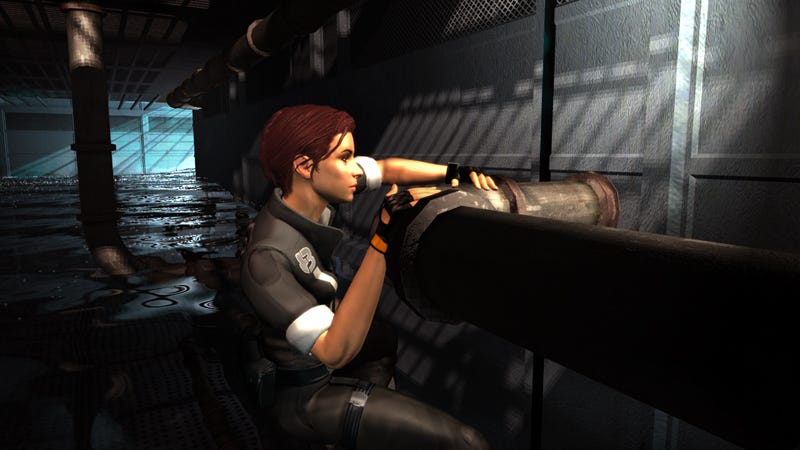
Story is one of the key elements to Hydrophobia, with Blade taking it just as seriously as the water physics, gameplay and graphics. The intention is to reveal story though interaction rather than stopping the drama to play a five minute cutscene, and there are also playable flashbacks that reveal just why a hydrophobic lead character is working on a floating city.
Kate's phobia is an element of gameplay that influences character control. When water begins to overpower Kate, the screen blurs and turns monochrome, audio becomes muffled and the players' field of vision warps. It's not as overwhelming as the effect used in Headfirst's Call of Cthulhu: Dark Corners of the Earth, but it's similar. Over time and through gameplay, Kate begins to master her fear, with the game changing and replacing the mechanic with something completely different, to be revealed at a later date.
Dark Water
Gameplay twists aren't just confined to the lead characters' abilities. As well as terrorists, a entirely different enemy enters the game later on, with an agenda far from political. Not a lot can be revealed just yet, but we do know they leave corpses suffering a more grisly fate than a few gunshot wounds.
This control that Blade is taking over the storyline has its trade-offs. The game is split into chapters so the player doesn't have the freedom of the whole ship. It's not as limiting as adventure games used to be, and there are alternative routes through the environment, with the majority of locations designed as big puzzles. This is where the water physics come in to play.
Blade has been working on its HydroEngine for years, and in doing so has created water that offers multiple possibilities for gameplay scenarios. Being an engineer gives Kate the plausible excuse of using the water to her advantage. It can be used to flood rooms and drown enemies, or redirected to block a path. It can be directed so the flow sweeps enemies off their feet, or Kate can use it to 'surf' to new locations previously unreachable. What Blade is promising is that in the majority of cases the player will get a choice of how to influence the environment and use the water how they see fit. Solid objects and the environment is tangible too, so Kate has the option of climbing over the flood or swimming though it.
The water moves quickly and with a sense of force. As rooms fill, Kate's movements are hampered and currents try to take her off her chosen path. There's also an exertion system in play that influences player movement. If you're not holding on tight you'll get knocked off your feet, but by successfully fighting the force of the water Kate can control exertion and master her hydrophobia and the effects it has on gameplay.
Wet Dreams
Visually, the the water looks lovely. It leaves water level marks on the wall and trickles down the side of a surface when a room is flushed clean. When blood mingles it becomes cloudy, a sort of red smoke effect, while burning oil sits on the surface allowing the player to swim beneath it. The player can leave water footprints like breadcrumbs to lead enemies down the wrong path and as it flows through a room for the first time it looks and feels as unpredictable and overwhelming as you'd expect.
While there's not a lot of gunplay planned for the single player Hydrophobia game, Blade is determined that any shoot-outs it does have will be quick and deadly. With enemy AI being worked on by one of the leads behind Rainbow Six Vegas and Splinter Cell: Chaos Theory, expect tactical use of the environment and outwitting the enemy to be more important than wielding the bigger weapon. Enemies will have different attitudes that influence their behaviour so the player should feel the difference between fighting an idealist or a mercenary - someone defending themselves will act differently to someone fighting to the death. Although multiplayer gameplay is still under wraps, Blade has confirmed that it will be weapons based, with exchanges played out across the flooded Queen between the terrorists and the ship's security team.
Hydrophobia is still a long way from release, with Blade pencilling it in for late 2008. But from early impressions it's on it's way to becoming a unique and interesting take on adventure games. These sort of games aren't really very fashionable - which may be to its advantage - and while the water is certainly the star, backed with design decisions where smart thinking takes precedence over gunplay, it's definitely a game that should be registering on the sonar.
