Hotel Dusk: Room 215 Review
Please go easy on the minibar.
Version tested: DS
The first thing people say when they see pointy clicky adventure Hotel Dusk is, 'That looks like the video by AHA from the 80s!' So it's the first thing I've said too, so it can be mentioned, and now forgotten. Far more interesting is examining how Hotel Dusk's animated pencil sketches look without coincidental comparison, but it does at least provide a vivid reference point for those who haven't seen it running.
Kyle Hyde (and yes, he's very proud of his name) is a door-to-door salesman by trade, but with a slightly peculiar edge to his business. His jobs require not only hawking dodgy late 70s technology (as this is when the game is set), but also finding 'lost' items for clients. However, three years earlier he was a cop for the NYPD, until he was forced to, for reasons not explained until very near the end, shoot someone close to him. His life is quite clearly not what it once was, and his deeply cynical attitude provides the lens through which you view the game.
Sent to Hotel Dusk, Kyle finds himself booked into the Wish Room - a room, it is claimed, that will grant your wishes when you sleep there. And with this put to you at the very start, it triggers ideas that were so beautifully explored in last year's Sci-Fi channel mini-series, The Lost Room. Magical rooms, mysterious objects, peculiar characters... However, despite this impression, Hotel Dusk isn't going anywhere near any of that. This is a story set very much in the real world, but with, well, rather a lot of coincidences.
It's from the same team that created Another Code, which was rather inexplicably heralded as the great white (or black or pink, and in Japan, a sickly blue) hope for adventures on the DS. It was, I think hindsight can confess, a weak game with a few lovely ideas. Three, in fact. Three superb puzzles that saw the instrument with which you played the game - a folding plastic console - playing a significant role as you interacted with the game's world. Reflecting one screen in the other, closing the console to print the top screen on the bottom - these were splendid ideas, lost in a trite and incredibly short story. It was, however, exciting potential. The DS you held existed within the game it was displaying.
Hotel Dusk definitely addresses the brevity issue. It's huge in comparison. However, this is mostly due to the extraordinary amount of conversation throughout. This is Phoenix Wright levels of chatter, except with one rather important element absent: the funny. Dusk is about noir, its inspirations the murky detective fiction that now only exists as spoof or homage. Cing have opted for the latter, and as such everything is taken very seriously. For a really long time.
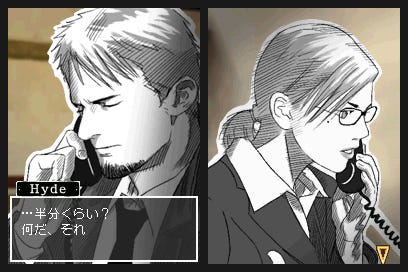
Er, imagine it less Japanese. Later on, Rachel on the right is mostly in colour. Does Hyde fancy her? Hmmmmm?
The hotel has a number of guests, and a few staff, all of whom have stories to tell, and secrets to hide. Hyde really only wants to get his job done and go home, so it's with a depth of reluctance that you start sniffing into people's pasts and presents. In fact, it's always motivated by Hyde's driving goal, to find his former partner, Bradley, missing for the past three years. It seems, by peculiar circumstances, that so many people in the hotel are linked to each other, and in turn, linked to Bradley. So you chat, and you chat, and you chat. And then you chat. Chat for a bit, then some chatting, solve a child's jigsaw puzzle, and then have a bit of a chat.
Importantly, these chats, while overly long and madly frustrating in their inability to be sped up, provide a depth of character so devastatingly missing from most games. People have motivation, and while they're reluctant to reveal it, learning why the drunken father is so distant from his daughter, or how the author came to find fame and ultimately destroying guilt, is the reason to play the game. It's not, however, for the puzzles.
Cing have somehow, once again, repeated their biggest mistake with Another Code: they've forgotten to put enough puzzles in. In fact, this time around with a game lasting about four times as long, they've put in relatively fewer. When the first two are both solving pre-school jigsaws, it doesn't bode well. There's a couple that lift a similar (and still nice) idea from Code, but sadly it's the same one twice. And then after that it's all too simplistic, hindered only by your not having the correct inventory item with you, because when you found it earlier the game wouldn't let you pick it up. A chapter later and you can, but how are you supposed to know that? And a similarly criminal mistake is made twice, where you're told you can hear a noise at the end of a hallway, and are then expected to go through three rooms' worth of furniture searching (that you've already done before when you first went there), trying to find the one object that will have changed or been added.
However, as annoying as this all is, it doesn't condemn the game to doom. Finding new objects does tend to lead inevitably toward that with which it must be combined, which gives you the continued feeling of progress and success that an adventure must provide. And as the mysteries deepen, and the threads begin to intertwine, you start wanting those endless chats, because they'll reveal the next snippet, the next bit of information that will lead you closer to solving the myriad mysteries that have been set up. It becomes, to use a horribly over-used phrase, an interactive novel.
Perhaps the factor that won my cynicism and frustration over the most is the development in Hyde's character. One resident in particular starts to chip away at his carefully constructed outer shell: Melissa. She's nine years old, and staying with her miserable and unpleasant father, told that she's going to get to meet her mom very soon, but only if she's good. Her mother, you learn, has been missing for a few months, and it's impossible not to sympathise with the equally brattish and cute Melissa. Especially when you learn she didn't even get a Christmas that year, and begin the little side plot of arranging a mini-Christmas party for the kid with the help of some of the hotel's staff.
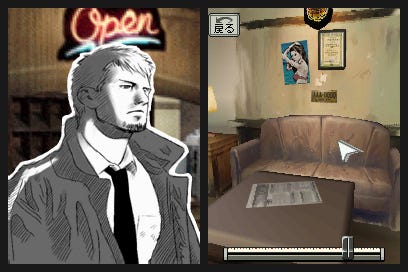
Rooms can be explored, the slider at the bottom rotating the view when you're searching an area.
Then there's Helen Parker, an elderly woman who is waiting to meet someone; Martin Summer, a dreadful bore and author; DeNonno, a former petty thief and foil of Hyde during his policing days in New York, now, coincidentally, working at the hotel; Iris, grumpy and pretty young woman; Mila, strangely mute girl who is clearly sitting on many secrets; and, ooh, at least seven others. As I said, a lot going on, and a lot of interconnections and histories to explore, and as Hyde's character develops, perhaps even help.
So to the looks. The DS is held sideways, somewhat like a book. This, like so much else in the game, is no coincidence. Interactive novel, remember. For the movement, the left screen is a first-person view, the right a top-down plan of the room, navigated by holding the stylus where you wish to head. The characters are the previously mentioned pencil sketches, surrounded by a white border as if they've been cut out from paper and then stuck onto the backgrounds. And such beautiful backgrounds, watercolour paintings that aren't quite finished, the brushstrokes not reaching the edges, as if a work in progress. As characters talk, the two screens are occupied by the members of the conversation, their black and white bodies occasionally washed with faint colour. Upset someone and a brushstroke of red will spill down their body. Get to know someone and their face might flush with hues. It's an absolutely stunning design idea, and despite the blurring of close-up objects, is constantly emotive.
Cing are clever people. They were clever with Another Code's meta design, and they're even more cunning with Hotel Dusk's presentation. Rather than spelling out their metaphor and meaning, the effect is left to make its impression on you, and be interpreted as you see fit. Why are these people so roughly sketched, and so frequently lacking colour? Why isn't the front door finished, and why are the walls of the lobby fading to white paper?
If only there weren't so many mistakes. If only you weren't punished for asking the wrong question in a conversation (and really punished, forced to go back to your last save [SAVE OFTEN] and have the same unskippable conversations all over again for painful minutes). If only inventory items were available when you found them. And if only the puzzles were aimed at people over the age of nine. Because so much is right about this, and so much is worth exploring. It's a game that really understands people, and their complex motivations. And yet so often forgets the motivations of the people playing an adventure game. It's a game that knows how to use the DS to great effect, and how the stylus can be so casually and effectively. But its ‘minigames' are perfunctory and underdeveloped.
But it deserves attention. It deserves it because I've realised I could write a thousand words on each character, exploring their behaviour and relation to the ever-evolving central thread. It deserves it because I've had to really hold myself back from becoming deeply pretentious and waffling on about Brechtian estrangement again, remembering that my interpretation of the presentation might not be yours. (Your wrong interpretation). It's made me think a lot, and I suddenly found myself waffling on at great length about how interesting the characters' behaviours are to an innocent passing housemate. It makes lots of mistakes, but it has substance, as well as the very finest style.
7 / 10
You may also like...
-
Retrospective: Star Wars Episode I Racer
-
Why Devs Owe You Nothing
-
Game of the Week: Catherine
-
Digital Foundry: PS3 Skyrim Lag Fixed?
-
Face-Off: Final Fantasy 13-2
-
App of the Day: Ascension: Chronicle of the Godslayer
-
Face-Off: The Darkness 2
-
Gotham City Impostors Review
-
Who Killed Rare?
-
EA evaluating FIFA Street features for FIFA 13
-
Kingdoms of Amalur: Reckoning Review
-
App of the Day: Sir Benfro's Brilliant Balloon
-
Catherine Review
-
Grand Slam Tennis 2 Review
-
The Darkness 2 Review
-
Ultimate Marvel vs. Capcom 3 Vita Review
-
Sony admits "dropping the ball" with Demon's Souls
-
Catherine launch trailer is looking saucy
-
One Piece: Unlimited Cruise SP Review
-
CD Projekt: Witcher 2 intro cinematic "the most expensive asset we ever created"
-
King Arthur 2 Review
-
Metal Gear Solid: The "Lost" HD Remasters
-
Skyrim patch 1.4 now live for Xbox 360
-
Epic's Sweeney on graphics tech: "the limit really is in sight"
-
Skyrim patch 1.4 performance tip: make a new manual save


Comments (44) Latest comment 4 years ago
Comments threads automatically close after 30 days, but please feel free to continue chatting on the forum!
Comment below viewing threshold Show
/orders
Comment below viewing threshold Show
I will still recommend this to my DS owning friend.
Comment below viewing threshold Show
You actually don't go to your last save, but to a checkpoint, if you screw up. And you can at least speed up the dialogue afterwards, although, admittedly not skip it entirely.
Anyway, good review. The things that seemed to annoy you annoyed me definitely less, though, and I'd give it a high 8, based on what you also said: the great characterisation, which is simply beyond anything in that genre I've played in years. It really helps, too (just like it helps with Phoenix Wright) to see it more like an interactive novel than a game.
Comment below viewing threshold Show
Perhaps because both revolve around a mysterious hotel. And are of japanese origin
Comment below viewing threshold Show
You, know, actually - that's a very,very good point.
Comment below viewing threshold Show
I actually like Hotel Dusk's way of doing it better - it forces you to think about what objects you've seen that might solve a problem, instead of just going around the locations hoovering up anything that isn't nailed down, like in other adventure games.
Comment below viewing threshold Show
Why didn't they give it an 8?
Comment below viewing threshold Show
And yes, UncleLou, that moment was splendid.
Comment below viewing threshold Show
A proper Murakami-style game done this way would be fantastic... wow.
/maxes credit cards to set up a DS development studio
/realises he'd need more money
Comment below viewing threshold Show
? ?
___________ ?
"Why isn't John paid more?"
Comment below viewing threshold Show
Does it cater for them by reversing the game a-la Brain Training?
Comment below viewing threshold Show
I am really annoyd by Trauma Center at the moment, because my hand keeps covering the "Heart Icon" that reflects the patient's condition. There should be an option to have it on the right.
Comment below viewing threshold Show
Plus I'm planning on heading up to Scotland on the train soon and I'll need something to do apart from worry about the state of the points...
Comment below viewing threshold Show
I actually like Hotel Dusk's way of doing it better - it forces you to think about what objects you've seen that might solve a problem, instead of just going around the locations hoovering up anything that isn't nailed down, like in other adventure games.
Agreement++
These days all the kids seem to start to violently and loudly hurl at the sight of any gameplay mechanics that even just show signs of deviating from the norm.
Ugh.
Comment below viewing threshold Show
You could take a decision to reward innovative and intelligent game design like this - it might make a difference to its commercial success, which might make a difference to the kinds of games we get to play in the future.
Comment below viewing threshold Show
I think it's fair to mention that I made a great deal of fuss about the characterisation.
"You could take a decision to reward innovative and intelligent game design like this - it might make a difference to its commercial success, which might make a difference to the kinds of games we get to play in the future."
Except, unfortunately it's my job to rate the game according to its successes and failures, and not give it an artificial boost based on a perceived "underdog" position. And of course, the game DOES receive its due rewards for those qualities you wish to be recognised. Without them, this would be a firm 4 or 5 out ot 10. It's got terrible puzzles, and is so achingly slow.
It is my hope that people will read the review (I know, I'm just crazy) and decide for themselves. 7, I think, is the score that most denotes, "Read it for yourself and decide". It's certainly the score I believe the game is worth.
(I think a reviewer can feel comfortable with his mark when the comments are split evenly between complaining that it's not higher or lower).
Comment below viewing threshold Show
Heh, the reviewer chooses the score in order to get the reader to actually read the review. Crazy thought: Ditch the score, then there'd be no choice.
Comment below viewing threshold Show
I'll have you know I was in that movie. I only had a small part.
Comment below viewing threshold Show
The puzzles are painfully weak, to the point of being patronising. They feel more like minigames than puzzles TBH, which just dosent suit the style of game.
The story is both good and bad. I agree that the characters are interesting, and its very good at slowly revealing the facts so that, in true detective style, I'd come to the storys big conclusion just before Kyle spells it out for you.
On the downside the way the overall narritive is paced is pretty crappy. Each chapter is, basically, you going through each guest one at a time and uncovering their secret, and a couple of these characters seem underused or underdeveloped compared to others, which leads me to think they were added as gameplay padding.
Also I thought the ending was a tad weak. But thats just me.
Comment below viewing threshold Show
About the backtracking for items. Think realistically. Hyde actually says "yes a hammer I can definately use that" when you as the player have so far seen no such use for it or "that screwdriver might come in handy" and so he picks it up and carries it around. The stuff you don't pick up, the split bag of flour for instance, really don't serve any relevance when they are first presented so logically you wouldn't carry them around with you, would you? If your goal was to speak to everybody staying in a hotel to find out what they may know about someones disappearance, you wouldn't upon reading a newspaper think, "hmm you know what, for absoloutley no reason I can logically think of, I'm going to carry this around with me!" Just doesn't make sense. And yes I know its a GAME blah blah but its not really supposed to be entirely treated as one.
No mention of the music either which is fantasic and a novel feature is that you can play the whole games soundtrack on an in-game jukebox whilst playing the game!
Comment below viewing threshold Show
Dude, rtfm man.
At, leat, I think so. It had a pretty complete backstory.
Though Cing did make the mistake in another code to have the 'main' ploit only at the beginning and end, and put the 'optional' plot through the other 90% of the game. Which you could fail when finishing the game, which sucked, hard.
Comment below viewing threshold Show
As for this object doodah. Here's the rule: If a game ignores an object, refuses to pick it up in a dismissive fashion, that's the code for, "This is not an object you need to worry about." Hotel Dusk does this for objects that will become necessary later, which is a gaming crime. Having him say, "I guess that might be useful for something, but I'm not lugging it around with me," would be fine, and it occasionally does. But it also ignores key items, and gets wrist-slappage accordingly.
The other issue I had was Kyle's occasional mad stupidity. On one particularly ridiculous occasion, he reads a newspaper that links together at least three characters, but doesn't notice. Instead you have to plod through weeks of conversations to reach the conclusion you'd already been told.
Ooh, and another thing - don't get the change in the right chapter, and it becomes unavailable, and all the fun of the number-based treasure hunt is a complete waste of time. I was really peed off about that - I wanted my prize! Why couldn't I ask for some change at the bar?! Boo!
Comment below viewing threshold Show
And Case 4 of Phoenix Wright 2?
That was the biggest surprise of mature themes within the actual gameplay I've come across.
Comment below viewing threshold Show
I haven't finished the game but it's pretty long and there have been occasional puzzles that made me stop for quite a while because I couldn't quite figure them out (the coins, the electric table and using the crowbar in particular). And yes, the characters are excellent and so is the dialogue. It's strange to see a Nintendo game with such realistic conversations and language (if you look at games in general, that is).
If the game would've handled items, puzzles and conversations a bit better then it could have been a sure winner. But it's definitely one of the better video game adventure games you can buy.
Comment below viewing threshold Show
[link url=http://aslimeappea rs.blogspot.com/
]http://aslimeappea rs.blogspot.com/
[/link]
Comment below viewing threshold Show
Cannot reccommend it enough. This game will suck you in and keep you enthralled from the minute you start. Sure it gets bloody frustrating at times, but overall, the game is pure unadulterated genius.
KatanaX
Comment below viewing threshold Show
I'm fairly sure I've screwed up on a couple of counts because there is an item I require that I have no means of detaching from the wall (previous players should know what this is) and perhaps I may have chosen to say the 'wrong' thing, although there is NOTHING in the game to indicate that freedom of speech will cost you your game. It's almost shocking to see such childish contempt for the 'rules' of the adventure genre. These are here to protect the end-user from facepalming and HATING the game, so I am in disbelief to see these so wantonly ignored.
This notwithstanding, it is hard to hate this game, though. The rotorscoped paper cutout characters (that are anything but in terms of character) and the basic first-person view gives you the sort of 3D movement and immersion I would never have expected from a DS game.
I actually like Hotel Dusk's way of doing it better - it forces you to think about what objects you've seen that might solve a problem, instead of just going around the locations hoovering up anything that isn't nailed down, like in other adventure games.
To this I will simply point out showing the player an object/area that will be needed/accessible later on in the game is fine, provided there is an obvious 'barrier' that explains why the player cannot currently have this item/access this area, the barrier being removed later in the game and therefore implying that the item can now be collected/area can now be accessed.
I'll give you two examples of this: (both can be seen in a game like Resident Evil)
1. An item contained within a glass case. You are aware of the item and understand why you cannot collect it (glass is too strong to break with your bare hands), but once you understand what you need it for you will return by which time the barrier will either have been removed (broken by someone/something else) or removable (you have another object/ability facilitating its retrieval).
2. A new area on the other side of some impassable or hazardous material (water, fire, gas, radiation). You are aware of the area and it looks like somewhere you might be able to access (properly lit and detailed, not just a dark, featureless corner). Later in the game you will either have the barrier removed for you, or have the means to remove it yourself.
Now, the problem in Hotel Dusk is that you are able to examine the item in question, but it cannot be immediately retrieved FOR NO EXPLICABLE REASON. The item is small enough to carry in your pocket, so the only reason you can assume that you don't pick it up is that it is not an important object. On the other hand, you allow the game to examine an object that does not appear to be 'description-related' (minor 'props' like furniture and ornamentation are given some description to help characterise Kyle Hyde's perspective of the game world). This is the only thing, aside from this review, that would give me even the slightest clue that the object holds some minor importance - the fact that I am given a description of something that would otherwise be treated as purely incidental and part of the backdrop.
The difference here is that in Hotel Dusk there is no clear delineation between what can and cannot be acquired at some stage in the game. You solve puzzles in exactly the same way, by discerning the required key to the solution and retrieving it, so it's not a question of the puzzlesolving being harder by this method. Similarly, it's not a question of this being the only alternative to the 'bottomless sack' inventory method, where all items are carried and mechanically cycled through until the key fits the lock, because as I have explained there are clear alternatives that do not frustrate the player.
So, really, I can only put this down to laziness or stupidity, and thank myself lucky that the game is charming enough to make up for me having to traipse through it again on a second run-through, making sure I have given the right response and collected the right item at the right time. -__________-
Comment below viewing threshold Show
i bought this game like a week ago n i finished it yesterday so its a ok in length!!!!!!!!! THE GAME ITSELF IS JUST ONE OF A KIND ITS THE BEST GAME AV EVER COM ACROSS U JUST CAN'T GET BORED OF IT (AV STARTED THE GAME AGEN U C LOL) N KYLE IS SOOOOOO GORGUZ N HIS NAME IS QUITE NICE TOO NO WONDER HE'S PROUD OF IT! ITS LIKE A VIRTUAL CHARECTER GAME, N THE GRAPHICCS ARE JUST AWSOME ! IF I WER TO RATE IT I WOULD RATE IT 11 OUT OF 10!!!!! IF U GOT IT N UR STUCK JUST TELL
ME I'LL TELL U!!