Version tested: DS
There is an original idea at the core of Henry Hatsworth in the Puzzling Adventure. This is lucky, as the rest of the ideas in it are less original than putting a a traffic cone on your head and going, "I'm in the Pet Shop Boys."
The original idea is this: what if you combined a puzzle game with a platform game, and created a cause-and-effect relationship between the two? The problem is this: both the puzzle game and the platform game are derivative, repetitive and mediocre. However, the bringing of the two together does create an interesting dynamic.
The platform game is played on the DS's top screen. You play as Henry Hatsworth, who looks like the love child of Dr Snuggles and Willy Fog.
He runs and jumps around 2D environments which are pretty enough, but nothing special (Lava? Ice? Again? Really?).
Hatsworth can swipe at enemies or shoot them, with extra weapons and upgrades available to purchase as the game progresses. Filling up his Super Meter enables him to do special attacks. It also lets him don a robot suit, making him temporarily invulnerable and allowing for yet more special attacks.
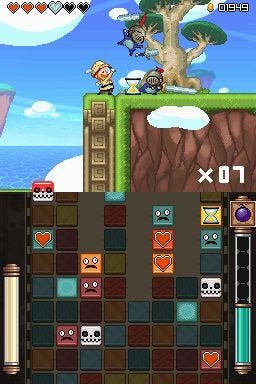
Remember when all the games in the world were green and blue instead of grey and brown?
The control system, gameplay and level layouts will be familiar if you've ever played Super Mario Bros., Alex Kidd or Wonder Boy. They'll be even more familiar if you've played any of the second-rate clones those games inspired - the platformers that weren't bad, but weren't innovative or interesting enough to make them anything other than forgettable. (Oh Bubsy, where are you now? Dead, hopefully.)
The puzzle game is a match-three affair played on the touch-screen. Using the d-pad or stylus, you switch pairs of coloured blocks around horizontally. When three or more blocks match, they disappear. So once again, it'll be familiar if you've played Zoo Keeper, Puzzle Quest or anything with the word "jewel" in the title.
The twist is you have to keep switching between the two games, and your actions in one affect the other. Each time you kill an enemy in the platform game, for example, it'll show up in the puzzle game as an angry-looking block. If you fail to match the block before it reaches the top of the screen, it reappears at the top of the platformer. Then you have to keep moving out of the way as it repeatedly drops drown and tries to crush you, which is tricky if you're simultaneously facing a load of enemies or a boss.
Each time you collect a power-up in the platform game - extra health, for example - it will also materialise in the puzzle. The power-up will only be activated in the platform game once you've matched it on the screen below. You also need to match the plain blocks to fill up the Super Meter.
There's a limit to the amount of time you can spend in the puzzle, which adds an extra layer of strategy and decision-making. Do you go for that much-needed heart, or get rid of those enemies first? Would it be smart to save those power-ups for when you have to face the boss?
The time limit can prove irritating, especially at first. Often you'll get caught up in the action on the top screen, only to find you've neglected the puzzle for too long and are under attack from a ton of blocks. Or, you might be about to pull off an amazing block-matching combo you've planned over the course of several moves, only to be kicked out of the puzzle because you're out of time. It feels like you can't ever really get stuck into either game.
However, as things progress, switching between the two becomes more automatic. Plus you start to understand how the timing of your switches can help or hinder you, and to develop new strategies. It's still frustrating when you're forced to change your focus at key moments, but this happens less often as your multi-tasking skills improve.
So sticking a platformer on top of a puzzler does create an additional gameplay element. But is it such an original idea?
The most obvious comparison to Henry Hatsworth in the Puzzling Adventure is Professor Layton and the Curious Village. They're both DS games starring similar main characters (Hatsworth is referred to as "Professor" in-game, if not on the box) with boy sidekicks, who go round solving puzzles.
The boss battle against Ellen McArthur is particularly challenging.
But there are some fundamental differences. Level-5's game is a point-and-click adventure bundled with a load of logic problems, not a platformer stuck on a Bejeweled clone. But it's hard to believe EA didn't look at Professor Layton's success and decide it wanted a piece of the action; the press release even describes Henry Hatsworth as "indie-inspired".
The other difference is that Henry Hatsworth has nowhere near the charm or intellect of Professor Layton. It doesn't have those soft sepia visuals or that storybook feel; it's sharp, shiny and futuristic. The gameplay in both the puzzle and adventure elements is much more fast-paced, and more about quick reflexes rather than logic and brainpower.
Which means Henry Hatsworth will have more appeal for some people. Not everyone wants to spend hours working out how to get the third wolf across the river without the other two eating the chickens; sometimes you just want to blow a load of blocks up or put on a robot suit.
However, while the platformer and the puzzler in Henry Hatsworth are perfectly competent, they're nothing special. Neither could be described as classic examples of their genre, and neither offer anything new. The switching mechanic does add interest, but not quite enough to make Henry Hatsworth in the Puzzling Adventure a great game. If you just can't get enough Bejeweled and don't mind a decent 2D platformer now and again though, it's fun.
7 / 10
