Version tested: PlayStation 3
Guitar Hero's history may not be as long and storied as Aerosmith's, but the young music game's popularity and commercial success has propelled the series to comparable stardom: North American sales alone are worth over a billion dollars; the band who wrote the third game's end song, Dragonforce, enjoyed a 126 percent spike in CD sales the week after the game came out; and there's even a whole South Park episode about it. Spin-offs, then, were inevitable, and Guitar Hero: Aerosmith aims to be the benchmark.
Making a game about a band isn't a completely new idea, but making a good one would be, as Aerosmith themselves can attest - what with Midway's mid-'90s arcade shooter Revolution X lurking rubbishly on their collective CV. This is nothing like that, thankfully. Instead it's an opportunity to play along to Aerosmith's career while learning a bit more about it and glorying in loving details: unlocking Joe Perry's custom-made 1964 SG Special, for instance, or being able to play through the Run DMC-assisted and vanilla versions of the crowd-pleasing "Walk This Way".
To this end the core of the game is a 31-song Career mode (with ten more tracks unlocked in a shop) that takes you through a series of venues that meant something to the band. The first venue, Nipmuc Regional High School, was their first gig; The Orpheum is a theatre that holds special significance; and the Half-Time Show is based on Superbowl XXXV, when Aerosmith performed alongside 'N Sync and had to watch the stage - in the words of awestruck band-members - erected and torn down in the space of six minutes. The trivia's related through quick-fire sound-bites from video interviews, which are sewn together rather over-zealously to avoid breaking the pace of the game progression, and viewed between the six tiers of mostly five songs apiece that are unlocked in clumps.
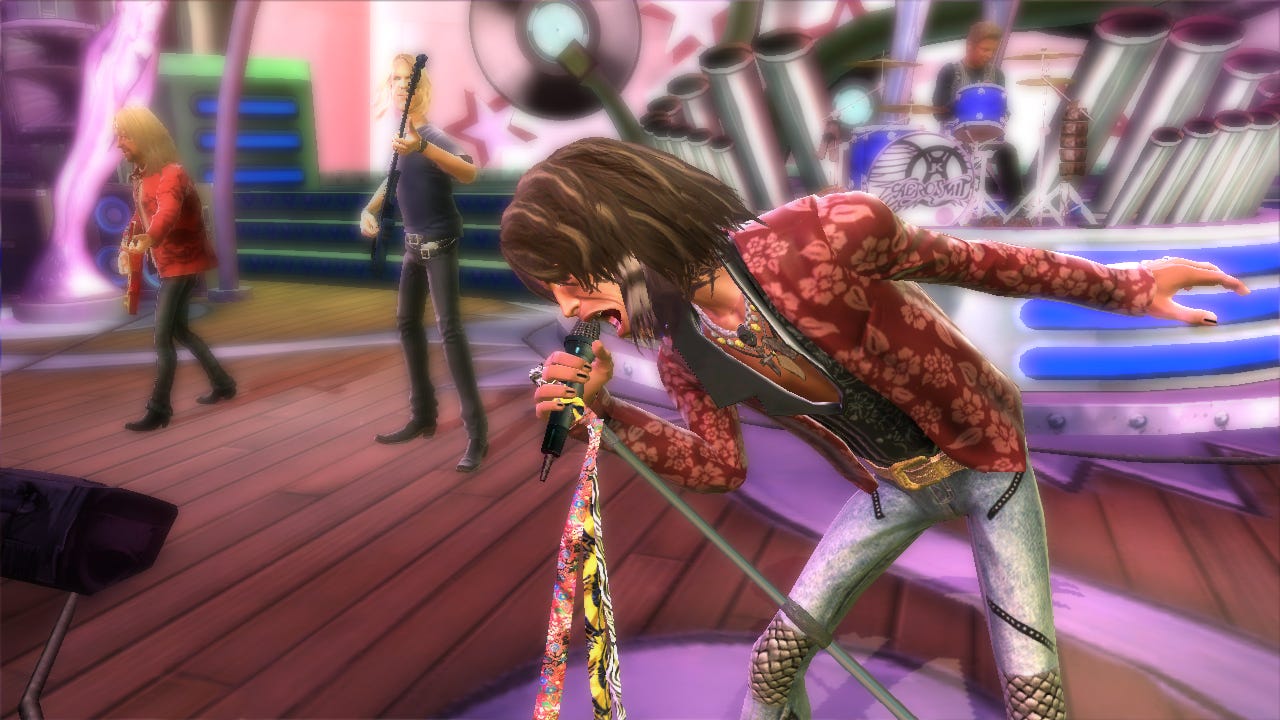
The game's recreations of each band member are helped by the fact each band member now looks like a cartoon character anyway.
Ignoring the videos (and the load-screen trivia), it's basically Guitar Hero III with different songs: there are four difficulty settings, and the most difficult won't let you make any progress until you've beaten all the songs in your current tier. Despite following the band to the '90s with venues, though, the music focuses most on the '70s, with the exception of songs like "Love in an Elevator" and "Pink" (an unlockable track). There's also a smattering of songs by other artists to mix things - most notably "Always on the Run" by Lenny Kravitz, "Complete Control" by The Clash and office favourite "She Sells Sanctuary" by The Cult.
The game lives or dies based on your fondness for Aerosmith, but specifically your desire to play along to their songs. Elsewhere the fan service is competent, but it wouldn't sell on its own: you can unlock more extensive versions of the interview montages used in Career mode, and they're interesting but also a bit ponderous and "what did you do in the war, Granddad?" We've not read it, but the band's 1999 autobiography is probably a better destination if you want to do more than stare in horror at Joe Perry's amazing face.
The venues are nicely appointed, though, and caricatured in Guitar Hero's traditional cartoon style, but, as ever, if you're actually playing then they're only things you glimpse out of the corner of a focused eye (and if you're not playing, you probably aren't the person who owns the game, because that's how we guilt people into sitting out). Otherwise you need to get excited about being able to unlock a DMC or Brad Whitford character model. Some of the novelty guitars are amusing, but then so are the non-Aerosmith novelty guitars, and the other Guitar Hero games (not to mention Rock Band) are already stuffed with them.
As for the game on its own merits, it's fundamentally the same as Guitar Hero III, which means the same excellent and refined rhythm-action mechanics: hold frets and strum the bar as notes pass through the bottom of the gameplay area, swing the neck skyward for Star Power, and hammer the whammy bar for extra points during long notes. GH3's contentious Guitar Battles - face-offs with superhero guitarists through the ages - are reduced to one key, skippable encounter with Joe Perry here, which remains irritating. The difficulty doesn't spike as aggressively as GH3's, although some passages might send you into the game's Practice mode to learn things in slow motion first - it took us about half an hour of learning by rote to master enough of "Walk This Way" on hard, for instance. Other than that it's business as usual, with offline and online multiplayer, quick play and familiar characters to play as before you unlock the big-name stars.
So it is the songs that matter, and realistically you need to digest the track listing to make your mind up. Do you know "Movin' Out", "Uncle Salty", "Back in the Saddle" and "Livin' on the Edge"? We can't answer that stuff for you, and if you refuse to look then we can only reiterate that most of it's from the '70s, "Dude (Looks Like A Lady)" is absent and more recent songs like "I Don't Want To Miss A Thing" and "Jaded" are also nowhere to be found.
From the Wii version. We reviewed from PS3, incidentally. So publishers do have PS3 review copies after all.
All of which makes Guitar Hero: Aerosmith almost impossible to rate. There's objective discussion of the non-music bits to be had, and it goes like this: it's not so startlingly revealing that it'll be serialised in the Mail on Sunday, but there's some interesting stuff in the documentaries, and the venues, guitars and character models represent competent rather than spectacular fan service.
The x-factor though is your own musical taste, and it will swing the score below up and down your own scale. Our feeling is that in this era of downloadable Rock Band albums for 13 quid - a price that's often criticised anyway - single-band games will have to offer gameplay innovations, spectacular fan service, or a lot more material than this to justify their existence and, more pertinently, an asking price of 40 quid without the guitar peripheral. Guitar Hero: Aerosmith entertained us sporadically - usually when we knew the songs, some of which are very well implemented - but the broader context of the current music game market boos the small scale off the stage before it's had a chance to tune up.
6 / 10