Gridrunner Revolution Review

Baa Wars: A New Hope.

Version tested: PC

"Fluuuffy Sheeepy!" drones the eighties synth-box voice as, two minutes into the current level, I collect my 12th upgrade-sheep. The frequent repetition has me parroting the voice after the event, trying to perfect the tone and timbre. But this is no time to pause and feel daft. I'm way too busy strafing waves of procedurally generated sprites with artful, calligraphic sprays of fire from my ship's cannons. Gridrunner Revolution keeps you so very busy manipulating its physical laws and countering the varied approaches of its baddies, you can't really give the infectious ambient soundscape your undivided attention - you just have to sit there and let it do things to you. This is precisely the effect developer Jeff Minter wants to create. And in this case, the result is gently if pleasingly embarrassing.

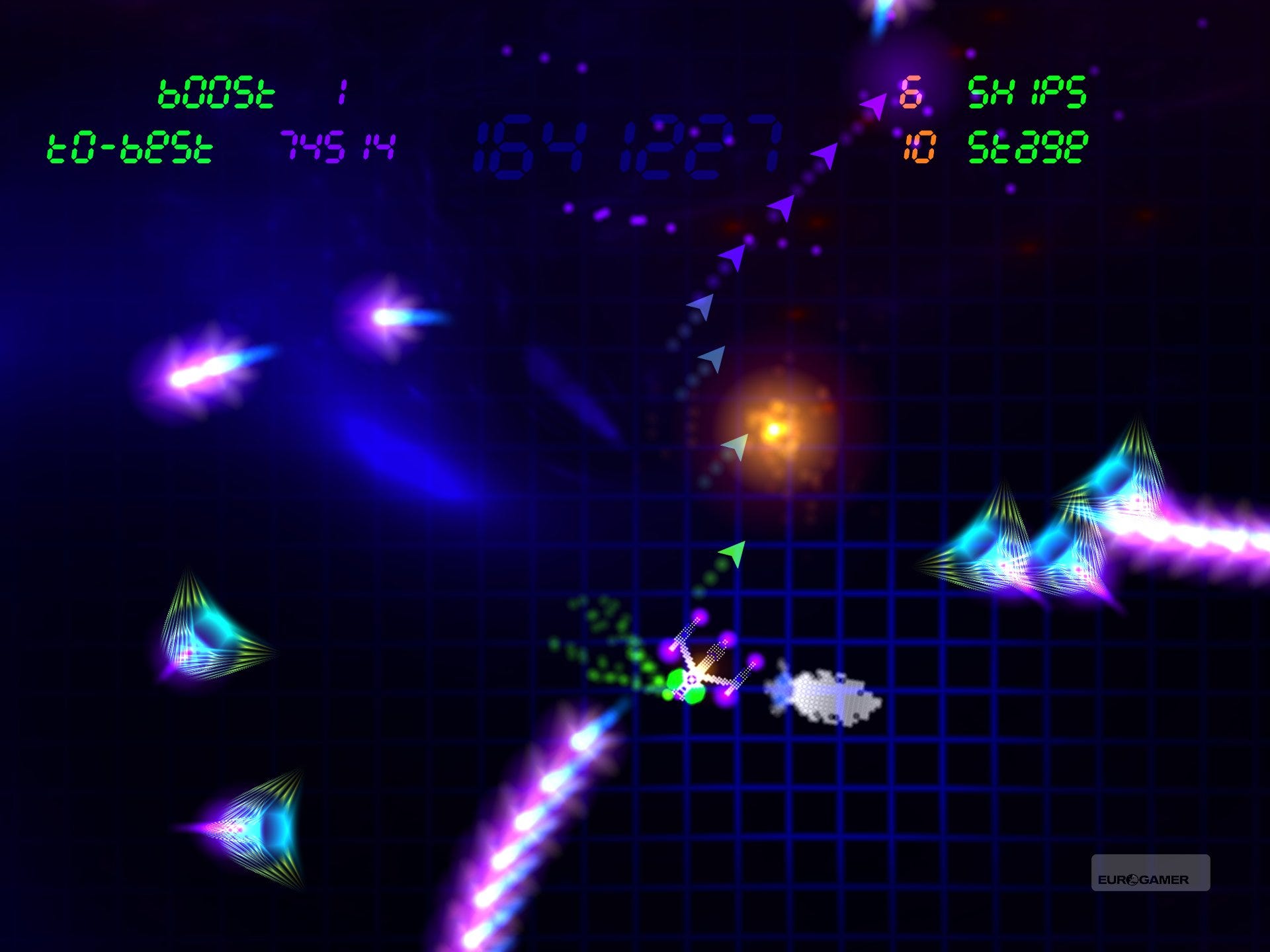
As shoot-'em-ups go, Gridrunner Revolution will seem familiar from the outset. Move ship around playfield, rotate ship to shoot in any direction, fire a constant, liquid stream of death at the enemy, grab upgrades. For the long of memory, it's clearly a vintage Jeff Minter shooter (note recurring sheep motif). Regarding its relevance to the modern landscape though, it's hard not to draw comparisons with Geometry Wars. Originally a mini-game in Project Gotham Racing 2, and later one of the great success stories of Xbox Live Arcade, Geometry Wars really planted the flag for retro-shooters. But it was just that - a shooter. An incredibly pretty and incandescent and addictive and very, very polished shooter. And one which took many of its cues from Gridrunner++, Revolution's forerunner. Grid? Check. Crabby ship? Check. Retina-searing particulate explosions? You get the picture.
1

Fluffy sheeps give more bullets. Go sheeps!

But there's a playful, experimental aspect to Revolution which shmups generally lack, and that's not a reference to its stylistic attributes... ruminant symbology and commendably insane voice-overs, for instance. It lies in the fabric of player choice, and the feedback loop the game provides you with. For example, you can happily play the entire thing simply shooting enemies, collecting upgrades and cracking levels, and you'd have a fairly good time. You don't even have to rotate your ship to succeed; with the advent of diagonal and rear-facing cannons, you're pretty much sorted. Playing the game like this would also be a tremendous waste of all that Gridrunner Revolution has to offer.

There are two key elements which turn it from a game into a playground: the first is gravitational hotspots. In every level, you'll find the sun floating lazily around the playfield. The sun has mass, and affects the trajectory of your fire - rather like the 'slingshot effect' in which satellites use a planet's gravitational field to gain momentum and alter course. The sun's mass bends the arcs of your weapon fire, and at the simpler, early stages, means you can effectively fire around corners and hit enemies which aren't directly in front of you.

The second factor is ship types. The sun itself can be attacked; you have to pour a bucketload of fire into it to destroy it, and while it fattens and prepares to go supernova, it fires pulses of energy back at you. But once destroyed, it becomes a black hole - offensively inert but still super-massive and able to jimmy around with your ballistics - and drops a new ship schematic for you to use. Different ship types have different angles of fire; some shoot straight forward in great barrages, some shoot fore and aft, some specialise in diagonals, and so on. Once you've collected a handful, you can switch ship types on the fly simply by scrolling the mousewheel up and down, to choose one which best suits the situation.

The situation is never simply 'kill the enemy' - you score higher points for destroying baddies using more intricate and complex arcs of fire. Heaven knows how it judges one fire-pattern to be better than another, but it works. The right ship-type at the correct orientation firing at the right angle near a black hole can set up dizzying eddies of destruction; streams of fire that turn into complete loops, or double back on themselves in figure-of-eight patterns, or wazz around in the sort of delightful curlicues and treble-clefs you might see on Mozart's scratch-pad after a night on the laudanum. It's a mechanic that's compelling, at times exhilarating, and turns the game from a simple, if charming shoot-'em-up into something rather more inspired.

Stylistically, it's very retro, as much because it tips the hat to previous Llamasoft games as anything else. The spacey trance soundtrack, psychedelic visuals and fixation with barnyard animals make it unmistakably a Jeff Minter game. But there are also some other cute touches, such as the Liberator from Blake's 7 that appears as a usable ship type. The game also changes the rules from time to time, which keeps things fresh. For instance, your weapon upgrades rely on collecting sheep, but occasional levels present black sheep, which don't want to be collected - you have to chase around the screen in a frenzy to grab them, which puts the thumbscrews on your baddie-mowing.

2

The sun prepares to go supernova, symbolised by an angry bull icon.

Graphically, it's a pleasing mix of old-school pixel art and modern Shader-Model 4 effects (if your graphics card supports DX10 effects, that is - it also features support for pre-NVIDIA 8-series and ATI X-series GPUs). At its quietest, it merely threatens to explode. At its most frenetic, it's a nuclear soup of pulsing colours, particle effects and alien soundscapes that thrill and engross in equal measure, with every level a perfect two-minute pop-song of rapidly intensifying effects. It's hard to walk away from once you get started.

In fact, the only downside is that the playfield can feel a bit limited - like you should have more room to manoeuvre. Whether you view this as a feature which ramps up the intensity or one which promotes claustrophobia depends entirely on how the game makes you feel. For me, it's a bit of both. But for a miserly 20 bucks (around £12.50 at time of writing), it's something of a shoe-in, for shmuppers and Jeff Minter fans alike.

8 / 10

Read the Eurogamer.net scoring policy

Comments (47)

Comments for this article are now closed, but please feel free to continue chatting on the forum!

  • Loading...hold tight!