Geometry Wars: Retro Explained

Bizarre's Stephen Cakebread does the maths.

It's not just the look and gameplay of Geometry Wars, Bizarre Creations' series of Live Arcade shooters, that hark back to gaming's earliest days. Its creator Stephen Cakebread is a games programmer from the old school, making games the old-fashioned way.

Cakebread, a senior coder at Bizarre, didn't create Geometry Wars out of a particular love of 2D shooters or a nostalgia for times past. He wrote it as an experimental test project because it was easy to code, and because he could. He conjured its looks out of raw mathematics because he didn't have any artists available to draw it. He didn't design it so much as refine it through play: a steady process of collaboration and iteration with his colleagues, playing it after hours around the office.

In these ways, Geometry Wars and Cakebread are the direct descendants of the very first computer game, Spacewar - another top-down, vector-graphic shoot-em-up - and its programmer Steve "Slug" Russell. Those are the exact same processes by which Russell and his fellow MIT hackers stumbled upon a new form of entertainment, almost by accident, on the DEC PDP-1 computer back in late 1961 and early 1962.

We caught up with Cakebread at Nottingham's GameCity festival a couple of weeks ago to talk through Geometry Wars' genesis and development through a prototype test program, a Project Gotham easter egg, a Live Arcade version (Retro Evolved), the recent sequel, and Kuju's Galaxies spin-off. He was joined by games manager Craig Howard, who was brought in to form a casual games team at Bizarre, and who worked closely on Galaxies and Retro Evolved 2.

Eurogamer: How did the first version of Geometry Wars come about?

Stephen Cakebread: The very first version was just kind of a test application. Basically we were on the Xbox1 and we were working in on prototype hardware, and we had these prototype joypads that were incredibly expensive, but rubbish. We didn't know why we weren't getting the right analogue [input] out of it, so we wrote a test app just to play around with the analogue sticks. Then at the end of [Project Gotham Racing] I had some free time, and started writing a game, and Geometry Wars kind of grew out of that.
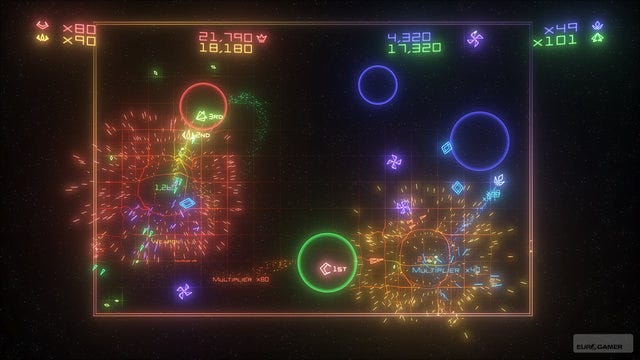
'Geometry Wars: Retro Explained' Screenshot 1

King is Howard's favourite. Which is just wrong.

Eurogamer: Was it a kind of game that you'd always wanted to do?

Stephen Cakebread: It's something I suppose I'd been writing for years before that, in college and so on, space shooters, top-down 2D things. There's nothing I particularly love about them - it's just they're easy to write [laughs].

Eurogamer: So shmups aren't a particular passion for you?

Stephen Cakebread: No, no, not at all. I just like games. Except for tennis games.

Eurogamer: And then Geometry Wars appeared in PGR2, as an arcade machine in the garage.

Stephen Cakebread: That was just an Easter egg. Even that one got a better reception than we ever anticipated it would; we thought maybe we'll get a mention at the bottom of a review somewhere, but surprisingly people seemed to love it, which started us thinking about where we could take this thing and what else we could do with Geometry Wars.

Eurogamer: Coincidentally, it appeared round about the same time as PomPom's Mutant Storm, another revival of the twin-stick shooter.

Stephen Cakebread: I saw that one just when we were starting work on Geometry Wars: Retro Evolved for Live Arcade. Interestingly, we worked out that they must have started working on Mutant Storm about the same time as I started working on Geometry Wars. I was wondering, maybe there was something in the press which sparked that interest in both people at the same time...

The game that Mutant Storm was was the game I had in my mind when I set out to make Retro Evolved 1. It was only when I saw Mutant Storm that I thought right, better make something different.
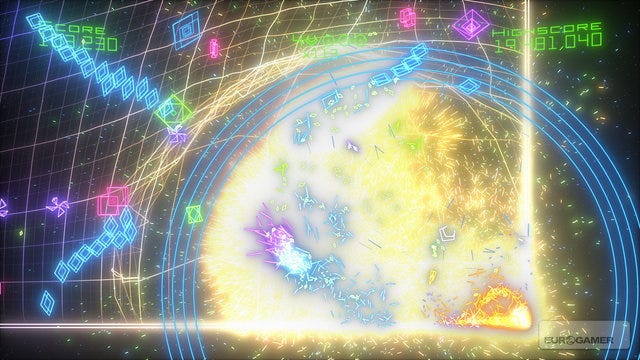
'Geometry Wars: Retro Explained' Screenshot 2

Squaring the cirlce. Or is that circling the parallelograms.

Eurogamer: So did you initially imagine having more of a level structure to the game?

Stephen Cakebread: In the original Gotham one and the prototype I didn't, because making levels takes time. So I never looked into it. When I started doing the Live Arcade one, I was like ooh, I've had proper time allocated to work on this so I'll do a level structure. It was then that I saw that you already had this level-based game. They'd probably have ended up very similar.

Eurogamer: Another crucial element of the game is its look - was that born out of necessity? I mean, did you have any artists?

Stephen Cakebread: Certainly for the PGR2 version and before that, I didn't have any artists working with me. Because it was an easter egg, I had a week to put it in, and all the artists were super-busy making cities and stuff like that, so it had to be the line stuff. I'm absolutely rubbish at drawing. I think that was good for the game anyway. There hadn't been many vector graphics shooters around at that point, and it was almost fresh.

Eurogamer: And it's kind of cool that you can make a really beautiful-looking game through programming rather than art.

Stephen Cakebread: Yeah, although I have to say that I do remember we spent about two weeks trying to come up with a logo for it. And all the achievement icons, oh, that was so much pain.

Eurogamer: Were you aware of Live Arcade as even a project, when you started working on these?

Stephen Cakebread: The first we heard about Live Arcade was when somebody at Microsoft Games sent [Bizarre boss] Martin Chudley a Live Arcade disc. We didn't hear about it until we'd started working on 360. So we hadn't really been aware of Live Arcade at all. Live Arcade 1 [for the original Xbox] wasn't built into the dash and I don't think many people knew about it, but it set the model, or at least set the ball rolling. When we heard it would be built into the dashboard [on 360] we knew it had the potential to be something big.

Eurogamer: And was there a decision at that point to put Geometry Wars on there?

Stephen Cakebread: Well, not really...

Craig Howard: Microsoft requested it.

Stephen Cakebread: We thought, well we put an Easter egg in PGR2, let's do an Easter egg for PGR3. When Microsoft came along and asked if we'd like to do a Live Arcade version, it just made absolute sense. It was interesting to get a foot in the water, to see if Live Arcade would take off.

'Geometry Wars: Retro Explained' Screenshot 3

Waves reminds Howard of Aliens - that "under siege thing".

Eurogamer: When it comes to Geometry Wars: Retro Evolved 2, did you do the various game type designs yourself, or did game designers get formally involved?

Stephen Cakebread: Well, they kind of came together by just getting down and playing the game.

Craig Howard: We did loads of iteration, we had the luxury of just taking as long as we needed to take with Geometry Wars 2. There were loads of modes that even quite near to the end, we just cut them out. Certain multiplayer modes.

Stephen Cakebread: Yeah, one of the multiplayer modes was an air-hockey kind of thing where you had gravity wells either side of the grid, and your ship was pulled back and forth, and the idea was to fill the opponent's gravity well up so it would explode. It was one of those things that was fun for five minutes, and then you were like... [makes non-committal noise]. It was like a Flash game.

Craig Howard: With the toolset it was easy to get things running and try them out. We'd play it, sometimes leave it for a while and then decide whether we liked it, or what bits we liked.

Stephen Cakebread: We were also looking at what people were requesting - some people liked Geometry Wars but they didn't like the fact that it didn't have levels or a set progression, which is where Sequence came from. And it was nice to get something to end the game on, the last level to unlock.

'Geometry Wars: Retro Explained' Screenshot 4

Sequence came about to answer fan requests, and give the game an ending.

Eurogamer: What was the thinking behind the Geom multipliers?

Stephen Cakebread: In Geometry Wars 1, people would just circle all the time around the arena, and that was the optimum way to score big - you'd have a huge tail of enemies chasing after you and just pick the ones off in front of you. And while it was optimal, it wasn't particularly fun to play. I wanted to encourage people to play the game more aggressively. Making enemies drop something made the player move towards them. Initially we had it so you had to pick up 100 Geoms to multiply your score by one, but people weren't bothering to pick them up. So we had to make them really, really strong.

Craig Howard: It was good because it didn't fix a player to a particular style of play.

Stephen Cakebread: We did try lots of other mechanics to achieve that, and they all felt like they were damaging the gameplay of Geometry Wars in some way. We had this weird one where you pressed a button and it flipped the grid, which was the biggest mindf*** you've ever seen. It was like two games of Geometry Wars on top of each other simultaneously...

I think the name Geoms came about because you were writing the design document at the time, and you were going to call them...

Craig Howard: Glimmers!

Stephen Cakebread: And I was like, we're not calling them f***ing Glimmers.

Craig Howard: A band took that name after we dropped it, and it's a cool band.

Eurogamer: How did you feel about Geometry Wars Galaxies? Letting another studio take your creation and run with it?

Craig Howard: It was weird, but we worked incredibly closely with them. We originally had it running on DS and Wii ourselves, we worked on a prototype. Vivendi wanted to take these versions up but we were just too busy. So it made sense for us to find someone we could work closely with.

It was kind of weird because we were a developer managing another developer - there was a publisher shield above it, but we were managing our IP. But they really got it, they understood the game quite early on.

Stephen Cakebread: It really came together in the end - we were worried for a time, but that's always the case with games, they always come together at the end. It was funny for us being on the outside. We're normally on the inside of that - we know what it's going to be like. But when we were on the outside we were like, oh my God, oh my God...

Craig Howard: The main thing was we could explore things like different-shaped grids, which we'd always played with, but they didn't fit the structure of what was the Retro Evolved Geometry Wars. We could do things that worked well as a 10 minute event within Galaxies, but it didn't matter if it was just a 10 minute game because you could play the other 60 or so games in there.

Stephen Cakebread: With Galaxies, because every level can be different, it doesn't really matter if one of the levels is bastard hard.

'Geometry Wars: Retro Explained' Screenshot 5

Somebody forgot their ruler today.

Eurogamer: The design of the original game basically boils down to the design of the enemies' attack and movement patterns. Were there any ways those interacted with each other that took you by surprise?

Stephen Cakebread: The green ones that dodge your bullets were always a good one, because when they turned up, you had to start thinking about them. But what I generally found was, you would notice something when they started interacting and think OK, they're interacting in a nice way, and I'm going to play on that.

For example, the spinner ones, when I was initially testing them on their own and having them spawn with nothing else, worked quite well by having them track towards you. But when we had all the other enemies in there, especially the weavers, actually having them stay standing still almost like mines actually worked better. They're making half of the arena uninhabitable and you've got to clear them out because you can use that side of the arena again.

Eurogamer: In the classic version of the game, the composition of the waves of enemies feels quite random, quite organic. To what extent is it, really?

Stephen Cakebread: It's kind of a controlled randomness. Over every 20 to 30 seconds, I'll say I want two of these kinds of spawns to happen, and I'm only going to spawn these kinds of enemies within that period of time - to that level, it is controlled. So at the start of the game it's easy and at the end it's hard. But it is fairly random, it just makes an effort not to give you something bastard hard just by pure random chance.

Eurogamer: I love the friends' scoreboard integration in Geometry Wars2. It's something no other game has done as well.

Stephen Cakebread: That actually came from the first prototype for The Club, we had that in there. That worked really really well, it's a shame they couldn't put it in the final version. But it worked so well in that prototype we just wanted to find a way of putting it into Geometry Wars. It made sense... we wanted to make people feel like they were wanting to compete on score, because that's what Geometry Wars is all about, that's the motivation for playing it.

Eurogamer: Were you taken by surprise by the level of competition for Geometry Wars scores?

'Geometry Wars: Retro Explained' Screenshot 6

Yeah, we always end up bombing these guys too.

Stephen Cakebread: Absolutely. Certainly for Retro Evolved 1, where to get a high score they'd have to spend 20 to 30 hours playing the game. They'd be going to work, leaving their Xbox on, playing for 6 hours, going to sleep, playing the game all the time just to set these huge high scores. It's amazing they put that much effort it. I wouldn't. I look at that and wish I'd made it so you couldn't do that... but they're just taking what it is.

Eurogamer: So what's next?

Craig Howard: We're working on a few things, we can't really say yet. Something that's not directly related to twin-stick shooters. But Geometry Wars will be back as well.

Eurogamer: But Bizarre has ideas for other kinds of games on that scale?

Craig Howard: Yeah, the casual games side is something that's here to stay. I mean Steve and we all work on other things at Bizarre as well. But we're playing around with a couple of other ideas that we're quite into at the moment. There will be more Geometry Wars, and there might be something different in between.

Comments (9) Latest comment 3 years ago

Comments threads automatically close after 30 days, but please feel free to continue chatting on the forum!