Version tested: PSP
The RPG-ification of mainstream videogame genres has been the defining design trend of the past three years, with experience points and levelling a key feature of everything from Modern Warfare to Borderlands. Everybody's Tennis is no different, doling out experience points on a per shot basis, rewarding you in endorphin micropayments for every ace served and on-the-baseline lob successfully landed.
As you level your character, so you unlock new items of clothing in the shop which boost your attributes in subtle ways: for example, giving your budding young tennis star a buff to his backhand while cross-dressing in a Japanese schoolgirl's uniform.
Not only that, but the developer subscribes fully to the RPG's wider tropes as you roam the grounds of tennis clubs or the hallways of a high school solving simple puzzles and challenging opponents to throw-downs on the court. The snappy dialogue and bold characters supply what is one of the most entertaining, if unlikely, stories to be found in a sports game, adding both sharp flavour and context to each match.
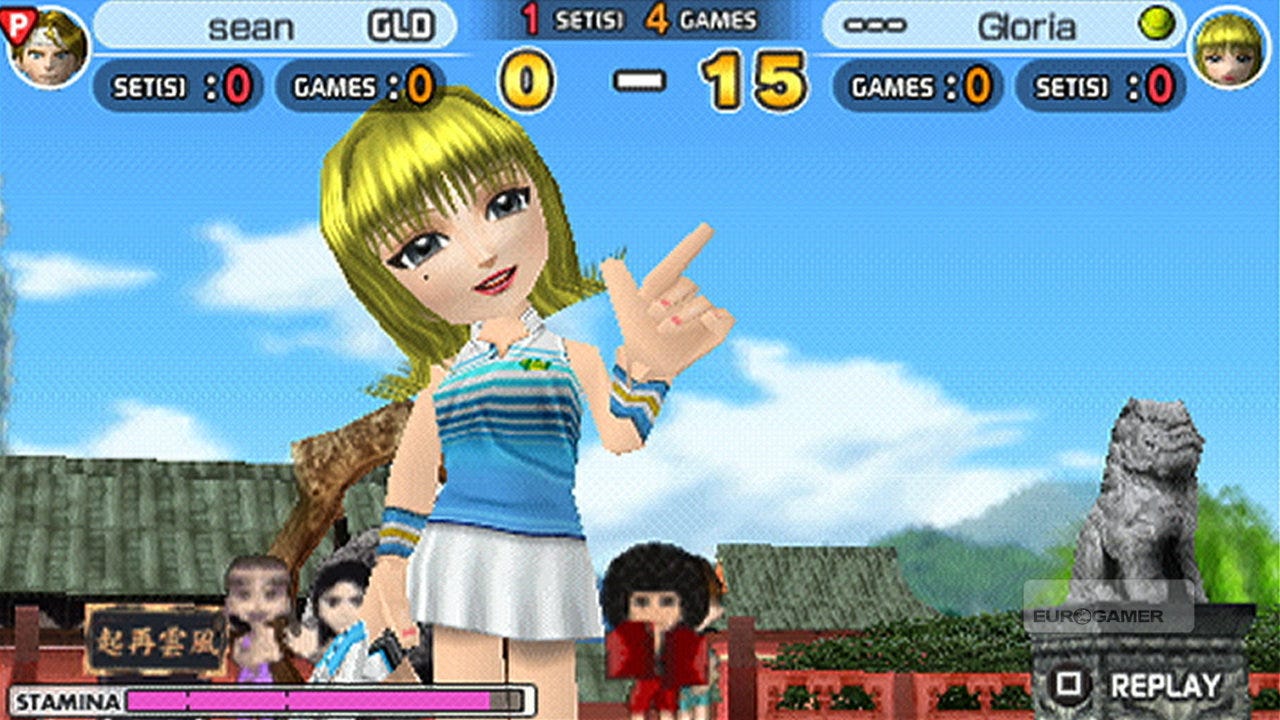
Far from merely dressing your character, the huge array of clothing on offer effects their abilities in different ways, giving stat boosts and penalties across a range of abilities.
Of course, we've seen some of this assured, cartoonish approach to sports before in the developer's other output. Cousin Everybody's Golf has been a consistently solid, enjoyable feature on Sony gaming hardware for well over a decade. The Nintendo-esque, breezy presentation has always been backed up by solid, irresistible systems that often communicate the spirit of the sport far more effectively than those games that stick to a drier, realistic approach.
Pleasingly, that's true here too; the tennis game at the core of the experience is effortlessly robust. More twitchy and fast-paced than Virtua Tennis, it has the feel of Namco's PlayStation-era Smash Court Tennis, quick in the hands but with all the precision required to execute a cross-court volley to the baseline.
Strokes, lobs and slices are each assigned a different button (which appears as a ghostly icon behind the travelling ball to indicate which of the three you and your opponent has used for any shot). Where Virtua Tennis encourages players to move into position and hit the button early, powering up a shot for maximum power, here the emphasis is on swinging at the last possible moment, testing reactions as much as strategy at any single point. Positioning is still important, however, as if you hit the ball while running the accuracy of your placement is diminished.
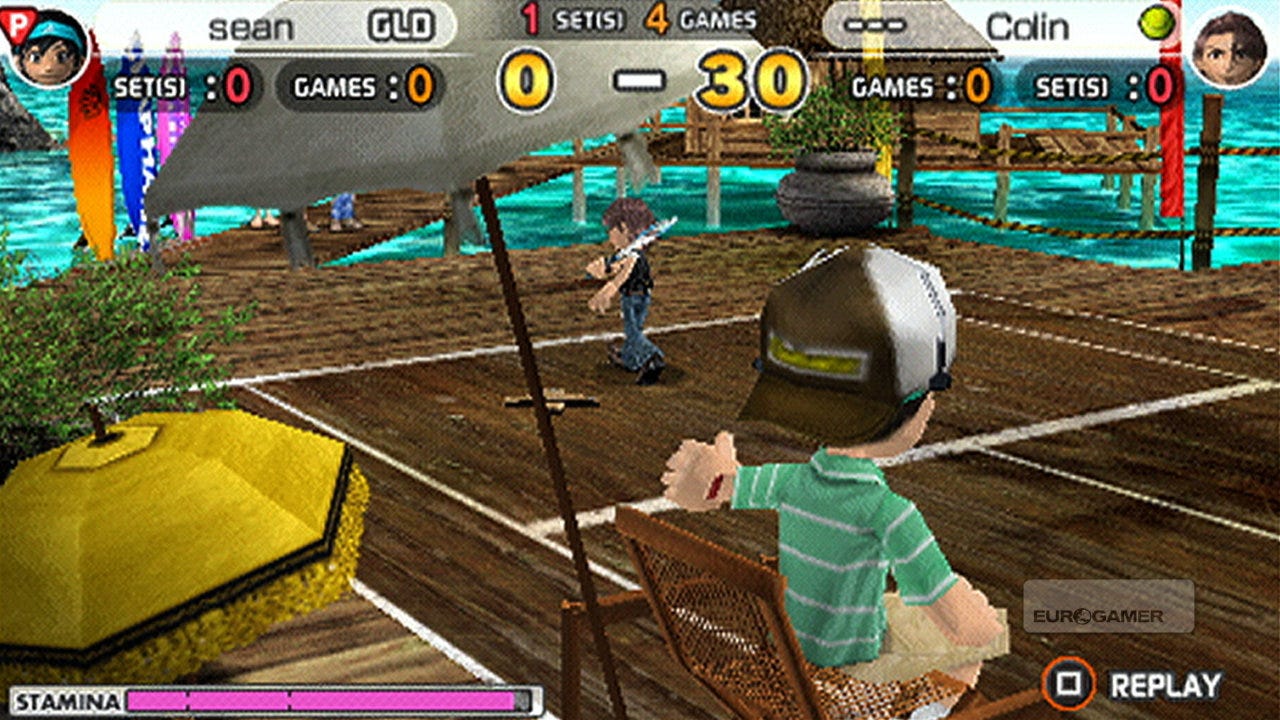
As you increase your loyalty with a character, so they unlock new shots and increase their abilities.
Featuring an unapologetically Japanese styling, matches are introduced by Fight Night style motion graphics while onomatopoeic speech bubbles fly up every time the ball hits an umpire or ricochets off a wire fence. The sheer amount of on-screen icons and meters flying about during a match is initially dizzying. Smiley icons indicate a well-timed shot while splashes of colour momentarily pop up on the court to indicate where the ball is going to land. These features can be turned off but even with the most minimal HUD on offer, this is still a busy game to look at.
Everything is overtly gamified and quantified. The number of performance bonuses in play far surpasses anything seen in a tennis game before. And yet, thanks to the cute aesthetic and clean, logical presentation of the data, it's never overwhelming.
Every winning shot you play earns shot points for how impressive it was, whether it was an ace or ace return, or whether it drew a long rally to a close. Conversely you lose points for failing to return a ball, and there are larger bonuses on offer for taking a game without your opponent winning a point. At the end of each match you receive score out of a hundred for how decisively you beat an opponent in the match, and the fewer the points they won, the higher the reward.
All of these different rewards feed into the same economy, and are aggregated and multiplied by your character's current tier level and then added to your bank, which can be used to purchase new items of clothing and equipment. The system is both strong and addictive as the steady flow of meaningful rewards on a minute by minute basis lodges the game's hooks into you, helped by the fact that most games are short, snappy affairs, over in less that five minutes.
Far from a port of the PS2 game of the same name, Everybody's Tennis PSP offers a complete overhaul of the original, fixing a multitude of problems.
The story that interweaves with the matches you play is often convoluted but is nevertheless wholly charming. By focusing on young players starting out at a smalltime local tennis club, and escalating through high school and upwards, the narrative has a kind of Karate Kid trajectory, and the rivalries that are set up off the court do inject wider meaning to the matches themselves.
In fact, it's one of the best examples of integration of a story into a sports game yet seen, a marriage usually awkward and bolt-on. By contrast, here you care about the characters and their micro-dramas, and the carefully pitched dialogue can characterisation works wonders for the experience, where it might have been expected to make it cumbersome.
Rather than picking a single character to take from the local club to world-class champion, you have a roster of characters with different strengths and weaknesses. This line-up is added to as you make new friends through the story and, while there are no penalties for chopping and changing between whom you pick for any one game, you fill a loyalty meter with repeated use of the same character that unlocks new shots and bonuses as it fills.
As in Smash Court Tennis, if your character is struck by the ball in play, they'll be stunned and will lose the point.
The issue with any sports game that takes an RPG approach is that it can be either boring in the earliest stages or too easy in the latter stages when the full range of abilities is finally open to you. Here Sony's experience with Everybody's Golf shines through, as the tennis is satisfying from first touch, and rather than breaking this core fun as it progresses, the new shots and abilities extend it into new areas along a distinguished development trajectory.
Everybody's Tennis is the ideal handheld approach to the sport, exchanging realism for lightheartedness without compromising the quality of the tennis. The micro-rewards may have an air of Farmville about them, but the unlocks they feed into embellish the core game, rather than simply decorating it. As a result, Everybody's Tennis is aptly named, appealing the everyman despite speaking in the vernacular of the RPG nerd.
8 / 10
