eRepublik

Bite-sized democracy.

It wasn't widely reported, but in April of this year, the United States declared war on Canada. Perhaps it was inevitable - the smug superiority over low gun crime figures, that cruel stranglehold on the world's moose resources, or maybe just the country's odd propensity for coming up with place names like Flin Flon and Winnipeg - whatever the reason, the US of A seemed to feel that its neighbour to the north had it coming. It certainly looked like the whole business was going to be over quickly: on one side, a nation of proud arms-bearing hyper-capitalists hepped up on Big Tastys and Buffalo Jerky, and on the other, a cadre of unnaturally polite international backpackers. What could possibly go wrong for Uncle Sam?

Alexis Bonte, the man who indirectly made this invasion possible, has been quick to distance himself from any fallout, however. "I didn't do this!" he says, when asked for a comment. "It was the users who did it." Bonte also adds that, once the dust had settled, the outcome turned out to be rather unexpected. "The US had about 1000 inhabitants at the time, and Canada had just 200. If this was all AI-driven, it would have been over in a few hours. Instead, the President of Canada was a pretty clever fellow. He called Spain, asked for forty of their best soldiers, and paid them well. So now there was a Spanish mercenary army showing up, and then the French Foreign Legion joined in, and eventually the US started losing the war and had to sue for peace! They paid thousands in reparations." The world, it seems, can be a surprising place when you look at it through the lens of an internet browser.
1

If you go on holiday in the real world, you'll have to stock up on food in the virtual one so your citizen doesn't die.

This invasion - and many like it since - took place in the fictional world of eRepublik, a bold collision of MMO, strategy game, and social networking site. Look at it one way, and eRepublik seems a lot like the world you already live in: you're a citizen of a country, you have to get a job in order to buy food, and if you're clever enough, or just horribly persistent, you can rise through the ranks to fame, wealth, and power. Look at it another way, and it's more like Facebook: a simple white page, largely text-based, with a scattering of innocuous-looking icons and update panels. Either way, someone like William Gibson is probably studiously wetting himself (if that's possible) at the prospect of a fully-functioning world-in-a-bottle peering out of his iMac screen. He would, wouldn't he? He's half Canadian, after all.

"The logic was the following," says Bonte, chief executive and co-founder of Tevin Solutions, the company behind the game. "eRepublik was never going to look like a typical MMO. With the 3D way, the problem is that you need a really powerful machine, and you need a downloaded client most of the time. You can't do it in a browser so easily. At the end of the day, we thought, 'We're building a strategy game. They don't need that many bells and whistles.' What you want is that experience where you play something like Risk. We then combine that with the user-generated potential of the web, and then the social tools that you find in things like Facebook, and what you get is really interesting."
2

Running a media empire is a sure route to political office - Italians are really going to like this game.

What you get, in fact, is America invading Canada, and sharpish. But while eRepublik is a game with a truly massive scope - it aims to provide a user-directed simulation of a world that's broad enough to capture geopolitics, social trends, and global economics, yet sufficiently detailed to cover what it's like to lose your job at a tyre factory and subsequently starve to death - it's been designed with the needs of a casual audience in mind. All you need to get stuck into the game is an internet connection, an email account, and roughly fifteen minutes of free time every day. This thing is going to be huge in prisons.

"We designed the game for people like me who are great fans of strategy games but no longer have the time to play them," says Bonte. "You know the feeling, you're playing Civilization at eight in the evening, you look at the clock again, and it's two in the morning. So we wanted to design a game with the same depth, but instead of a lot of hours over a short number of days, it's a fifteen-minute experience over several months."

And so you start out in eRepublik by choosing a country to belong to, and then set about getting a job to earn money. In keeping with the game's short play sessions, you can only work once every (real-world) day, an activity that involves answering a set of trivia questions to get a cash boost. The more questions you get right, the bigger your productivity bonus. In time, these quizzes will be tailored to your profession - become a dentist, and you're likely to learn a lot about gingivitis in the process (quick heads up: you don't want it) - but right now, it's kind of a mish-mash. I chose to join a lumber firm, for example, and ended up fumbling my way through a few questions about Baltic ports and Henry VIII. I did not fare particularly well.

Working gives you experience points as well as money, and levelling remains a big part of the eRepublik appeal. Over time, better jobs will become available, and you'll eventually be able to start your own company, and employ other people. Or, you could become a merchant and travel the world undercutting your rivals. Or, you could just relax, enlist in the military, and fight against another country for reasons you scarcely understand, answering trivia questions all the while.

But if you detect the nasty taint of educational software lurking at the heart of eRepublik, rest assured that the day-to-day grind and Baltic shipping pop quizzes are actually only a small part of the overall package. The most ambitious aspect of the game is its reliance on other players. The boss of your company, and all your fellow employees, are all real people. So's the president of your country, and his congress, and all the other characters helping the world to slowly tick over. There are no NPCs at all in eRepublik, and this leads to the game's real point: social interaction.

"When you get to level two at the lumber job, say, if it was just a normal game, you could get a better job automatically," explains Bonte. "Here, you can talk to your boss and say, 'You're not paying me enough! Give me more money or I'll move on.'"

3

The US was the first nation to initiate war - and also the first to lose. No clear exit strategy?

And that's only the start. eRepublik encourages you to get stuck into your society in increasingly meaningful ways. With the game playing out across a single server, if you get in now, there's a chance that you'll be able to make a real mark on the world. Having just turned thirty, and with a noble history of complete non-achievement stretching behind me as well as beckoning me into the sunset, this is actually starting to sound kind of appealing as far as I'm concerned.

When you first join your country of choice, for example, you'll be greeted with a letter from your new president. This president will have had to make a name for him or herself - most likely by doing something industrious like starting a daily newspaper, writing articles, and getting a lot of subscribers - before getting elected to congress and working his or her way up the ladder to the top. And even if that seems out of reach as an ambition, you can still worm your way into the congress itself and help direct the course of the country from there. For every action in eRepublik, there is an equal and opposite social interaction - and even if you've got a bad apple in charge, the game schedules fresh governmental elections every month anyway. Like in Italy.

So while for most players, the aim of eRepublik is still to make your mark, there are endless ways to do it. "That's the whole idea," laughs Bonte. "Because we offer different careers, you can choose how to work your way up. When you join, you're not just doing your thing, you're part of a nation, and you want your citizen and your nation to do well."

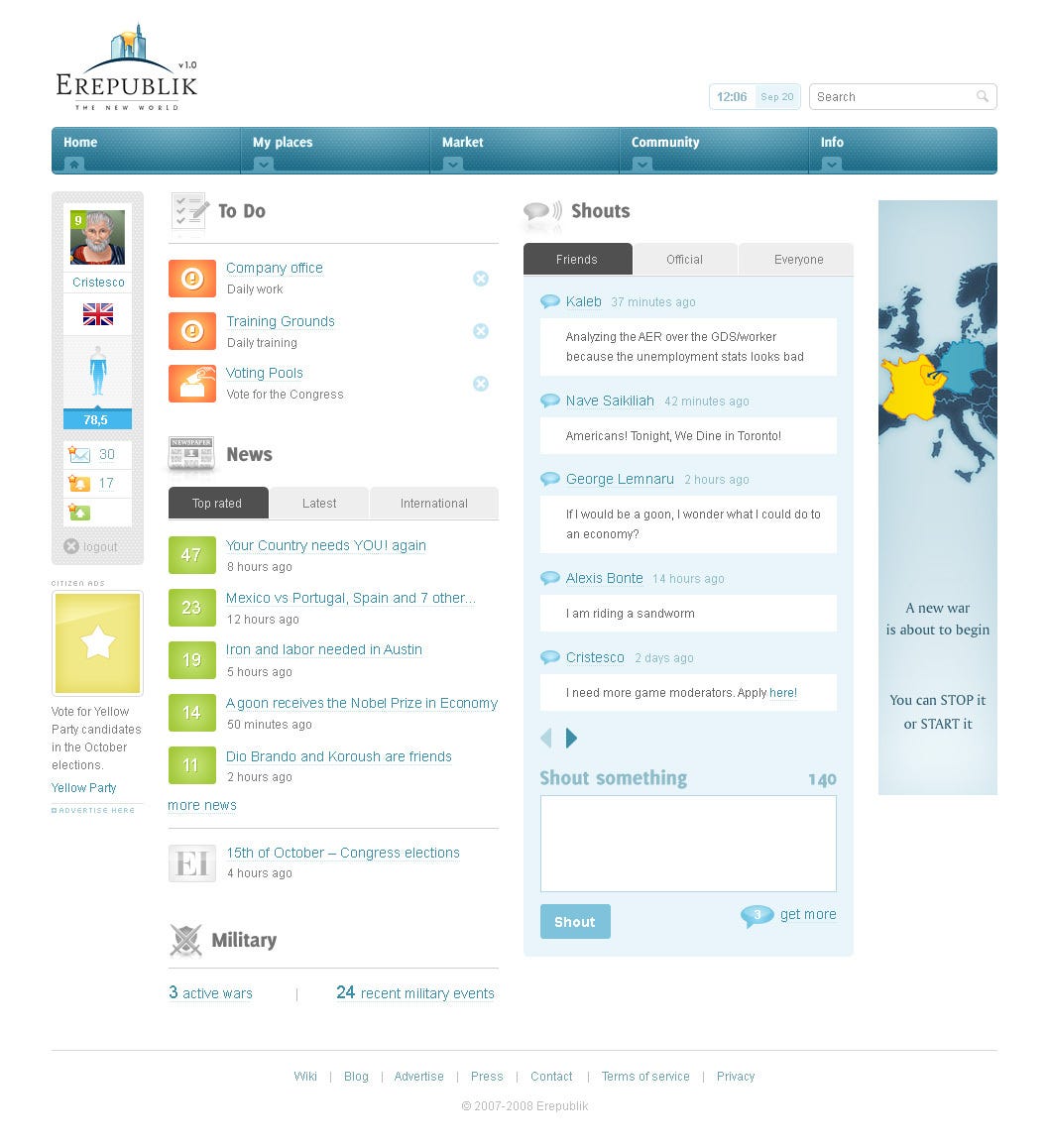
And to help new players through the initial thicket of options - newspapers to subscribe to or start up, political parties to join or form, and nations to trade with or fight - there's always the familiar crutch of fresh experience points, along with a few judicious thefts from Facebook. "We give you a to-do list, which knows what level you are and is constantly giving you tips on how to progress or things you might like to do - for example, get a job, and get some experience points, become a soldier, put some pictures in your avatar," says Bonte.

"But it comes back to the fact that the way you really start progressing is when you start interacting with others. That's why newspapers are a super-important part of the game. There are about 13,000 at the moment. The top one is a Swedish newspaper with 800 subscribers, while the top 200 have at least 200 subscribers each. You can form one or just submit articles. And there are a lot of comments on the articles already, a lot of interaction going on. And that's just one way of becoming successful. It's social strategy."

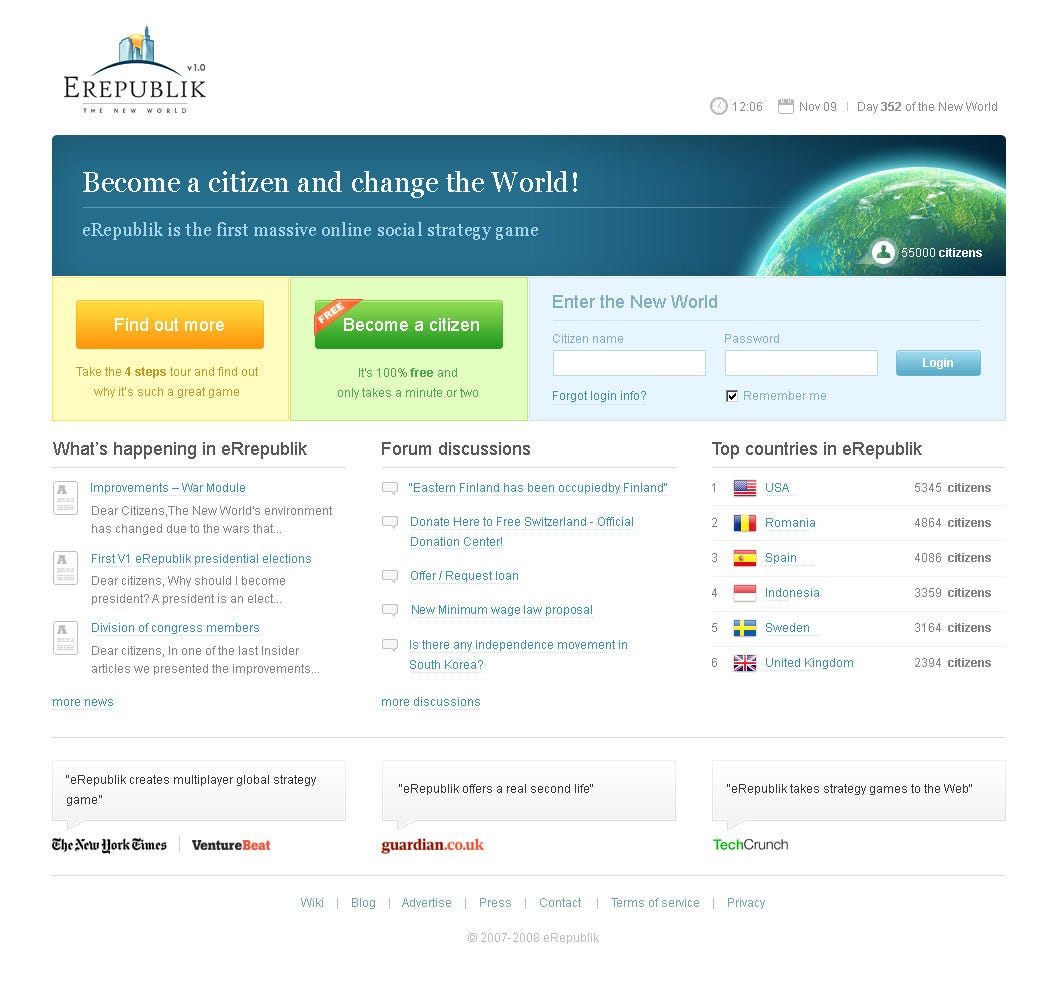
And at the moment, it seems to be working. eRepublik may initially seem slightly austere, but the clean interface holds a wealth of options, and the game is only ever as cerebral and strategic as you want it to be. At the very least, it's fascinating to spend time in a mirror world where the most populous superpowers are America and Romania, and Sweden's IKEA-like ingenuity has lead them to be the most economically successful nation on the planet - possibly through careful deployment of Allen keys and flat-pack bookshelves. The more you investigate in eRepublik, the more papers you read, jobs you try out, and politics you dabble in, the more this strangely familiar environment opens itself up to you. And while the infrastructure is nothing but HTML, the landscape that is emerging is driven purely by the choices of other, living, breathing (and largely Romanian by the looks of it) people.

4

Trivia questions ping-pong between simplistic to sadistic, a bit like the Tory supporter base.

But the most promising aspect is that this game isn't just about democracy: it's a product of democracy too. Bonte describes the current version of eRepublik as about twenty per cent feature-complete. "It's a constantly evolving and changing world. It needs a lot of work, but that's one of the great things about doing things online, every day you listen to what people want, and tweak it." The first thing on the horizon is a new API to allow players to make their own applications. There's a chance that the whole thing could all go a bit Scrabulous, with eRepublik's clean geopolitical lines blurring under a confusing influx of zombie and pirate requests, pokes, winks, and Naruto Fact-of-the-Day dispensers, but the carefully playful way in which the audience has behaved itself so far suggests this probably won't be the case.

At times, eRepublik seems a dangerously intelligent take on entertainment for a world which likes to watch lycra-clad celebrities trying to fit through holes in a polystyrene wall of a Saturday evening, but Bonte's player numbers are already growing steadily. The beta topped out at 35,000 active participants, and two days after the game's full launch, the figure had risen to 42,000. It helps that there's no subscription fee - eRepublik is currently funded by the entirely optional purchase of additional in-game currency, but even that is sensibly regulated to stop players from buying more than a little every day - and with such a simple sign-up process, the game is almost too interesting a prospect to ignore. So far, its designers have been clever enough to keep a growing population playing by the rules in an environment where they could easily choose to revolt and spoil everything, while as a strategy title, eRepublik has proved sufficiently subtle to explore the distinction between choosing to wield power, or opting to be quietly influential instead. And, if nothing else, the whole enterprise will at least provide Canadians with somewhere nice to hang out.

You can access eRepublic at www.erepublik.com.

Comments (15)

Comments for this article are now closed, but please feel free to continue chatting on the forum!

  • Loading...hold tight!