Dungeon Hero Preview

Taking fantasy seriously for once.

Firefly Studios is one of the unsung heroes of British game development - largely because it doesn't do much singing. The company's been around since 1997 and has managed to sell 4 million units of its biggest PC series, Stronghold, but still you struggle to place the name. It's all down to stereotypical British understatement, says co-founder Simon Bradbury. "We're not very good at blowing our own trumpet," he sighs, as we settle in to have a first look at the studio's next big thing, Dungeon Hero - due out in about a year's time on PC and Xbox 360.

For a developer whose bread and butter for ten years has been intricate, hectic 2D strategy games, Dungeon Hero is a bit of a departure: it's a third-person perspective brawler with RPG elements, all rendered in glorious 3D. More than that, though, Firefly hopes it will be a "shot in the arm" for the whole dungeon-crawler genre. "For so long it's suffered under the yoke and tyranny of D&D," says Bradbury, not entirely joking. He says that while D&D is great, its influence has discouraged developers from trying new things, resulting in a disappointing lack of evolution.

So how is Dungeon Hero going to shake things up? Well, for a start this is a game where you're playing for the opposition - and not in the tongue-in-cheek "be evil" sense that Dungeon Keeper introduced. Instead you play a human mercenary hired by a tribe of goblins living in an underground city - and as you might expect from a barbarian mercenary, your character is a violent sociopath whose social graces are matched only by his personal hygiene. "Hero is a loose term," says Bradbury.
1

"Yeah so you take a left at the screaming amputee and then hang a right at the loudly sobbing new recruit, you'll be there in no time..."

More importantly, Firefly wants to use that setting to explore the whole idea of an underground world. The "dungeons" in the game are subterranean cities, living and breathing, in which the goblins live, work and fight. This is the dungeon from the point of view of goblins - not just somewhere for heroes to invade and nick treasure from, but actually a place where a whole species makes its home.

The upshot of this is that goblins actually become characters rather than brainless monsters. The Firefly team professes to be sick of games where you find a goblin, orc or whatever patrolling a room, with a Level 5 Giant Spider standing three feet away (but not attacking the goblin, for no apparent reason) and a conspicuous chest in the corner with a Helmet of Pith or whatever inside it. In a realistic fantasy world, this just wouldn't happen. It breaks the fiction. In the brief section we saw, Firefly's counter-point to this expressed itself pretty clearly.

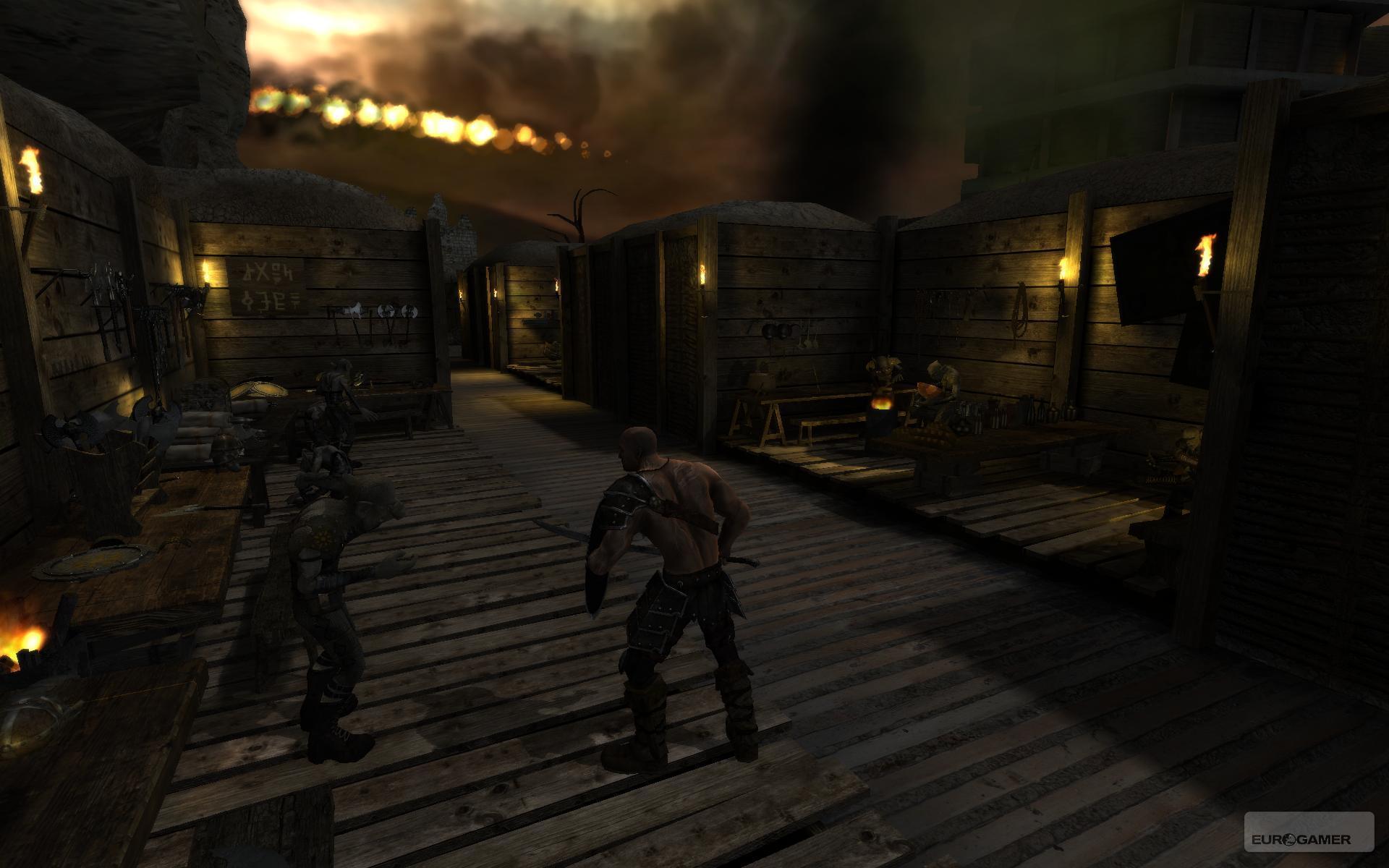
You're recruited by the goblins to fight in a battle against their enemies, another goblin tribe who reside in a city across a stretch of desert that has become a battlefield - and rather than showing us the goblin home city, Goldstar, the developers decided to show off a zone called the Back Trenches. These are the tunnels which lead from Goldstar up to the battlefield - and as such, they're filled goblin soldiers who are off-duty and waiting to return to the fray, as well as the wounded and the dying who have been stretchered off the field. It looks and feels like a World War I scenario.

Colours are muted and dark, the overall atmosphere bleak and claustrophobic. As you trek towards the battlefield, you walk past tables of goblin soldiers playing cards, while just down the corridor a less fortune soldier screams as a doctor saws off the remains of his leg. Even in an unfinished state, it's a fairly powerful piece of mood-establishing storytelling, and certainly lends some weight to the developer's claim to be doing something totally different with the dungeon crawler genre.

Once we move past the back trenches and towards the front lines, our hulking anti-hero starts to encounter his first foes - goblin soldiers from the rival tribe. This gives an opportunity to demonstrate the combat system. Much as with Firefly's changes in narrative, the combat is designed to bring a certain measure of realism to the fantasy environment. "We're a bit sick of kung-fu movie-style fights, where loads of guys sort of queue up to hit you," says Bradbury. Dungeon Hero's combat is very close-up and physical, but it places huge emphasis on positioning and, more importantly, on space. If there's a mob of enemies, the whole mob will attack you - simple as that.

In response, the combat model grants you a set of moves that don't do much damage, but effectively shove enemies out of the way to give you manoeuvring space. When you're clearing space, these moves map to the face buttons, so you can intuitively choose which direction to attack. In the demonstration we saw, clearing backwards would whip around to plant a nose-crunching elbow in the face of a goblin approaching from the rear - without dropping your guard relative to the foe in front.

4

We knew that goblins are traditionally the evil race of fantasy fiction, but we hadn't realised that they played ukulele. That's nasty.

The basics of each brawl, then, come down to knocking back the enemies around you, and then selectively engaging with one of them in proper, sword-swinging combat - keeping an eye on his pals to ensure that they don't creep around behind you and knife you between the shoulder-blades in the meanwhile. It looks fast, deep and exciting.

In order to keep it fresh throughout the game, Firefly is also building its RPG-style progression system entirely around combat moves. Rather than powering up statistics ("hmm, spend points on SPI or INT? Decisions, decisions...") as you progress, each level allows you to unlock upgrades to your combat moves. The team wants to make levelling up into a meaningful event, says Bradbury; something which visibly improves your character, giving you cool new combat animations and abilities.

Overall, the aim is to create something that isn't vastly intricate and hardcore in the sense that many stat-heavy D&D based games can be. It's not that Firefly can't do depth - Stronghold is one of the most intricate and complex games on the market - but that the developers feel they can bring that depth to the genre through tactical combat and well-realised narrative and environments. From the promising fraction of the game we've been exposed to so far, it would be worth tracking the developers' progress to see how well they do, and with a year left to run in development we'll be sure to do just that.

Dungeon Hero is due out on PC and Xbox 360 next year.

Comments (35)

Comments for this article are now closed, but please feel free to continue chatting on the forum!

  • Loading...hold tight!