DS Game Roundup Review

Monsters, mazes and more that you've never heard about.

Version tested: DS

Sifting through the ranks of obscure Japanese videogames used to be the sole preserve of the risk-taking importer; the chancer with a smidgen of kanji tumbling around his brain, some product listings cut from the back of a magazine, and a wacky bridge adapter for fooling his hardware into compliance. But now, thanks to the massive success of Nintendo DS, more of these games than ever are turning up locally, as small publishers like 505 Games take one look at Nintendo's figures (23 million DS consoles sold in the last 12 months, 123 million software sales, casual games outselling Mario) and start cutting cheques to Japanese companies like Taito, Success and Star-Fish. Budget-priced and in some cases roughly translated, the six titles reviewed on the next few pages are all available in this country, either this week or next, and it's all thanks to that man at work who says games are rubbish but secretly plays Brain Age with his girlfriend. You might have to look behind a few Nintendogs to find them, but they're there. The question is, will you want any of them?

So, anoraks, throw away your magazines and join us for a sift.

Monster Puzzle

It may not be a name that sticks in the memory, but Monster Puzzle is probably worth nailing to your pre-frontal lobe for a few hours at least. It's a falling blocks game that works a bit like Jewel Quest; there are lots of icons with monster faces on, your basic work is eliminating them in groups of three, and wherever you delete them the colour of the squares on the grid behind them changes.

Stages in the story mode ask you to change a certain number of squares' colour, perhaps several times over, while the shape of the playing area changes from stage to stage, so covering all that ground is more difficult than simply spotting a few easy chains would be in Bejeweled, Zoo Keeper or Puzzle Quest.

The method of eliminating monsters is different too. Instead of moving one tile one space at a time, and only being able to do it when it forms a set of three in adjacent squares, here you use either the stylus or the (much better) button controls to move an entire line back and forth, so if you have two furry blue monsters lined up then you can actually reach to the other side of the screen to locate the third.
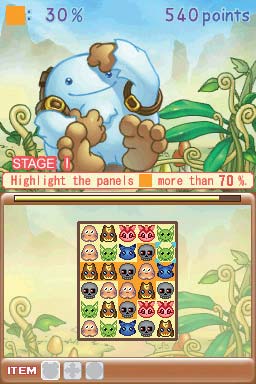
1

The square grid's a dull-looking starter, but the later boards are all sorts of shapes.

Obviously this leads you down different strategic paths, and the things the game chooses to reward are interesting too. Whereas the shape-association games we name-checked earlier all reward lines of four and five blocks handsomely, Monster Puzzle is nonplussed by this, preferring to see a pair of twos sliding alongside one another to form a square of four - at which point all four disappear along with those directly around them.

More immediately familiar is the game's principle means of building up tension: running down a timer quicker and quicker. Fortunately you can amass little clock power-ups to help claw a bit back when you're on your last legs. Other power-ups delete certain shapes, but you need to watch out for negative effects too, like a spider that reverses movement controls, or cobwebs that hold monsters in place, forcing you to work around them until you can kick off a deletion in an adjacent square.

All in all it works fairly well, but it suffers from the same problems as a game like Jewel Quest, where you end up treading water for ages with meaningless clearances just to keep the timer alive, all the while the other half of your brain's scrambling to work out a way to clear tiles in hard-to-reach areas. Becoming proficient is inevitably rather strained, since half the time you get it right you do so by accident, and the opportunity to practice only emerges when you're under pressure.

Nevertheless, some players will enjoy the way it works, and our constant references to Jewel Quest certainly should be interpreted as a signpost for fans of that. But there's a much wider pool of excellent and far more accessible DS puzzle games out there to sink into, and even single-cart multiplay probably won't keep Monster Puzzle alive for those who've bathed in warmth of games like Puzzle Quest. Worth a look, then, but not very memorable. Perhaps the name's apt after all.

7 / 10

Labyrinth

Better known as Mawashite Koron (which is probably saying something), Labyrinth might jingle your mental jangle a bit more if we referred to it as Cameltry - to which this DS effort is a direct sequel. Those of you who remember Taito's late '80s arcade game or the subsequent Super Nintendo release will be perfectly at home here, rotating mazes around a little ball in the centre of the screen so that it eventually falls into the goal.

The DS version introduces touch-screen controls and an overhead map, but don't expect to find much use for either - the stylus often slips out of the areas on the screen that accept control input, rendering the extra precision it can allow rather moot, while the map is a mess of squiggles that doesn't really help at all. Fortunately you can get on fine without either feature. The d-pad left and right buttons, the shoulder buttons, or the face buttons' Y and A all happily rotate the screen instead, depending on which you want to use, while the X button activates the ball's "gyro" function, revving it up like Sonic the Hedgehog's spinball attack so that it can cut across conveyor belts and bust through blocks.

2

You might enjoy it as a high-scores game. I didn't.

This is something you'll spend a lot of time doing, but while speed is critical to beating the countdown you're up against, with so many steel bumpers and other obstacles to avoid the real challenge in Labyrinth is in controlling your ball's movement in tight spaces. Rather like PS2/PSP title Mercury Meltdown, you can find yourself hung up on things unless you pay close attention, and with plenty of time-sapping blocks waiting to steal your precious seconds away, you have to be - in deference to the SNES version's US title - fairly On The Ball.

The levels themselves are usually pretty easy to find your way through, although once you conquer the first four sets of courses and unlock the trickier sections you might find yourself getting lost here and there. You can at least retry as many times as you like, although the need to memorise sections by rote isn't particularly welcome. More so is the four-player single-cart competitive mode, and there's also the option to customise your ball - although whether you'll bother when the result is so small on the screen is questionable.

Sadly the difficulty level is all over the place, with some of the unlockable "Maniac" levels easier than the opening ones, and although it's nice to see the game in English, we find ourselves using the term rather lightly. "When a ball is slid into the Gyro Area, the gyro depends on the ball. Furthermore, when the timing of sliding is good, the Gyro will power up." Amusing, yes, but not very helpful when you face a level where you need to increase the ball's strength through evenly timed bashes of X in order to bust through certain grey blocks, and neither the game or manual come close to explaining this.

There's still fun to be had, but Labyrinth hasn't really moved on in the nearly-20 years since it rose to fleeting prominence, and is probably best left alone until it's fallen off the budget games shelf into the bargain bin.

5 / 10

Turn It Around

Remember the turn-table bit in Elite Beat Agents? It pops up every so often and the idea is to spin the disc really quickly to pick up some extra points. It's fairly irritating. You certainly wouldn't build an entire game around it. "Yes you would!" Quiet, Taito.

Another obscurity even by the standards set by Japanese obscurities elsewhere in this roundup, Turn It Around (or "Mawasunda", for those of you keeping track) is a collection of 25 mini-games that are controlled exclusively by performing rotations on the touch-screen. It's been comically translated, which is about 80% of its charm (look forward to baseball game "Pinch Hitter", and being declared a "Village Uncle" when you lose - hey, I said it was 80% of its charm, I didn't say it was funny), and by the time I'd played the first five games it really was a struggle to bother with the other 20.

That's saying something, since the 25 games are closer to WarioWare's "microgames" than the sort of thing you'd encounter in Feel the Magic/Rub Rabbits or something else with a bit of heft. Although each game lasts a good few seconds, the presentation and accompaniment is deliberately cheap and manic, and most of your stylus revolutions are meant to be swift, so expect a sore wrist.

3

Dull and uncontrollable, this duck race game is pretty typical.

Tasks, which can be taken on alone or fought over with a friend (for how long is another matter), call upon a range of rotational gestures, but you'd hardly claim it has depth. Some, like skateboarding, involve waiting for a prompt (in this case the boarder launching into the air) before rotating as quickly as possible; others, like baseball, involve waiting to perform a single rotational sweep when prompted; others still are simply about cramming in as many revolutions as possible.

Then there are the ones that have you rotate for a bit and then pause, repeating the process to deliver sushi to customers in a restaurant or reel in a marlin. Another example of that is "Umbrella Man", which is a 2D side-scrolling game where a chap with an umbrella above his head and pedals beneath his feet somehow takes flight with each of your rotations, and has to dodge his way over and under stony obstacles to stay ahead of a robot firing rockets. A bit like that Flash helicopter game everyone played for one afternoon and then forgot about, then, except virtually uncontrollable, with little to entice you back.

That pretty much sums up the entire game, sadly, but in case anyone's in any doubt, this is a bad idea, badly executed, which hurts your wrist and rips you off. The multiplayer lifts it into 3 territory, but mainly because that's the score I'd give a competition to see who could clap their hands the most in 60 seconds.

3 / 10

Kameleon

I'm not clever enough (and don't have enough softmints) to play legendary Japanese strategy game Go, but I am clever enough to use that as the basis for Kameleon comparisons, since Star-Fish's puzzle strategy game sits firmly in that camp. Or at least sits close by and paints itself green while singing dementedly.

Known as Kuru Kuru Chameleon in its homeland (and also out on PSP for fans of the Sonyslab), Kameleon's a competitive puzzle game where you face off against another player or the AI in a battle to take over more than 50% of the hexagons on-screen. Starting off with one hexagon in the bottom-left corner, you look at the blocks adjacent to it and pick the colour you'd like to take over. Then your opponent, starting in the top-right of the top-screen, does the same.

If you form a solid line from side to side, you annex all the territory on your side, and as you both collect more and more of the available territory, you need to choose your moves carefully. You can't pick the colour that your opponent is using or the one that you chose last time, so thinking a few moves ahead is vital if you're to avoid being pushed in a direction you don't want to go. There are also obstacles to avoid - dead brown blocks that you can't use, and bombs that sit on certain colours that, if annexed, explode and randomise the colours of their surrounding hexagons, which completely changes the dynamic of that area of the board. Adding to the tension is a time limit on each of your turns, although fortunately this can be turned off.

4

With Story mode gone, her tale will never be told. Phew.

Both players also have some special abilities to take advantage of, depending on the character chosen before the game started (not just a pretty face, see). These abilities become available once you've taken over hexagons with special stars in them, and have two levels of effectiveness. "Delphi", for example, can turn obstacle blocks into neutral ones, but if she waits until she has three stars of special power, she can neutralise bombs, which is potentially more useful.

It's not just about taking over most of the space, either - some levels require you to reach a hexagon with a flag on it instead, or to take over the majority of the special "King" zones, which need to be surrounded on more than half their exterior to fall under your control. As well as multiple gameplay types, there are other modes, too - the single-player Normal mode is round-limited, but there's also Endless mode (mistakenly referred to as "Continuous" by the instruction booklet), and a single-card wireless game for two players.

Weirdly though, despite an explanation in the manual, Story mode is completely absent. If you play the Japanese version, it's second-from-top on the main menu, with wacky cut-scenes and everything, but there's no sign of it in our PAL DS copy. 505 Games tells us it was cut and that the entry in the manual is a production error. Presumably it was simply cheaper not to translate it. Still, Story mode's absence isn't sorely felt (unless you really were interested in what Elliot, Crest, Eboshi and Delphi get up to outside work - thought not), as there's plenty of gameplay in the other two.

All of which has its moments (particularly when you turn off time-limits, which needlessly enforce tension that otherwise builds up naturally), but still feels a bit flat, and the power-ups and explosive blocks feel like knowingly disruptive elements designed to make up for the inevitability of the outcome. Look far enough ahead in a game with no power-ups and it would be like playing noughts and crosses.

Then again, noughts and crosses can be fun, there is a certain charm to plotting your approach, and the only other criticism is that you can't browse around the larger boards during your opponent's turn. Besides that, it's agreeable - if a little reliant on your not asking too many questions - although fans of actual puzzles have plenty of other options.

6 / 10

Monster Bomber

One of the few games in 505's budget-priced DS range that's already available in the West (Majesco brought it out in the US last November), Monster Bomber is part Bust-A-Move and part Space Invaders, with the player using the stylus to flick coloured balls at the cuddly-looking aliens advancing down the top-screen.

Initially it doesn't seem much more complicated than that. You keep the multicoloured enemy force at bay with a steady succession of neutralising projectiles - blue balls for blue bugs, red for red, etc. - and a few levels of flicking exhausts the wrist and suggests that it's just a game of staving off the inevitable.

Fortunately there's more to it than that, although the ineloquent tutorial fails to explain this, which is fairly typical of the cheap translations on display here. What's key to note is that you can flick the balls from anywhere on the touch-screen - the coloured boxes at the bottom are simply where you go to collect them before moving them around and discharging. Moving them closer to the hinge allows for more precise targeting, and helps negate the standard DS problem of the game not acknowledging the 1cm gap between screens.

5

More interesting than it initially appears. And then dull again.

What's more, holding onto balls for longer charges them up, making for a bigger impact and pushing enemies of opposing colours backwards. If they then smash into compatriots whose colour does match your ball's, they all explode together, which is what the game considers a chain.

Chaining then becomes the norm, as you try and fulfil the single-player game's quota demands - 100 enemies, 150, 5 chains of 5, etc. - and avoid the obstacles that it uses to disrupt your efforts on the top-screen, which include metal bars that bounce balls around but also black holes that absorb your balls before they have a chance to reach their target.

Unfortunately with enemies wiggling this way and that any high-end strategy is hard to locate. Doubly disappointing is that the random tactic of simply picking a colour and firing it off repeatedly has a tendency to work, as, when the action heats up, there's inevitably an alien of every colour on the screen somewhere, and pushing the others back and back will eventually connect with it and chain. If you have no luck, you can always move onto the next colour along. It reduces certain levels to shooting dead fish in a barrel.

Elsewhere, the multiplayer mode is more a case of surviving the longest than exhibiting any competitive skill (in which case, why not just play Survival mode?), and while those who get stuck in will find plenty of stages and difficulty levels to work through, it's all still quite basic even after a few tortured hours, and the occasional lazy design decision (like refusing to accept chains bigger than those asked for in "get 4 chains of 4" style scenarios) conspire with the general lack of urgency to turn you off completely. Speaking of fours...

4 / 10

New Touch Party Game

In fairness to whoever signed off on the name "New Touch Party Game", we're not sure what we'd call a mini-game compilation set in a haunted house either. Then again, we're not sure why New Touch Party Game is set in a haunted house at all. The "Challenge" mode is merely each of its seven mini-games played in succession, wrapped up in a plot that wouldn't have passed for a bedroom coder's best effort 25 years ago. Good thing, then, that you can simply play through those games in Free Play, with five difficulty settings for each.

This you may very well do, because although the developers haven't completely resisted the urge to produce mediocre stylus-driven mini-games (darts, for example), the others include two fairly strong card games (Speed and Page One, which is very much like UNO), a neat little word jumble and everyone's favourite strategic board game, Othello. Well, my auntie's favourite.

Put your hand up if you've played Othello. Right, not all of you. Well, it's simple enough. Played on an 8x8 grid, the object is to end up with more stones than the other player. On your turn, the idea is to place your stone so that there is at least one straight (horizontal, vertical or diagonal) line between it and one of your others. Any stones located in between are then converted to your colour. With each passing turn, you and your opponent aim to convert more and more. It's a bit baffling to begin with, but soon becomes second nature, and there's a good bit of strategy to it (as the annual World Othello Championship, which has been running for nearly 30 years, ought to attest).

6

Word Hunt. Imagine the stylus is a spear.

Strategy is also a bit of a factor in Page One, but luck is more significant (or maths, if you can be bothered to count that many cards). Like UNO, you start with five cards each and take it in turns to lay one down in the centre if you can match number or suit, or take a card off the pile. Producing certain cards skips other players' turns, forces them to draw two or three cards, reverses turn direction or allows you to pick the next suit, and the ultimate goal is to get rid of all of your cards - the final quirk being that when you place your penultimate card you have to hit the "Page One" button, or else you'll be given another five cards when play returns to you a few seconds later.

Less strategic but still quite demanding is Speed, where you and the other player both have four cards in your hand, with two sat on the table between you. The idea is to get rid of your cards as quickly as possible by adding them to the piles on the table, but you can only add a card one number away from one of the ones before you. Limited then (and a bit of a pain against the better AI), but still a lot better than Pairs, which is simply a memory game, and quickly saps your will to live. Darts is certainly better than that, with players using the stylus to "throw" darts with a flicking motion, but it's very difficult to gauge speed and distance, and it ends up being more fun chuckling at the AI, which tries to simulate a bad darts player on lower levels by building a score slowly - managing to fill its column with impossibly precise double-2s and triple-1s.

Finally there are the two hunts: Ghost and Word. Ghost Hunt shows you a room. When furniture wobbles, a ghost is about to pop out. When it does, you tap it. Ghosts escalate in speed and volume, but the premise is always the same, and in the absence of a high-score table or anything else to liven it up, enthusiasm quickly wanes. Fortunately Word puts in a better showing for the Hunts - it's a game where you drag the stylus over letters in a grid to form words based on a particular theme ("Greek Alphabet" has Delta, Alpha, Beta and Pi, "Fish" has Blowfish, Shark, etc.). It's a neat little game, and although there are only five difficulty levels there seems to be a fair variety of jumbles to work through.

Sadly though, anyone hoping for a left-field recommendation a la 42 All-Time Classics is going home disappointed, because much as we like Othello, Page One and Word Hunt, they are but three games, and there are lots of other things that count against NTPG overall.

The lack of structure isn't a big deal in this context, but the quality of the graphics is a bit of an issue when you're struggling to tell spades from clubs, and the interface for dragging cards with the stylus can be rather fiddly. It's also disappointing to discover that multiplayer requires more than one copy of the game. Given the simplicity of the activities on offer, it's hard to imagine this was a programming decision, and it knocks a mark off the score. As it is, card and board game fans are better with 42 All-Time Classics, although if you spot this going for a fiver at some point in the future, it will do a good job of filling the hours.

6 / 10

Read the Eurogamer.net scoring policy

Comments (24) Latest comment 5 years ago

Comments for this article are now closed, but please feel free to continue chatting on the forum!

  • pikemon #1 5 years ago

    six games to avoid, then

    *contemplates on available methods of acquiring puzzle quest and slitherlink*
  • poxymoron #2 5 years ago

    Want Phantom Hourglass. NOW! Damn it.
  • MyPointIs #3 5 years ago

    For all interested in knowing what is it - here you can play Slitherlink online:

    [link url=http://www.puzzle-loop.com/?size=0
    ]http://www.puzzle-loop.com/?size=0
    [/link]
  • Daikon #4 5 years ago

    Good to see EG cover obscure import titles, however crap they may be.
    Keep up the great work!
  • krudster #5 5 years ago

    They're all available here, these aren't import titles.
  • Vinicity #6 5 years ago

    Why Do You Talk Like This?
  • Frosty840 #7 5 years ago

    This article would've been a lot more interesting if some local publisher had stumped up the cash for games that weren't rubbish, I reckon.

    If you pay attention in any newsagent's, there's a pretty stunning number of godawful "puzzles on paper" titles available. The games are out in Japan, all anyone would ask for is a reasonably competent J-2-E translation (though I suppose most would see the neccessity for an excellent translation in the case of the seemingly endless array of Japanese DS crossword titles), and the puzzles would stand on their own merits.

    Until that happens, my DS is just going to continue to gather dust on a shelf somewhere.
  • Tomo #8 5 years ago

    Yeah, I'm enjoying these articles. Good stuff.
  • justsomeone #9 5 years ago

    i have an idea to improve these articles. i notice that EG writers always produce far better, more interesting and amusing text when tackling a truly awful game. so how about simply changing the title to: "crap game roundup", or "5 and under", so we know what to expect, then really rip the crap out of them in surreal, non-prose, back-to-front, thru-the-medium-of-dance style writing.

    that way all the nay-sayers, who clearly only care about the score, who complain when faced with an EG review written in an interesting way, know to go elsewhere.

    just a thought.
  • Azazel #10 5 years ago

    except some of these got 6 and 7 which means they are not awful.

    Still: awful game reviews ftw!
  • silver-jon #11 5 years ago

    How strange. An article reviewing what appears to be a selection of sub-standard games that nine out of ten people wouldn't even have looked at in the first place, and telling them they were right not to look at them.

    SOunds like you've had a tough week reviewing those games, Brammers.
  • Kiigan #12 5 years ago

    So, just got a new DS flash card? :)
  • IAmBatman #13 5 years ago

    For a second there I thought someone had had the good sense to make Hexic on the DS.
  • Frosty840 #14 5 years ago

    I'm all for interestingly-written reviews when I'm reading for entertainment.
    At the moment, though, I'm just looking for some puzzle games that I want to play, rather than another segment for my crap-DS-game-frisbee-o'-doom.
  • hokuto_no_rob #15 5 years ago

    On The Ball/Cameltry on the snes was awesome. Oddest music ever.
  • LeoliansBro #16 5 years ago

    Play Slitherlink. You will never need to do anything else ever again.
  • spongebob #17 5 years ago

    I really like these roundups. EG is doing a good job.
  • krudster #18 5 years ago

    505 sent Tom all of these, so the flashcart wasn't required!
  • jonsaan #19 5 years ago

    Good round up.

    Oh and check out Diner dash if you want a good game for your DS. It's out today!
    Edited by jonsaan at 04/05/07 @ 10:12
  • Caspar_Esq. #20 5 years ago

    Out today? thats quick. What's the date for Sim City?
  • brooza #21 5 years ago

    That puzzle-loop site is ace, I've been playing with it for weeks now
  • toy_brain #22 5 years ago

    Bit annoying to see 505 pulled an entire game-mode from Kamelion rather than try and translate it. Just how hard would it have been to replace a bunch of text? (or was it done comic-book style which would involve reworking the graphics? Either way its pretty low.)

    505 seem to be at their most useful when piggybacking an Atlus USA/Xseed/NIS game and giving it a PAL release as they rarely mess with any of the already-translated content and always include a 60hz mode. However, in the region-free world of handhealds they become a bit redundant.

    I just hope they treat Exit 2 properly.......
  • aine #23 5 years ago

    Bit annoying to see 505 pulled an entire game-mode from Kamelion rather than try and translate it. Just how hard would it have been to replace a bunch of text? (or was it done comic-book style which would involve reworking the graphics? Either way its pretty low.)

    Yeah, that is annoying. Especially since back when they used to release Simple 2000 games (most of which were godawful), every single one of them had a fully translated story mode (well, unless the Japanese version didn't have one).

    I bet it's a cost-cutting measure imposed by the UK division. I'm going to blame the UK division for everything 505 does wrong now, based on absolutely no evidence other than the fact that I refuse to believe the Italian side is staffed by anything other than the greatest people in the world. Grr.
  • samadriel #24 5 years ago

    Kuuuuru Kurukurukuru Kuru Chameleon... You kuru go... You kuru go-o-o-o...