Last night, I travelled home angry. I nicked a seat on the tube, I bullied stumblebums out of my way; I was generally a bundle of passive-aggressive geekery. Why? Not because my day had been bad or because I'd messed up in the office. It was because the Chancellor (boss) of my Convergence (guild) had kicked me out, after I'd pressed the "mistrust" button on Dreamlords' rudimentary web interface.
Why had I pushed that button and doomed my place in the Convergence? Because I didn't know what it did (apparently it tells the chancellor you think he's composed entirely of poo and weasels and, as for some reason it's not anonymous, he entirely fairly boots you out). Why didn't I know? Because very little in Dreamlords is explained with communication skills exceeding those of an embarrassed six-year-old mumbler with a mouth full of pebbles. The 60 per cent of the game that is adequately explained comes from a confusing tutorial (the first question most newbies ask is "where's my dreamlord?" to which the answer is "he's the giant glowing thing just off-camera") and some badly organised FAQs, forum posts and half-written online manuals. Not the best way to ease newcomers into the game.
What is Dreamlords anyway? It's both a free MMO-strategy title, that mostly-insipid mongrel, and an update posing as a sequel to last year's Dreamlords. It matches Time of Defiance and Planetarion in that it posits a broken world consisting of floating islands sitting in the mind of a dreaming creator, which you fight across to improve your army and the state of your city (though you never see your city after an initial tutorial). It differs in that the most permanent part of this world you encounter is solely PVE, and the entirely-optional PVP takes place on another world.
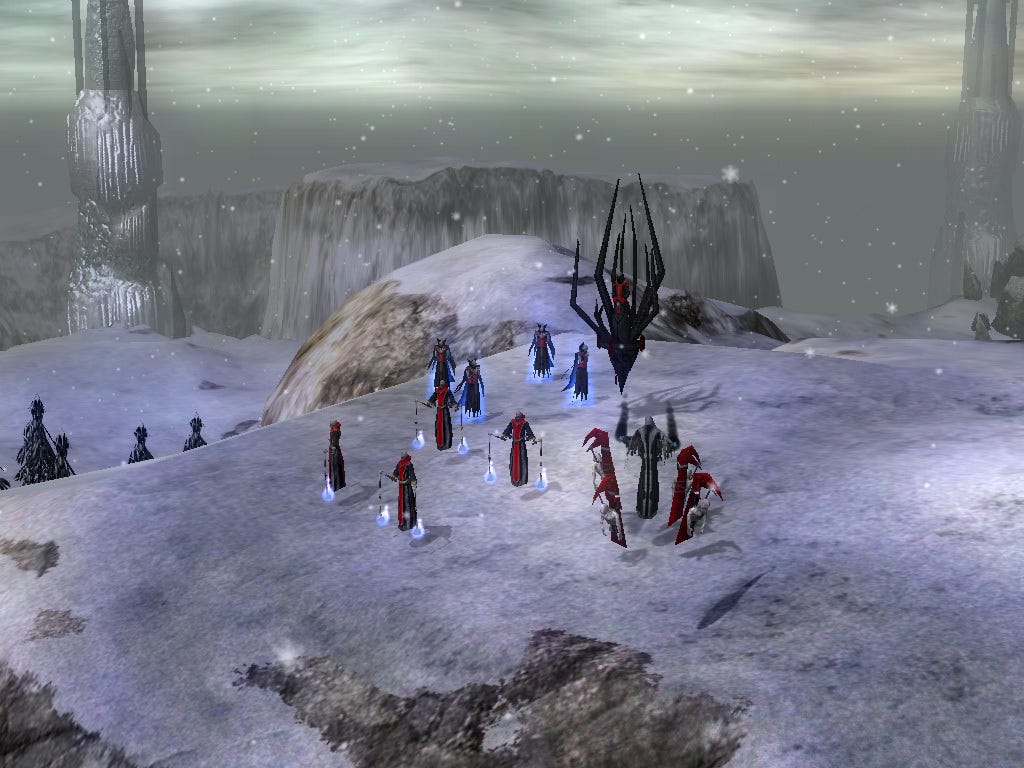
The Nihilim are all magical, evil, and the only race who are meant to move like they're floating.
As we've said, the game makes one massive mistake from the very beginning: not explaining a damn thing. You're given a choice of three races and there's the usual poorly written, slightly illiterate translation explaining their differences. Nowhere does it say that you can't change faction without starting a new account or waiting for the era to end (which happened yesterday, the 14th), so most people will only ever experience one race. There is one badly organised FAQ, a forum thread that explains half of the game mechanics and the rest is up for you to discover. Oh, and that mess of a tutorial. As you go through it, you learn about combat, get an inkling about building buildings... and are left with no clue whatsoever about crafting.
There is crafting in the game, but nowhere is it explained how you get to it. Having played the game for a month now I've asked in my Convergence forum, in the general forum, I've read the FAQ, the manual... I've got an inkling that you unlock it through PVP but that's it. I've found the right page in the management section and pressed all the right buttons, but I'm endlessly given error messages. Not that it matters because, as a non-premium player, I can't sell anything I make anyway.
So this bipolar game is split between an ugly 3D interface where you move across the land, battling PVE foes or take part in pretty meaningless battles against PVPers, and a more-fun web interface where you manage building your forces and buildings, trade and deal with the Convergences - loose alliances of players that are mandatory for PVP and crafting, but seem to have little social benefit; you simply have to belong to one to access those areas.
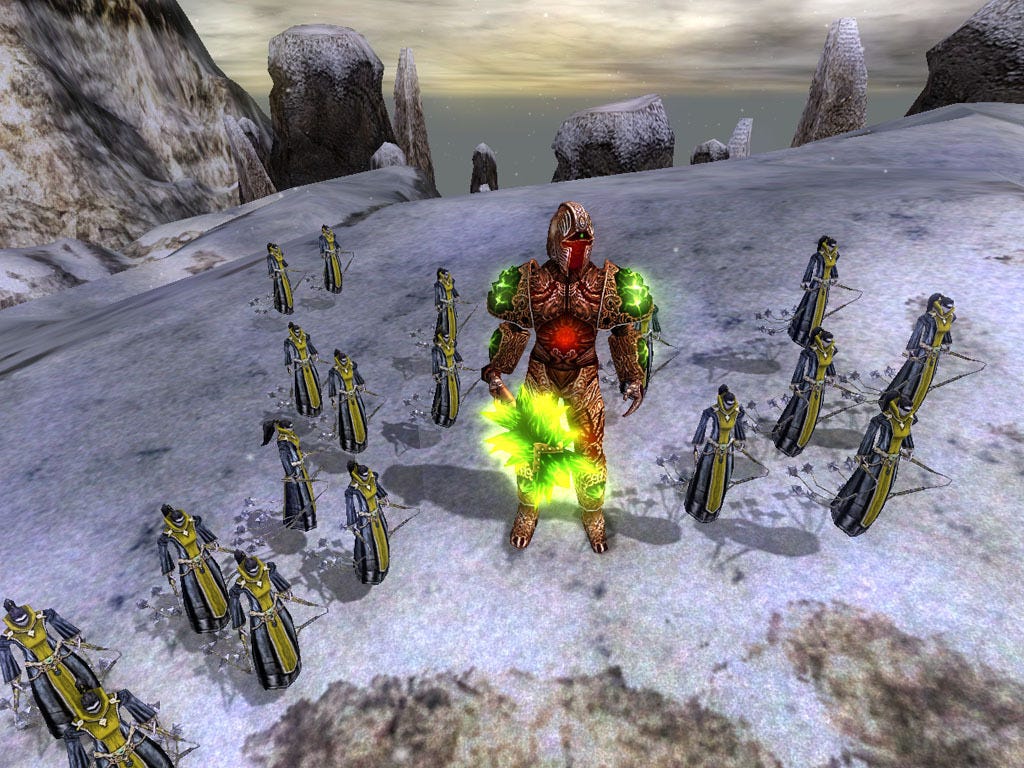
Armour upgrades are mostly bought through real money.
As you battle across the world, fighting progressively tougher enemies in a sub-Total War 3D engine, your PVP and PVE forces get tougher, your buildings upgrade through a fairly complex mechanic involving many resources, the most important of which are gnosis, which increases your population; soul shards, that are a form of currency; and tribute, a premium form of currency available almost totally through a micro-payment system. (Grind your egalitarian teeth here; you are going lose out a bit to people who are willing or able to shell out cash for better gear and upgraded Dreamlords. It seems the concept of a level playing field has gone the way of the school playing field.)
The game is driven forward by a cycle of grinding PVE or PVP enemies which grants you gnosis, which expands your population, which allows you to research more technologies, unlocking better troops and giving your Dreamlord experience, which upgrades and unlocks more stuff, so you can grind higher-level enemies for bigger rewards. At the end of the roughly quarterly eras, your city is destroyed, along with all your troop, buildings, gear and whatnot, and you can choose a new race and start again; your dreamlord retains its experience, so the longer-term game is focused in unlocking more traits for him. Notably it's much easier to do this if you're willing to pour real money into buying tribute, which allows you to buy experience and equipment.
The fundamental flaw of most current examples of the MMORTS is that it has to somehow combine rewarding rapid button-pressing and time-critical action from the RTS/RTT side with resource-management and persistent empire building, which can't be allowed to unfairly punish competitors that might be offline or destroy enough of someone's forces that they don't want to play anymore. Which means that the effects of PVP combat have to be either entirely consensual (taking the point out of an always-on game) or be backed up by AI defences (taking the point out of it being a multiplayer game). Dreamlords has gone for the former, accompanied by era restarts every few months, as a form of temporary rebalancing and also has that solo game you play in parallel to the PVP.
There's a very limited selection of troop types for each side, though they can be upgraded and differently equipped.
Moreover, the rudimentary combat simply isn't exciting. You have to molly-coddle your troops around the place and tough battles can be won by playing around with the stupidity of the system; thankfully, it's in a permanent state of rebalancing, but the first era was overbalanced towards the beast faction. Far from being massive, it's actually tiny; much of the time is spent fighting (dumb, tactic-free) AI enemies where the challenge comes from working out if your level is high enough to kill everything on the map or not, and the most people you can fight in PVP is one.
Yes, there are lots of people to fight; but there are lots of people to fight on Battle.net and that doesn't make StarCraft an MMO. Yes, Convergences give you the impression of a guild, but you can't actually do anything together. There are slightly different tactics in PVP and there are different tech trees to explore to improve your performance in that, but it mostly comes down to your current tech level (which restricts who you can fight anyway) and your willingness to gamble troops (who'll die permanently if you lose too many of them).
As you can see from the screenshots, the game lacks graphical polish. The 3D graphics are somewhere between the old, old Warhammer: Dark Omen and Rome: Total War, though without the hyperbolic flair of the former or the historical accuracy of the latter. Animation is clunky, units glide across the landscape, and modern special effects are superimposed on a low-poly, dull-looking environment. Let's move on.
A bit like a fantasy version of Material girl, if the material in question was Kryptonite.
I've laid into Dreamlords a lot here, so here's the core criticisms again: there's more rewarding and fun game mechanics down your local garage and this actually feels like a step-back from story-led RPG/RTTs like Dark Omen. It misses all the advances in GUI and graphical flair that modern RTSes like Supreme Commander and Company of Heroes have introduced. The paid-for system makes non-payers into second-class citizens, much like Archlord promised to do Back In The Day. It's not great to look at. The MMO side doesn't add much except an opportunity for micropayments and is pretty much a glorified multiplayer mode.
What's good about it? The research system and the online city management is fun. It's very low-spec. Um. The script isn't too bad. It's free (except if you want to buy an advantage through a premium account), so even if the tone of this review puts you off, you can still try it.
At the moment, with nearly all mainstream genres as stagnant as The Butte Pool, it's nice to see people still trying to innovate, but sadly Dreamlords falls way behind the equally-free efforts of, say, Armor Games. A better interface, higher-spec graphics, more compelling combat and a level-playing field for subscribers and non-subscribers might encourage us to play. This mixture of confusion and bare futility doesn't.
4 / 10
