Disciples III: Renaissance Review

Matthew, Orc, Luke and John.

Version tested: PC

I'd love to be able to start this review by telling you about the time in Mission 4 I was held hostage by a talking codpiece, or the bit in Mission 7 where I fought undead tapeworms inside the gut of a flatulent troll princess. Sadly, I can't. Nothing anywhere near that anecdote-worthy happened to me. Though Disciples III is mechanically very similar to the fabulous King's Bounty, it doesn't have any of that game's wit, energy or quirkiness.

That isn't to say it's not deserving of your precious time. Disciples III's face might be po, its laces strait, but only the most ardent fantasy hater or inflexible Heroes of Might and Magic aficionado could actively dislike its hearty turn-based mixed grill of exploration, character cultivation and hex warfare.

Whether you're playing one of the trio of hefty campaigns, the hot-seat multiplayer or the lone single scenario, you start off feeble, ill-equipped, and surrounded by darkness. Level maps are crammed with SSSSSSIs (Sites of Special Sword, Sorcery, Stat or Supply Interest). Creep camps, resource-producing settlements, loot hordes, buff buildings, and crawlable dungeons... you can't move your party ten paces without them stumbling on something clickable.

As you push deeper into terra incognita, neutralising opposition and claiming the all-important guardian nodes, the stone and gold necessary to recruit new personnel and build city structures streams into your storehouses. The mana required to learn and cast spells and create runes also accrues. Before you know it, you're leading a gang of strutting toughs with more hitpoints than they know what to do with and scoffing haughtily at the thugs, wolves, and giant spiders that once turned your blood to ice.
1

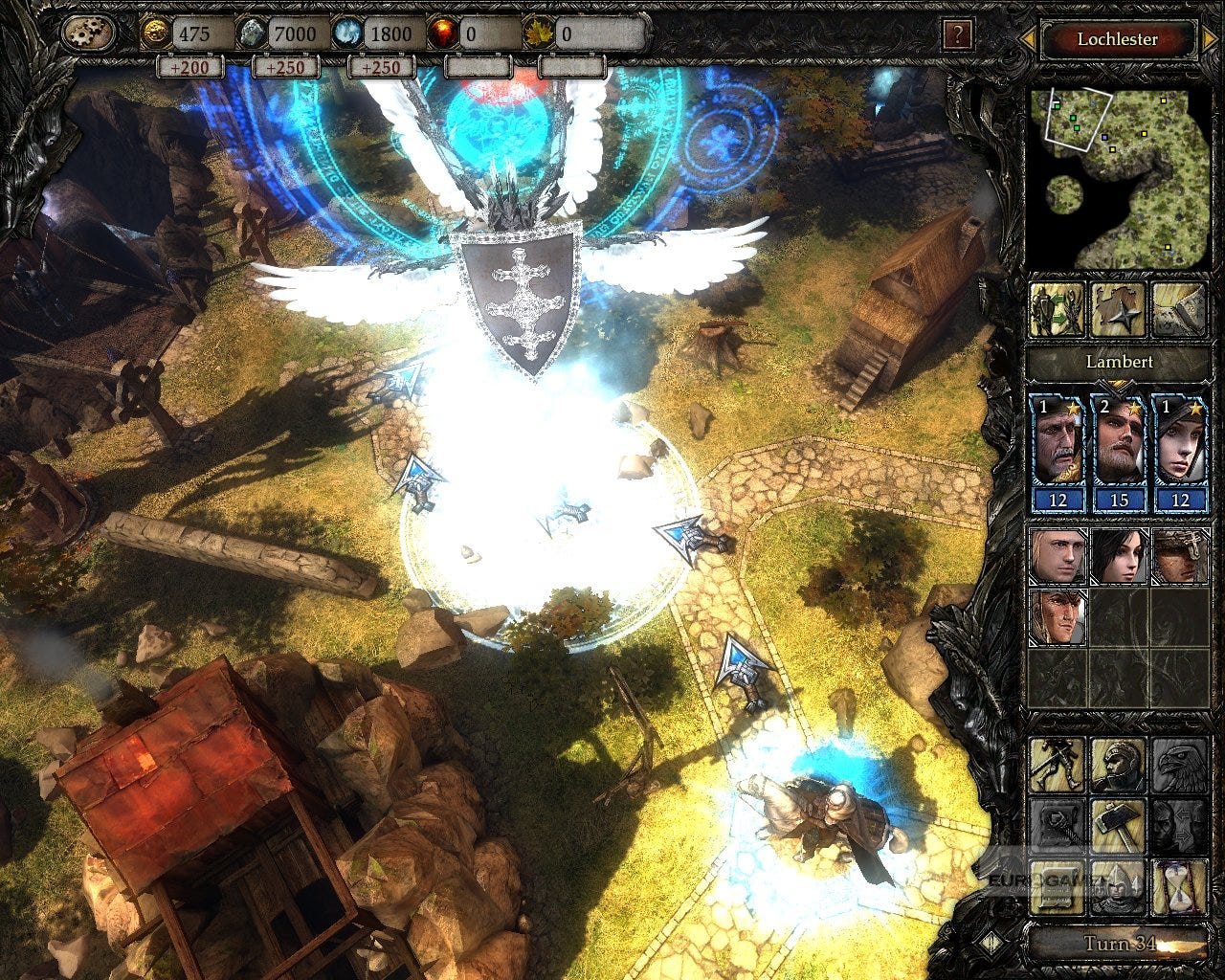
Angels, inquisitors and warrior nuns reinforce the religious vibe.

Of course, by this time, those thugs, wolves and giant spiders aren't nearly as common as they once were. Their place has been taken by armoured trolls, stiletto-twirling inquisitors and shambling demons the size of bungalows. Playing the campaign on the standard difficulty setting, you might coast for an hour or two on occasion, effortlessly slaying everything that crosses your path, but a tightly straitjacketed storyline means tricky encounters can't be sidestepped forever.

For every battle in which you confidently press the auto-combat button and nip off to the Bog of Piney Freshness, there's one in which you're glued to your seat, nervously shuffling forces, preying for critical hits, and vainly scouring your inventory for heal elixirs and runes of stone golem summoning.

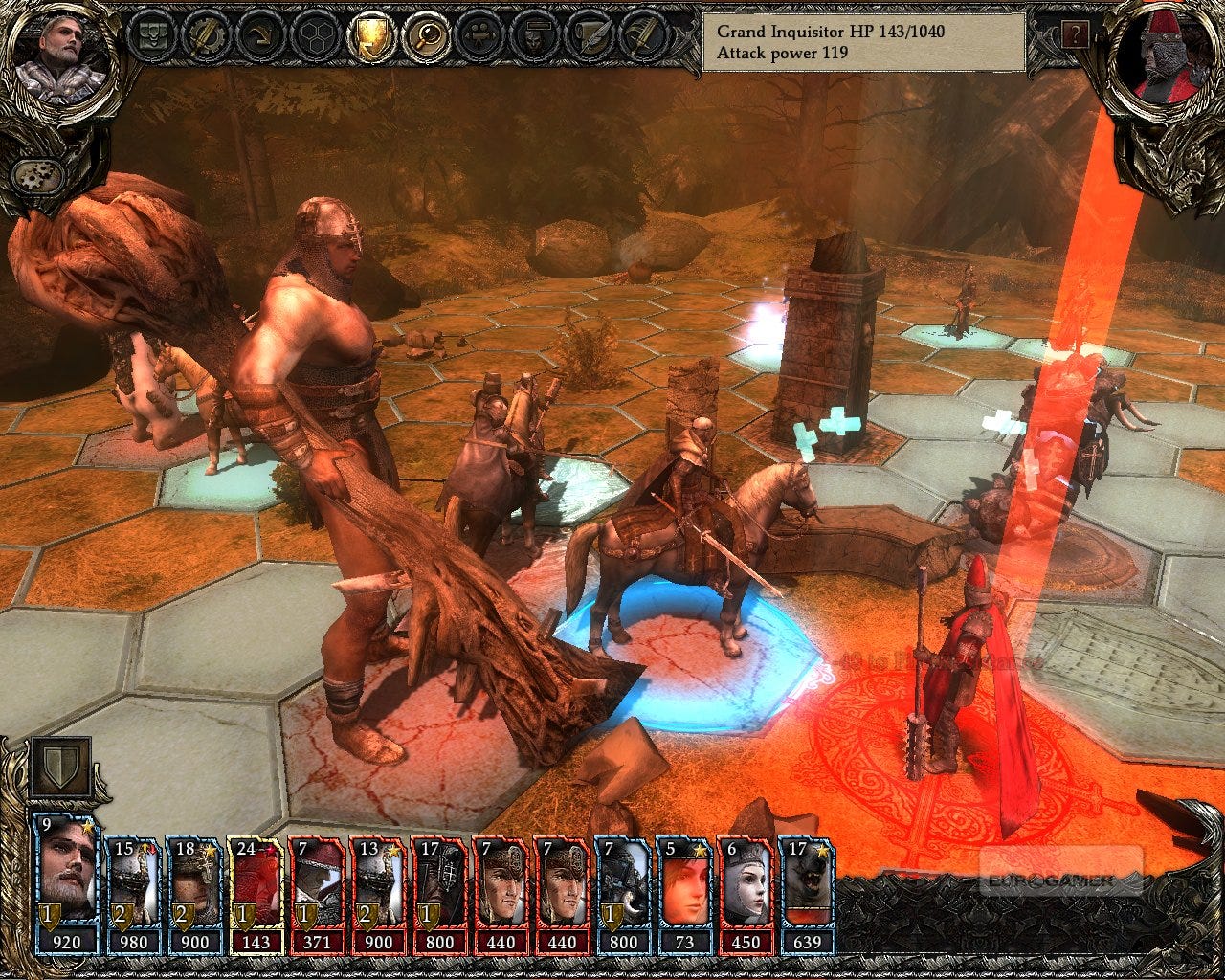
For Disciples disciples, the most welcome aspect of the Renaissance renaissance has to be the revamped combat system. Gone is the old 12-square chessboard with its static pieces; in its place is a 117-cell hex-grid on which units can roam at will. Should I try to get my titan onto that melee-boosting hotspot in the centre of the arena, or keep him close to my vulnerable acolyte? Should I block that causeway between the boulders with a summoned elemental or rush everyone forward in an attempt to overwhelm their archers? Every battle is strewn with testing tactical dilemmas. Enemy AI could be sharper - its target choice and use of advantageous terrain isn't always brilliant - but the stiffness of the opposition frequently masks the shortcomings.
2

The titan's earthquake power is a fine way to finish off several severely wounded foes.

As someone that plays more wargames than RPGs, I would like to have seen a tad more realism in the battle layer, and a touch less reverence to genre convention. Large rocks and combatants block movement but not missile fire, AI retreats are rare, and the grievously wounded seem as capable of delivering fatal blows as the fighting fit.

I'd also like to have seen more varied arenas and spectacular special abilities. Though the character animations are generally superb - watching a titan swat a goblin with a tree-trunk club never gets old - and the spell effects sumptuous, there's nothing here to rival the baroque splendour of King's Bounty's Spirits of Rage.

King's Bounty also offered more freedom. In Disciples III, the scripter's dagger-point is frequently at your throat. In the human campaign (there are also elf and demon sequences), you're tasked with protecting a mysterious celestial agent from the attentions of an over-enthusiastic Inquisition. You swear never to leave the lady's side, but a few turns later are forced, by the campaign writer, to hand her over without a fight. It's an annoying moment - an emasculating one - and totally at odds with the spirit of a true RPG. Opportunities for involving moral choices come and go while you look on, unconsulted and miffed.

Fortunately, outside of the story, there are lots of chances to stamp your personality onto proceedings. Each of the 19 campaign levels starts with the player assigned to a home city. What buildings you choose to construct in this settlement determines how party recruits upgrade.

You also get very fine control over your heroes. At any one time you can have up to three hero-led parties scampering about a map. When leaders level up, there are points to spend on attributes and new skills. Instead of a conventional tree, the latter are arranged on an irregular, maze-like grid (different for each class), meaning choices are far from simple.

3

As usual, you can binge-drink potions without fear of side-effects.

Spellbooks and inventories provide further opportunities for customisation. Every turn, assuming you've got the requisite resources, you can learn and cast one spell (or two, if you've picked a magical character class). The fact that offensive bombshells like Heavenly Fury can be used on the level map means you come to rely on them as standard pre-combat softening-up steps. Spotted a gang of giants guarding a stat-boosting well? Stonk them with a divine bombardment then move in for the hexy melee. After coming to rely on such tactics, it comes as a bit of a shock when the campaign scripter hurls an unavoidable ambush at you, or one of your parties gets bushwhacked by a wandering enemy.

Ah yes, that's another important way in which Disciples III differs from its more colourful and unhinged peer. While neutral opponents sit tight at their assigned locations (usually guarding something or blocking a route) there's generally an enemy faction in play, which, like you, is trying to grab guardian nodes. While it doesn't always go about this particularly sensibly, the threat does add another ingredient to the strategic tasty stew.

Can a game be both a "tasty strategic stew" and a "hearty turn-based mixed grill"? Probably not. Whatever meaty meal Disciples III most closely resembles, one things for sure: there's enough of it in the box to feed a multitude. I've spent more time contentedly slaughtering my way through one of the campaign levels in this game than I did contentedly slaughtering my way through the entire campaign in the last thing I played. There's weeks of solid strategic sustenance here, and, surprisingly, the story that underpins it isn't complete hogwash.

4

Autumn in Nevendaar. A time of mellow fruitfulness, reflection, and stabbing.

Though it involves some extremely tired tropes (demonic taint infecting the land, old interracial alliances reforged...) and is narrated by a chap who sounds in urgent need of caffeine, mystery and quasi-religious menace is injected regularly enough to keep plot wheels turning in their ruts. Developments are conveyed through text pop-ups, which is a slight shame, as going on the evidence of the handsome load screens and character portraits, Akella's artists could have executed some stunning cut-scene art.

Recommending a game as satisfying and substantial as Disciples III is easy. Recommending it over other satisfying and substantial titles encamped in the same neck-of-the-genre-woods is a little trickier, especially when those titles are now as cheap as, say, Heroes of Might and Magic V. What I can't bring myself to do, under any circumstances, is seriously suggest anyone buys this game before sampling the dippy delights of King's Bounty.

7 / 10

Read the Eurogamer.net scoring policy

Comments (111)

Comments for this article are now closed, but please feel free to continue chatting on the forum!

  • Loading...hold tight!