Tech Interview: LittleBigPlanet 2

Alex Evans on building a platform for games.

In Digital Foundry's last Saturday feature before the onslaught of E3, we talk to one of Media Molecule's tech masterminds, Alex Evans, about the origins of the company's association with Sony and how they got to grips with unique PlayStation 3 architecture.

We also go in-depth on the make-up of the proprietary engines that power both LittleBigPlanet and its forthcoming, hugely anticipated sequel.

It's a frank, candid and in-depth technical discussion about what is clearly something of a singular release, revealing a mine of hitherto unknown information about one of Sony's best-loved first party franchises.

Bearing in mind the insanity that takes grip across the games industry just prior to E3, we'd like to take time out to thank Alex for giving us so much of his time in what was clearly a very busy time for him.

Interview by David Coombes and Richard Leadbetter.

Digital Foundry: So let's go back to the beginning of Media Molecule and LittleBigPlanet. Why PlayStation and why Sony exclusive?

Alex Evans: Way back indeed! When Mark [Healey], Dave [Smith], Kareem [Ettouney] and I were first debating starting a studio, the only real consensus we had was the idea of 'creative gaming' - something that engaged the player in the joy of creation. But beyond that, we wanted as many constraints as we could - we're naturally over-the-top, too-many-ideas-to-fit-in people, so constraints are incredibly motivating and constructive.

One of the first constraints was a small team, making a AAA game. For me, technically, already having chosen that we would build all tech from scratch, that meant that cross-platform would be too much of a distraction. Which narrowed the field to three really!

We were already talking to someone about doing something small - we'd just finished Rag Doll Kung Fu - but it was when our 45-minute slot with Phil Harrison took three hours and he totally challenged us in amazing ways and 'got' it (most of those challenges we have yet to fully realise, to give you an idea how forward-thinking and inspirational that meeting was) - that was when we knew we'd found the right partner.

So the two-word answer to that question could have been 'Phil Harrison'. But also, the fabled 'power of PS3' was very appealing prospect. The prevailing wind back in 2006 was that nobody would be building tech, you'd be licensing it, but nobody had good PS3 tech back then. So we immediately were on a level playing field with everyone else, despite not having a line of code. A wonderful prospect for any serially over-ambitious tech programmer...

Digital Foundry: We're assuming that LittleBigPlanet was your very first experience with PlayStation 3. If that's the case, what kind of research did you carry out on the system? How did it differ from what you were used to, and what were your key challenges?

Alex Evans: Research-wise, we just dove in. I knew that we'd have these six SPU processors, and I'd heard rumours (incorrect in detail, helpful in spirit) that the vertex pipe was weak on the GPU. That doesn't really count as research, but it was enough of a nudge to just force us to build an engine where all the vertices are pushed through SPU.

It gave us a familiar set of problems - skinning and cloth - that we knew how to solve in a parallel way, and a great way to learn how to use the SPU. Anton [Kirczenow - senior programmer] takes all the credit there - he's amazing at getting beautiful stuff up and running with the minimum of fuss.

Beyond that we just got down to coding as fast as we could - we only had six months to prove ourselves, and we'd decided (unconventionally for Sony at the time, I believe) that the green-light build would be a fully playable 'vertical slice'.
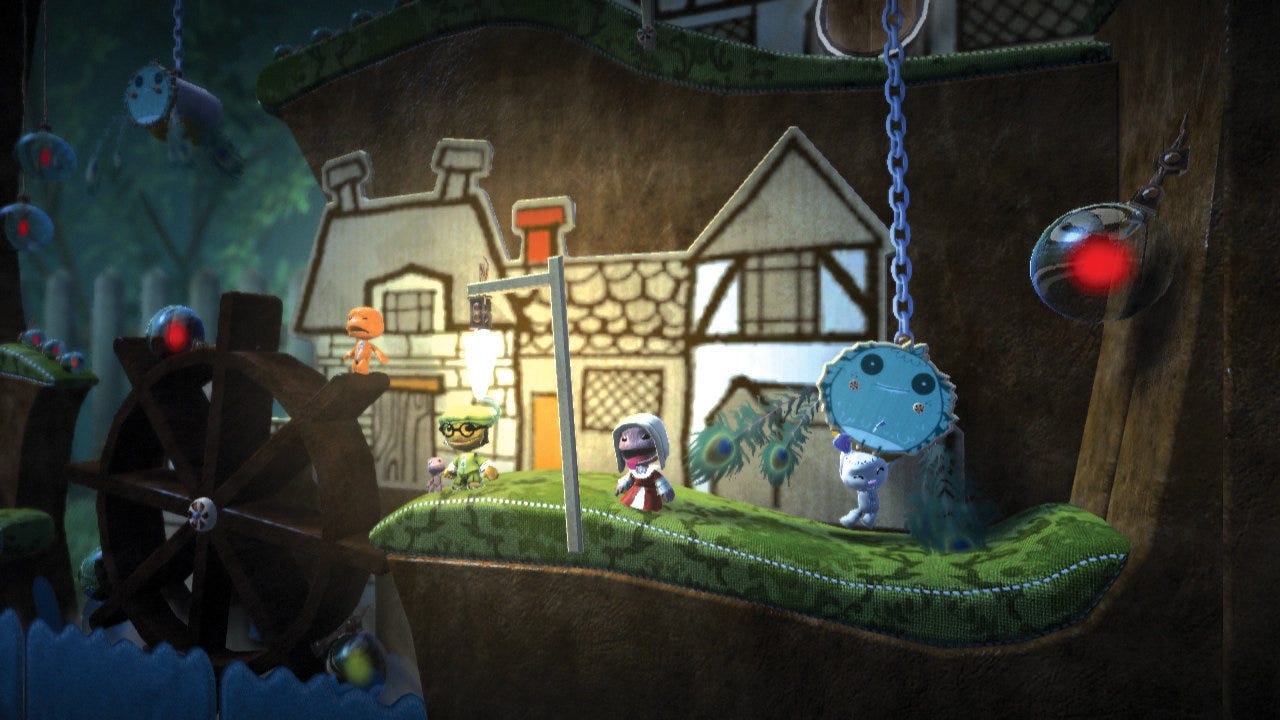
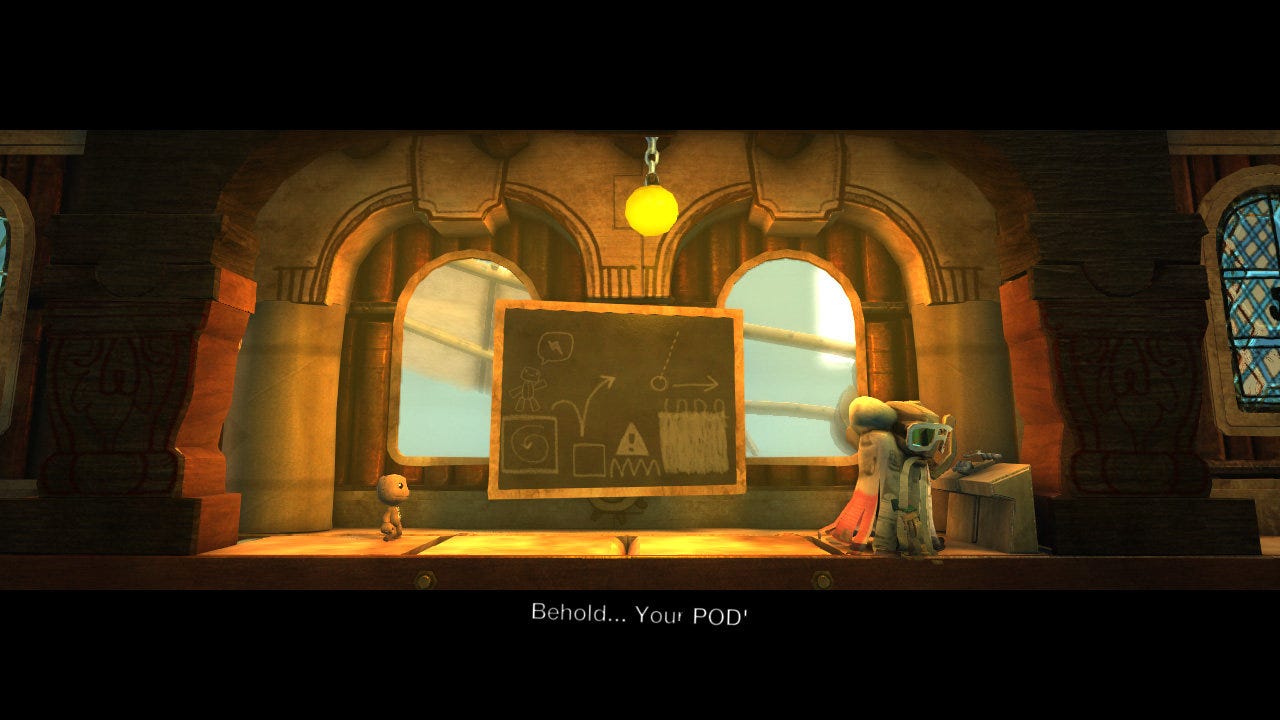
Digital Foundry: LBP made a show-stopping appearance at GDC 2007 not least because of its phenomenal 'next-gen' visuals. Before you left Lionhead to form Media Molecule, you were toying with a real-time lighting engine you called irradiance slices. Was it always your intention to create a game using this technology, creating a title with a signature look, and was LBP its first application?

Alex Evans: No, the irradiance slices wasn't really a motivating factor in the look of LBP. However, the philosophy of algorithms or techniques that operate in world space rather than screen space or over vertices really appealed to me.

Artistically, I wanted LBP to tick all the 'next-gen' boxes of 2006/7 - heavy, characterful bokeh, stylised motion blur. Mark and I worked well as artist/coder and we developed a way to really layer lots of small textures at different scales to give very tactile, 'small' look, and then under the hood, I really wanted to keep the tech as uniform as possible.

I hate anything, as a matter of taste, that operates at the 'per object' level, or has arbitrary limits like 'oh you can have two hero lights and then the rest is baked into an SH probe' or 'oh we'll just lightmap everything'.

Of course, these are normally the most practical and tried-and-tested techniques, but I'd set myself a goal of just trying to do things differently, for the sake of it, preferably in the spirit of minimal code, maximally simple algorithm, even if it becomes 'uniformly slow' as opposed to 'lots of weird corner cases where it will suddenly slow down in this odd configuration'.

That's especially important for UGC [user generated content], where your designers are not sitting next to the tech team to be told what not to do.

Comments (14) Latest comment 2 years ago

Comments threads automatically close after 30 days, but please feel free to continue chatting on the forum!

  • HokutoNoKen #1 2 years ago

    Awesome stuff !!!

    / Ken
  • flanker22 #2 2 years ago

    just ridiculous how DF constantly gets bashed on for being biased when awesome articles like this are frequently written. yet not a single person would admit they were wrong because we live in a generation of fucktard.
  • Alkeno #3 2 years ago

    It's quite a revealing article. Alex mostly avoided tech talk and gave some nice ideas at how they work at MediaMolecule... and it's funny to see they almost have an amateur-ish way of doing things, lots of trial and error and even some pretty lame mistakes taken straight from the "managing files for dummies" book (a flat directory tree???? You kidding me...)

    But I guess doing a lighthearted game such as Little Big Planet takes this kind of approach, guess you can't expect guys from seriously-managed and structured studios to take the minimalistic approach and do some plain creative stuff.
  • RandomTerrain #4 2 years ago

    Nice interview! Didn't understand a lot of the tech talk admittedly, but it sounds like they're doing all the right things, and enjoying themselves too, which is always good for motivation. Looking forward to the sequel. :o)
  • berryl227 #5 2 years ago

    top article and interview! Really dont understand the bashing LBP got from some people. really looking forward to the sequal and the levels the community come up with. In particular I wonder if the narrative tools which have been mentioned previously improve the 'story telling' aspect of the levels
  • FirewalkR #6 2 years ago

    Fantastic interview of a phenomenally talented developer.
    Edited by 1 at 12/06/10 @ 16:13
  • Omroth #7 2 years ago

    Great interview - much more open and interesting than most.
  • My1stLoveJak #8 2 years ago

    "In the end, the players and creators seem to like it!"

    Darn right, we do! Little Big Planet has got to be the most important game for this console generation, in my mind. User-generated content is simply brilliant, but LBP also has an amazing single-player experience, as well. You get the best of both worlds, the talent of the developers on showcase as well as the shared creativity of the userbase. If I could only have one game, it would be Little Big Planet...or LBP 2, when it comes out!!!
  • trubadman #9 2 years ago

    Excellent article!
  • Silvergun-Blue #10 2 years ago

    "Digital Foundry: So players will be able to import their old levels directly into LBP2 and improve them with all the new features you've added to the editor?"

    "Alex Evans: Yes."

    Now THAT'S how you do a fucking sequel !!!

    I can't even put into words how much respect I have for this studio and what they have created here.
  • Silvergun-Blue #11 2 years ago

    @ My!stLoveJak

    " Little Big Planet has got to be the most important game for this console generation"

    I could not agree with you more. I personally think that LittleBigPlanet was the first, and possibly still the only true next gen game this console generation.

    It seems a frivolous and trivial game at a casual glance, but the ambition behind it is truly staggering.

  • Eighthours #12 2 years ago

    Should have asked Alex about the floaty jump that completely ruined the gameplay in the first game for me and many others, but I'm very optimistic for LBP2. With lessons learnt, should be incredible.
  • curtlikesmeat #13 2 years ago

    I think they said the floaty jump is fixed for 2 (not that I minded it) - well, not fixed, but apparently you can tune the jump to suit your tastes.
  • man.the.king #14 2 years ago

    I look at this interview, and thank the Gods that it was Rich Leadbetter interviewing Evans, and not Ellie with all her oh-I-am-being-witty-at-your-expense non-jokes.

    As others on here have commented, superb interview, good questions, and excellent, fascinating answers.