Diablo III

A tale of four classes.

Blizzard says it's focusing on character class reveals for Diablo III - like the recent unveiling of the Monk at BlizzCon - because "seeing a guy running around exploding people" offers the most bang per buck, and conveniently avoids story spoilers to boot. That's logical - but it's hard not to think that there's something more to it.

For all that we're promised a more fully realised world and a richer questing and storytelling experience in this sequel, there's definitely an extent to which, in Diablo games, the classes are the content. Sky-high level caps and ocean-deep customisation make each one an epic journey in itself. The randomised dungeons are a canvas for their self-expressive slaughter; the monster designs a counterpoint to their spectacular skills; the multiplayer a lab to experiment with their interactions; the difficulty levels and ladder play a stress-test for their design. Diablo games are simple, immediate action-RPGs on the surface, but the classes turn them into bottomless wells to plumb, and they have tempted countless Diablo II players into countless replays.

Diablo III certainly won't be any different in that respect - but the classes themselves, and therefore everything you can assume about the game itself, certainly will be. Of the four classes revealed so far, only the Barbarian returns from the previous game, and even that monster-smashing brute is transformed by more sophisticated skills and a resource system that's all about momentum. The Wizard, Witch Doctor and Monk move progressively further and further away from Diablo tradition and standard RPG archetypes into a world where you find designers name-checking Street Fighter and God of War.
1

Monk-y magic.

There are still many things we don't know about Diablo III: how the rune skill customisation system will work (it wasn't in the build of the game at BlizzCon, as the designers are still iterating on this terrifyingly flexible feature); how randomised events will spice up the more carefully-crafted "overworld"; what form player-versus-player combat will take; and what the Battle.net online feature set will be (although, after the example set by StarCraft II, expectations are very high indeed). But the game is defined by its classes, and all four were available to play over a very extensive demo at BlizzCon. So I hogged a terminal for as long as I dared to delve into each one, and discussed them in detail with lead world designer Leonard Boyarsky and lead designer Jay Wilson. This is what I found.

The Monk

Boyarsky: "They're really religious holy men, they are raised from childhood in secluded monasteries where they are taught to be pure expressions of their deities through perfection of their fighting techniques. They have 1001 gods and they go so far as to tattoo a symbolic representation of them all over their backs, it's this intricate design and it takes their whole life to complete... When they're not fighting they're training to fight, they spend their time in deep meditation to cleanse sin from themselves... They're equally feared and respected, even by their own citizens, because they are a little bit - you know, they dedicate their whole lives to this. The guy who dedicates his whole life to fighting in the service of God is not a guy you want to see coming down the street for you."

Wilson: "One of the things that we're really excited about with that class is the contradiction of a melee class who is fragile, who has this really high-risk placement. A character who can also have a little bit more diversity than the Barbarian in that we can use magic, we can use a broader range of defensive skills and really focus on speed... We're also really focusing on the idea of making a fighting game character. Something that would probably hold more to, say, God of War or Street Fighter than Warcraft or Diablo II."

2

Not a monk, but that statue's wearing sandals.

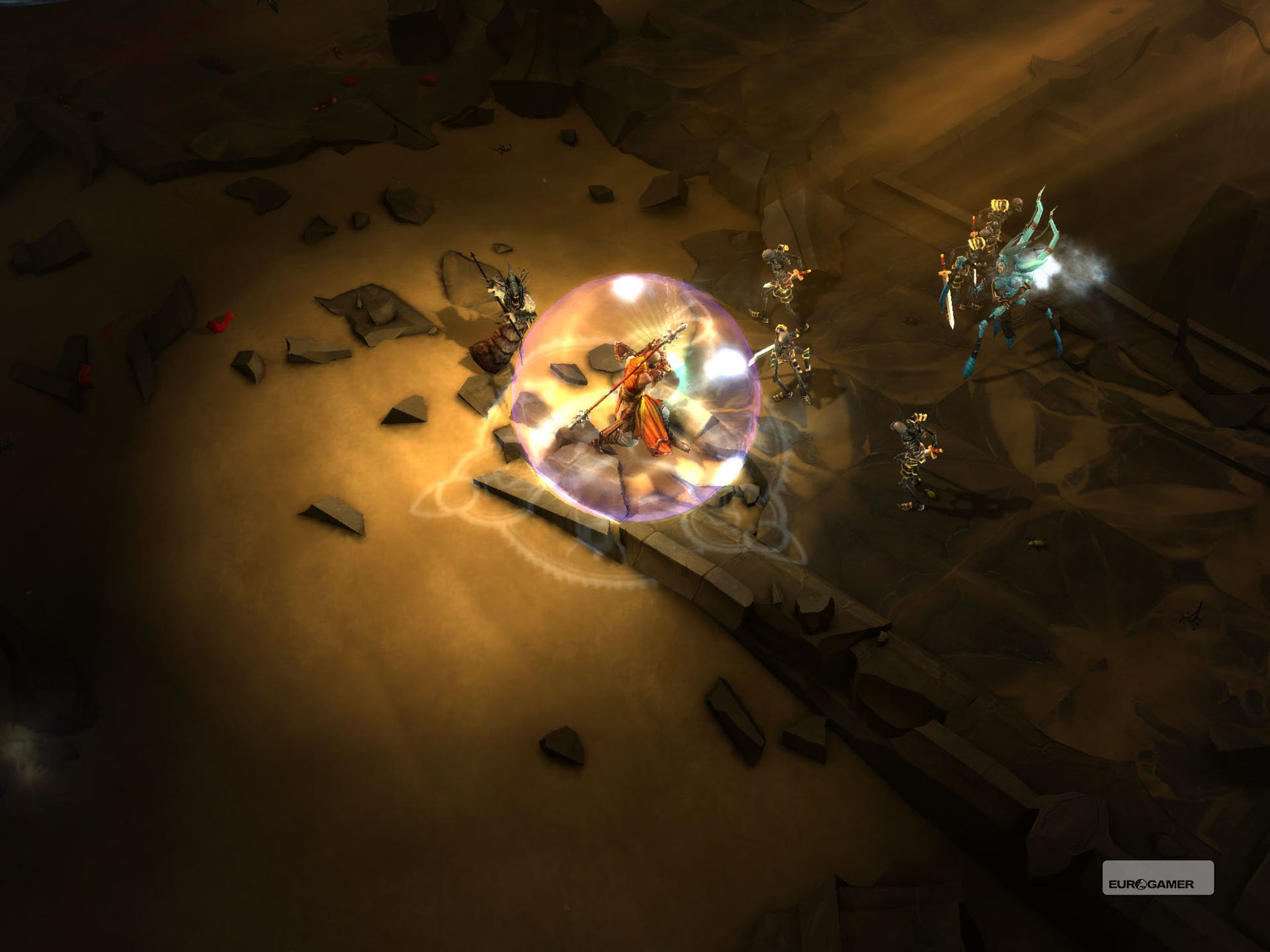
A combo-driven brawler you control with a mouse? A close-range fighter with hardly any more armour than a ranged spellcaster? A holy warrior who is looks like a Latvian crusader and moves like a Shaolin disciple? The Monk sounds like a mess of contradictions, but the only mess he makes is by punching enemies so hard their hearts explode.

The fighting-game influence is partly, but not purely, stylistic. The Monk's lightning-speed rampages are defined by exaggerated Shaw Brothers sound effects, sudden frame-jumps, dash-lines and even 2D cutouts when you trigger Seven-sided Strike, a skill that teleports him around a group of enemies in quick succession to hit each one. But it's also about how crisp and precise he is to control, how immediately his blows land - a logical but still extreme extension of the button-mashing Diablo play-style, where reflexes matter more than juggling cooldowns.

And it's about combos. Although his resource system is currently a standard pool of magic-user mana, the Monk is defined by combos. His core physical attacks all come in three stages, each activated by a subsequent click. Way of the Hundred Fists' dash attack segues into a flurry of blows into huge area-of-effect blast; the Exploding Palm chain ends in a damage-over-time bleed effect that, if the enemy dies while it's still applied, will start a messy chain reaction of bloody explosions. But the combo counter is global across the skills, so you can mix-and-match the effects of two or (if you're quick with hotkeys) three chains, much like hot-swapping weapons mid-combo in God of War.

It's a very clever way to mix up the rather repetitious hammering of Diablo melee combat, and to give the Monk enough tools to survive the huge scrums of demons that roam the sand-blown desert locale of this demo, despite his low defences. He'll take some mastering though, initial impressions being of a chaotic, frantic scramble to stay on the knife-edge when things get busy. With the emphasis moving off potions (still in the game, but expensive and for sparing use) and on to health drops, you need to stay in the fray to stay alive, so I move on to the thick-skinned Barbarian for a more leisurely exploration of the demo.

The Barbarian

Wilson: "We really tried to amp the Barbarian up from not just being a dude who swings a weapon. We really tried to build a lot of really interesting, cool attack skills in there - seismic slam, cleave, these are all kind of massive physical attacks that can damage over a large area... [The Fury resource system] puts some interesting choices in the class that really could be the most humdrum. There is a certain design philosophy behind the Barbarian, though, that he is for the players who want to wade in to combat, they want to be really tough and resilient and take a lot of incoming damage, and so a lot his skills play into that as well. He can debuff enemies, he can recover health, he's just flat-out tougher."

3

Barbarians still think Ugg boots are fashionable.

He certainly is that. Although Wilson personally thinks the Witch Doctor is the easiest class to play currently, my survival rate is highest with this murderous juggernaut, perhaps because he's the easiest to grasp at this low level (around level 12). The corollary is that his skills are the least interesting, consisting mainly of smash one monster, smash many monster, make all monster weak, make self strong.

But as Wilson says, it's the way that those skills play into his Fury resource that give the Barbrain more depth. Like an accelerated version of a World of Warcraft Warrior's rage, Fury is built up by dealing and sustaining damage. It's built up very fast, but only really if you use skills appropriate to your situation - single-target for one-on-one fights, multi-target like Cleave for wading through the crowds. Play mindlessly, and the Barbarian feels somewhat lethargic and unsatisfying. Pay close attention to tactics and context however, and you build up enough Fury that you can spam his show-stopping blows at will, building up unstoppable momentum.

4

Is that bridge made of adobe?

It's clear that even at its most basic, Diablo III has far more to think about, far more mechanical sophistication than its predecessors. "Is it more considered? Yes, that is our goal," says Wilson. "To make a game that... well, we don't want chess. We want an action game. But we do want an action game that does occasionally make you think, challenge you, make you approach a situation in a different way... Creating a combat model that has a bit more depth is I think one of the keys to moving the series forward."

The difference won't be so apparent at Normal difficulty, he says, but on higher settings Diablo III will become more cerebral, rather than just more unforgiving. "One of the things that happened in Diablo II was that they didn't have a lot of options to make the game hard, because they had a player with endless health, that can get away from any situation. The only real option against a player like that, as a designer, is to kill them. That's a terrible device to use against your player. You want them to actually feel the game be hard before they die."

The Witch Doctor

Contrary to Wilson's expectations, I die quite a lot as the Witch Doctor, but that's because it takes me a little while to understand this highly unusual class. The spooky voodoo priest and zombie summoner is neither a classic ranged spellcaster nor even a traditional pet class; his attacks are indirect, but he still needs to get close to the action.

Wilson: "We like for the Witch Doctor to feel almost like he's a conductor in an orchestra. He's got all these things going, all these plates spinning, and that's the real challenge, keeping all those up... The Witch Doctor is: I'm going to set up my pets, I'm going to get all ready, then I'm going to walk them forward, and back off, and poison you and back and lob things in. Unlike the Necromancer [in Diablo II], where the pet was not only main line of defence but also primary damage, so you could kind of just look at your gear while your pets took care of everything. We designed him such that he can't stay too disengaged."

The Witch Doctor's pets - we get to play with Zombie Dogs at this level, a pair of sturdy undead hounds that distract enemies - are completely autonomous, but they hang close to their master. You need to dart dangerously close to deploy them, and perhaps unleash a scourge of poisonous spiders, before pulling back to hurl the glorious but inaccurate flaming skulls. It's almost like micro-managing an RTS raid, and positional play is hugely important. So's tempo; as with all the classes in Diablo III, once you start to feel the rhtythm and experiment with the interplay of skills, the random fracas slowly starts to gel into smooth crescendos of carnage, and demons fall like dominos. If dominos tended to blow up in fountains of gore, that is.

5

The Witch Doctor. Like an angry Carmen Miranda.

There are plenty of opportunities to conduct such symphonic violence in the demo. The quest asks you to follow a path across the desert to a devastated town, and if you do so without leaving it, you'll come across a handful of carefully paced and placed choke-points staffed with tougher demon mobs, punctuating more randomly-strewn cannon-fodder. There's a huge amount of freedom to wander off this beaten path, however, and either side-quests or simple curiosity can lead you into adventures just as long as the path from A to B. The map is scattered with portal entrances to randomised dungeons; escort an NPC to treasure, loot as much as you can before the edifice collapses in five minutes, or just harvest items and XP. Thickly populated with enemies and proudly showing off the extensive destructibility, these feel the most what you expected next-generation Diablo to be like.

The Wizard

Boyarsky: "The Wizard was kind of a child prodigy who comes from a very poor village... This Wizard is very young, she's the youngest of all the classes, she's probably like 19 or 20 years old, doesn't have a lot of experience but she is very very powerful, very talented at what she does, was probably a lot more powerful and smart than a lot of her instructors. She's basically a teenager with a lot of power. She has no religious leanings whatsoever, except she just wants to find out more about how she can wield more power. She could care less about what's actually going on."

Wilson: "The Wizard is really meant to be a classic glass cannon, but I think for me what really makes her interesting is that she's the person with a trick for everything. She's a complete and total master of magic, and so she uses that for everything, for survival, to impede enemies and to damage them as well. She can create illusionary copies of herself, she can turn her skin to stone, she can freeze her enemies in place and even has skills that can combine these ideas."

6

Smell my cheese, you muthas.

It was the Wizard, at the end of the day, that held me spellbound. Every one of these four classes is a unique and highly individual twist on classic RPG ideas; every one of them has a striking balance of thoughtful intricacy with that gluttonous, over-amplified sense of unbridled power that is what Diablo is all about. But none more so than the Wizard.

As Wilson says, the Wizard is a combination of full-bore magical fire-power with a cunning box of defensive tricks. At the level of the demo, she could pull and freeze enemies, slow them around her, distract them with illusions, bomb multiple distant targets with energy or cause devastating close-range damage to a single-target. Unlike most spellcasters, the Wizard isn't just about keeping enemies at a distance, but rather a constant ebb and flow of risk and reward, of cause and effect relative to range, with those health drops as the carrot, spurring you on, keeping you from being too conservative, keeping you on the tipping point.

It's thrilling stuff. In all four classes, even the meat-headed Barbarian, Diablo III is playing subtle games with the expected dynamics, without ever sacrificing the frantic forward momentum the series is famous for. In fact, it intensifies it. Maybe the classes only represent the basic building blocks of this game at present - but they already seem like a huge leap forward for the action RPG.

Comments (46)

Comments for this article are now closed, but please feel free to continue chatting on the forum!

  • Loading...hold tight!