"Right now, there's nobody younger than me that I feel threatened by. I haven't met anyone that I felt possesses the skill to surpass me in the future. I'm not over-evaluating myself. I can analytically see their weakness, their ineptitudes."
Daigo Umehara is better at Street Fighter than you and he knows it. Fighting games always bring out the inner show-off, but his is no hollow boast. Earlier this year, the 28-year-old Japanese defeated American champion Justin Wong at the Evolution 2009 Championship to take the Street Fighter IV world title.
Daigo Umehara, it turns out, is better than everyone at Street Fighter.
This victory was just the latest in a long line of high-profile competitive achievements that Umehara (Ume, to his friends) has to his name, the most famous of which is his astonishing comeback against Wong during the 2004 Evolution loser's bracket final. You don't need to understand the intricacies of Street Fighter III's parry system to appreciate that something extraordinary is happening as he bats away each of Wong's potentially lethal attacks before taking the round with a dazzling special move of his own. The crowd's ecstatic reaction, coupled with Umehara's understated demeanour in the face of such deafening adulation, catapulted the clip to YouTube stardom, where it ranks amongst gaming's most famous.
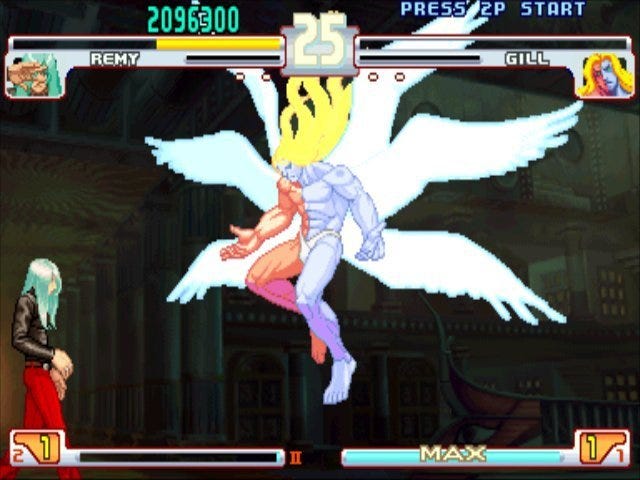
The chances are that if you don't recognise Umehara's name, you will have seen his most famous victory.
Since then, Umehara's fame and reputation has spread through the fighting game community and beyond. He plays with unrivalled precision and grace, combining the reactions of a peak-form Muhammad Ali with the strategy of a Garry Kasparov. He is undoubtedly the greatest Street Fighter player to have played the game.
But his own understanding of his supremacy comes not from the vanity of world championship titles but rather from the measured perception of a giant. "I think, right now, I may well be at my absolute peak," he tells me. "My reactions are probably comparable to when I was younger, but I no longer grow agitated when I'm cornered. Nothing can mentally break me anymore; I have mastered nervousness and tension. I can instantly tell opponents apart and categorise them into groups and types according to their personality and weaknesses. As I haven't felt my physical abilities weakening yet, I think I might be at the peak of my career as a fighting gamer."
Spoken by anyone else, this might come across as supreme arrogance. But while Umehara's known to his fans as "The Beast" (a term he neither coined nor uses himself), his real-life persona ill-fits the nickname. This tall, handsome Japanese is altogether shy and unassuming. In contrast to his American rivals, Umehara shuns the spotlight, rarely giving interviews to the press or meeting fans.
He is a star born in the arcade scene, a dimly lit underground world filled with cigarette butts, bleeping neon lights, cathode-tan boys and the sweat of twitch competition. His digital sport has neither the glamour of boxing nor the ceremony of wrestling: there are no promoters or agents to turn talent into stars in this world. Even if there were, one feels as if Umehara's well-mannered, nice-boy exterior would always mask the inner beast.
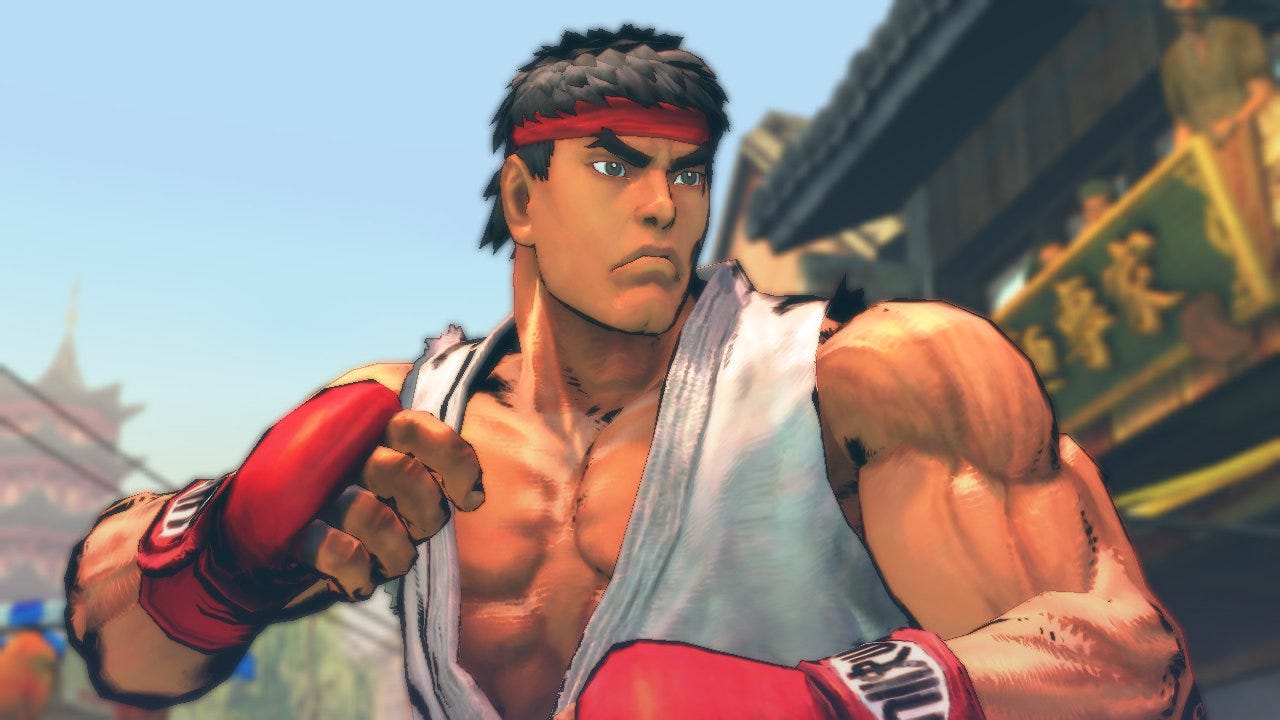
Like Ryu, Umehara proves difficult to track down. (That's Ryu in SF fiction, obviously. Throw a stone online and you'll hit 58 Ryus...)
Umehara is near-impossible to track down. Initially, Capcom suggests I fly to Tokyo, find an arcade where he's playing of an afternoon and sit next to him with a tape recorder. After he declines an invitation to a UK tournament and fails to show up to a meeting we schedule during this year's Tokyo Game Show, Capcom steps in to help organise a cross-continental rendezvous, using one of Umehara's bilingual friends as an intermediary, to put my questions to him.
His reluctance to talk to interviewers coupled with these difficult-to-reach circumstances have contributed to the enigmatic legend that is Umehara. Rumour and speculation follow his every move. When, in 2005, he took a two-year break from the fighting game scene, some fans speculated it was so he could focus his attention on his other love: pachinko. His reactions, so the story goes, are so supernaturally fast that he is able to tilt the odds in his favour far enough to earn a living from what is essentially a game of chance. In truth, Umehara works in the public welfare/health sector by day, following in the footsteps of his parents who both work at a hospital in Aomori, Japan.
"Playing games professionally is not really an option in Japan," he explains. "If I did really want to do something with my gaming skills in the industry, I think I would have already done so by now. It's only relatively recently that I started to receive invitations to overseas tournaments with prize money. In Japan, games are something you play for enjoyment; you don't expect anything in return."
Umehara's older sister, Hoyumi, with whom he'd play Dragon Quest and Final Fantasy from a young age, introduced Umehara to videogames. However, it was when he first visited an arcade that videogames turned from an interest to a passion. "My first visit to an arcade changed my life. It was such a sensational experience. At the time, everyone was playing Street Fighter II. The visual aspects of the game were impressive, but it was the fact I got to play with total strangers and connect with them through the game that enthralled me.
"Now, when I go to an arcade, I now probably fit in the middle to the upper-mid age group in the arcade community. But back then, I was easily the youngest player there. Everyone else was older than me, and I enjoyed talking to and learning different perspectives. A Japanese arcade is such a special place for me. It provided a community to interact with others that I would not have dealt with otherwise and an opportunity to learn from them."
We were always surprised by Capcom's decision not to make sequels to Street Fighter II.
Of course, in Japan videogame arcades aren't burdened with the social stigma of their American and European counterparts. But even so, as a young man from a respectable, middle-class family, I wonder how his parents reacted to his newfound passion, especially when it began to blossom into a vocation. "My parents are very generous, laidback people. My older sister was such a good kid that I think they got the idea that that's how little effort child rearing requires.
"They applied a similar laissez-faire approach to me, but I ended up doing everything opposite of what they wanted. Were they fully supportive of my increasing involvement of videogames? I'd say they were indifferent. They weren't particularly impressed when I started winning tournaments. Other people started looking up to me when I became the Japanese champion, but when I told my parents about my victory, they didn't care much. I think that indifference, and the way they continued to treat me in the exact same way no matter what I achieved, ensured I kept my feet on the ground, and could analyse and focus on myself. Without them, I don't think I'd be where I am."
As anyone who has committed themselves to learning and mastering a competitive fighting game knows, the learning curve leading up to true proficiency is measured in years, not weeks. I ask Umehara how the countless hours spent playing in arcades have affected his life. "When I was most involved in the game, I was in my late teens - which is most important time of life, right? I was playing every single day, at least 10 times the amount that I play now. I only did minimum of other activities. My life was school, sleep and play. Everything revolved around playing games.
The PSP version of Street Fighter Alpha 3. Umehara probably wouldn't touch this with a bargepole.
"It was as though I could not live without them. I had separate friends inside and outside of my game life. When I visited the arcade, I met my game friends. Once I got to know of the different, appealingly mature world of the arcade community, my peer group became so uninteresting. Besides, people with the same interest share a lot of common sensibilities, and naturally it's just so much more fun to hang out with those who share your passions. That is how I slid deeper and deeper into the arcade culture." Despite Umehara's hard work, he failed to qualify for Japan's national championship, the GAMEST Cup, the first time he entered the competition in 1995. Two years later he returned, qualified, and went on to defeat Shin'ya Ōnuki to take the title of national champion.
The following year he won the official Capcom Street Fighter Alpha 3 championship in Japan, which resulted in his first invitation to play overseas in a face-off against the winner of the US championship, Alex Valle, in San Francisco. Umehara won the match two games to one, becoming the Street Fighter world champion at just 16 years old.
"The match against Alex Valle was my first time outside of Japan," he recalls. "Even though I had no idea about the skill level of US players, I sensed that Japanese players would be stronger. For some reason I was confident that I would win, even though I had no solid base for my assumption. I hadn't met any strong foreigners among those who I ran into time to time, and the US joysticks I had seen looked awful, thick at the top and tapered off at the bottom. They just seemed to lack finesse or precision. It was just my hunch that opponents who used such bad sticks could not be better than me.
"I don't think my views were proven wrong. I witnessed it first hand at that tournament how the Japanese players were operating at a higher level than the US players. The Japanese, in my opinion, enjoy a much better fighting game environment with enriched arcade culture to begin with. As such I do think the Japanese have an advantage in fighting games in general."
Despite this, Umehara still prefers Western tournaments to their Japanese counterparts. "I find Western tournaments way more fun than those held in Japan. The players have a sense of ownership of the scene and feel that the tournaments they attend are their event and that they have to take part to make them the best they can be. At least, that's how it appears to me.
By contrast, corporations usually lay on Japanese tournaments. The Japanese players take no responsibility: whatever happens is up to the host or sponsor. Western gamers at tournaments are very enthusiastic and eager to make it a great event because they have ownership. Regardless of the size of the event, none of the Western tournaments I've participated in have disappointed or bored me. I must say that I love the US tournaments best of all: they keep the pride and fighting spirit alive."
"I was not playing much Third Strike at that time." Blimey.
With this in mind, I ask Umehara about his most famous moment at a Western tournament: the Evolution 2004 full parry. "To be honest, I was not playing much Third Strike at that time, but for some reason, I made it to the semi-finals. At the winner's round, I lost against a Japanese player and wasn't at all confident that I could come back through the loser's round.
"I just hadn't played the game much and so lacked that hunger for victory. That helped because I was relaxed when I matched against Justin, as I didn't have anything to lose. At the end of the final game, when I was cornered, I didn't feel overwhelmed. I calmly registered it thinking: 'If I lose here, I guess that's it.' I only realised later about how much incredible enthusiasm, excitement, cheering, and screaming filled the venue. I was so focused that I didn't hear any of that. I had absolutely no idea at the time what was happening around me. After I won, I noticed several Japanese players who were beside me standing and cheering in excitement. That's all I remember from the moment itself. Only when I saw the video clip of the match later, did I realise what really happened there."
Five years on from that moment and the Umehara name has swelled in fame and recognition. But at 28-years-old, Umehara is undeniably one of the older competitors in what has always been a young man's scene. I ask him how he feels about playing fighting games professionally as he grows older.
"I don't really plan ahead. I always go as I please," he says. "I don't have a particular plan or idea of how I want to be, but I do have an idea of what I don't want to be. If I could maintain my skills into my thirties and forties, I wouldn't mind continuing to play professionally. But into my fifties, as I start to see my physical abilities go downhill, I would not want to be jealous of others.
Not Umehara's cup of tea, apparently. Tekken 6, that is - everyone loves a butterfly bikini.
"Looking back my childhood, I devoted all of myself to playing games. I'm the type of person who just loses himself in one thing. I am so bad at balancing myself. I dive in so deep. Since I was a little kid, I would forget myself when I become interested in one thing. That kind of personality is perfectly suited to fighting games. As we grow older, we can see all that has made us become who we are now and, we can better analyse and assess situations.
"So now, when I look at a younger player, I can spot his weakness, like 'his such-and-such is disadvantageous for fighting gameplay'. Everyone I've ever played has some fatal flaw. But you know, personally I enjoy being a challenger more than a titleholder. I definitely would welcome a supreme character's arrival. When he appears, gaming for me will become fun again."
Umehara's expertise is almost entirely limited to Capcom titles, especially the Street Fighter series. I ask him whether he's been tempted to try his hand at other fighting games. "I've always played Street Fighter since the first days I started visiting arcades. To be honest, I don't go to arcades as much as I used to, so I don't feel like picking up a new game series now. The Tekken visuals are appealing, but that's not enough to move me."
And what about Street Fighter IV in particular? "To be honest, though it was visually great, I didn't get an impression that it was very different to what had gone before; I didn't get a sense that it was brand new. I had imagined that the game would be well done, but it wasn't sensational when I actually saw it. It didn't drive me wild with excitement. Rather I only picked it up because it was the latest Street Fighter, and that's what you do."
I ask Umehara if there's anything he'd want to change with the game. "I miss the Guard Clash system. I believe it should be revived. And the throw tech system I think adds to a slower defensive pace. And the new saving system, too, should be tweaked. The addition of the saving system is not harmful as such, but it needs an adjustment because the range of uses is narrow.
"Also, the back-dash is very strong in Street Fighter IV, and the saving, from which a character in defence position throws a move, allows the character to cancel into a back-dash. Too much back-dash slows down the speed of the game, and irritates players. I feel the game should be exciting, but there are too many defensive systems, preventing players from doing damage. The Guard Clash was there to solve that problem. It was such a good system, but for some reason, it got removed.
On Street Fighter IV: "I wanted to see a bit more."
"I know it sounds harsh, but to be honest, if SFIV hadn't come out at this time when fighting games were booming, I don't know if it would have been as successful as it has been. Compared to other Capcom games, I find it a little unrefined. Still, gamers were dying for a new Street Fighter, and it fell on their laps at the right time. I think that the developers were too focused on making a bug-free and character-balanced game.
"Rather than thinking about where to improve, they focused on eliminating the problematic elements. Their intent was not to do something brand new but to avoid creating a bad game. I wanted to see a bit more; a little more of adventurous attitude towards development."
There is a sense in which a player of Umehara's calibre could not exist outside of the arcade scene. No matter how solid a developer's netcode, online competition can't compare with the thrill of sitting down opposite an opponent and fighting it out free of any threat of lag or latency.
Moreover, these pressure-cooker environments allow players to develop at a far quicker rate than over a net connection, where the stakes are necessarily lower by virtue of the detached, remote nature of fights. The news that the next iteration of Street Fighter IV may not be coming to arcades has caused uproar, not least amongst Japanese arcade players, who usually lead the field in exploring the limits of a game and uncovering techniques for the rest of the community to adopt. I ask Umehara for his take on Capcom's controversial decision.
Umehara wishes SSFIV was destined for arcades, but thinks it may be good for the Japanese arcade scene on some level regardless.
"Of course, I am hugely disappointed by the decision," he says. "I wish that Super Street Fighter IV were coming to arcades. There's a chance that those in our community who don't play games at home never get to play the game. That said, I think the younger Street Fighter generation may survive. They don't really go to arcades but play at home. So there is a possibility that we can capture those young gamers and bring them into competitions."
Umehara's tone shifts, revealing sadness for a beloved culture that seems to be slipping away. For all Street Fighter IV's huge popularity in the West, it has done little to reinvigorate the arcade scene that birthed it. Without a healthy, vibrant arcade community nurturing tomorrow's star players, can the world in which Umehara excels sustain?
"SFIV has certainly breathed fresh air into the fighting game scene. It has helped to bring back people to the community. Overall, however, I don't think much has changed. What will happen to fighting games in the future will depend on whether they will shift towards home consoles or remain in the arcades.
"I personally think that whatever happens in Japan will not change the scene nearly so much as movements in the West. I go there to participate in the events, and I feel that first-hand. But if Western players continue to broaden their community and invite each other to tournaments, I feel that this culture that originally sprung up in Japan will somehow make its way back home."
Massive thanks to Capcom's Seth Killian, Shino Imao and Leo Tan from Capcom Europe for their assistance in helping Eurogamer make contact with Daigo Umehara. Special thanks to Shino Imao for her help in translation.
