Charge That Windmill

Alex Gambotto-Burke stands up for the Romeros, Molyneuxs and Cages of gaming.

Several months ago, I buried John Romero. I dug a little hole for him in the garden, covered it with dirt, and said a few poignant words over the spiteful-but-soothing strains of Paul McCartney's Too Many People. It was an emotional moment for me, because I really loved the guy. We'd had some great times together: the time, for instance, that his home was destroyed and we went out to get a new one. Or the time he chased his girlfriend around for over an hour, before finally taking a nap in the miniature Taj Mahal nearby. Mostly, though, I just remember him pressing his face up to the water jet, his jet-black, silky, slimy mane billowing out like a raven's wing. He was a spectacular goldfish.

To allay any suspicions that I named a Black Moor after one of the games industry's most storied figures just so I could write a piece like this at some point in the future: my daughter named him. Over a week, I'd spent about four hours interviewing Romero in two consecutive slabs, so it was inevitable that she'd heard his name at some point. And when we went out to find a replacement for Batman, our previous fish who'd just suicided in the dust-balls under the kitchen table, she looked up at me and said, "Let's call him John Womewo." Struggling to come up with a better idea - and disarmed by that cute-ninja gaze that toddlers have - I shrugged, and said, "Okay."

And why not? Just as John Romero the man is ambitious, persistent, and occasionally adorable, so too was John Romero the fish. It was a fitting tribute, and I was heartbroken when I discovered that someone - be it a cleaner (my suspicion), or that teenager for whom I'd refused to buy a bottle of Smirnoff Ice Double Black the night before (my wife's; he wasn't a bad guy) - had poured bleach into Romero's fountain abode, fatally poisoning him and his aquatic friends. He lived for a few more excruciating days, but after the third day of swimming side-saddle, I decided to put him out of his misery.
1

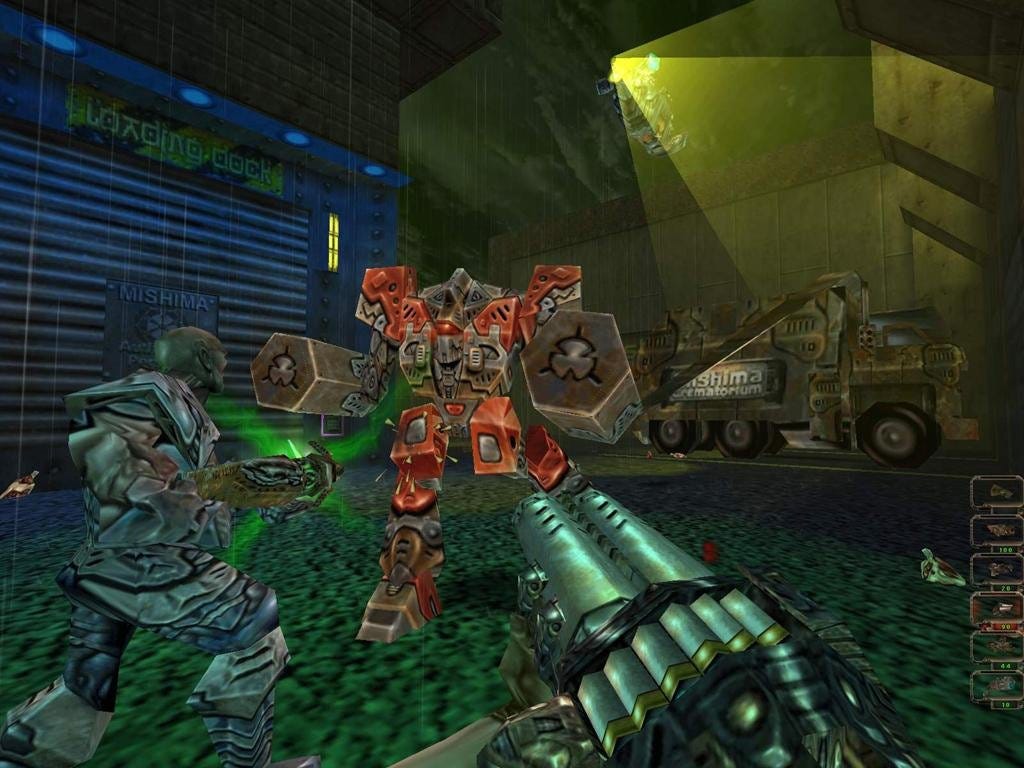
Daikatana. But seriously, the man is misunderstood.

John - the bipedal, endothermic John - has a lot to live up to in my mind, but I think he can make the cut. For while he's stumbled occasionally - one recalls the Ion Storm debacle most prominently, although Romero denies mismanagement on his behalf - I can't help but admire him for his ceaseless enthusiasm for the new. I love all designers like that. We, the people, tend to punish public figures when they appear to be punching above their weight, but I've always preferred a well-intentioned mess to calculated blandness, certain heads of state notwithstanding.

And it's not just mere fancy; those tirelessly quixotic designers have often paved the way for the innovations we've all come to cherish. Take Romero himself: his successes at id Software, where he designed three of the most influential games of the past two decades, inspired an entire genre. His work with the DWANGO team on DOOM set the foundations for the modern online multiplayer technology that allows fragrant West Virginian youths to question your sexual proclivities on Xbox Live. And even Daikatana, deeply flawed as it was - though not nearly as awful as it's made out to be - was... actually, no, that's drawing a rather long bow.

But still! Romero's spirited approach to games design has led him down some dark alleyways, but also towards indisputable triumphs, and I sincerely believe that despite recent setbacks, his new MMO will be every bit as unique and innovative as he's promised. (Judging from his Twitter account, he plays World of Warcraft enough to know exactly what's wrong with it.) If it isn't, well, I guess I could play Dragon Age again and see what it's like to be a nancy elf or a dwarven inebriate. Or go outside.

It's not just Romero, though. Remember poor old Trespasser, that Jurassic Park-themed, physics-oriented shooter that came out long before Half-Life 2 was a twinkle in Gabe Newell's eye? Various Valve personnel have complained over the years that Trespasser's critical and commercial (and technical) failure terrified them like Swiss schoolchildren locked in a room with Roman Polanski, and so they didn't dare to dabble in real-time physics until years after Trespasser's release.

I don't buy that, though: Trespasser, the tragic brainchild of Looking Glass vet and all-round smart-guy Austin Grossman, set the template for everything you see in modern physics-based shooters. Stacking puzzles, physical object manipulation (think the Gravity Gun), ragdoll corpses, inverse kinematics instead of scripted animations (think Spore), vast open-ended environments - anything you've seen in everything from Crysis to Penumbra was premièred here.

2

Trespasser.

Trespasser also featured innovations that have, thus far, yet to be repeated. A "Real-Time Foley" system allowed the game to mix sound files in real-time, facilitating the sound of any imaginable object collision. Christ, it even featured bump-mapping - which wasn't particularly well-received by mid-range and even high-end gaming PC users back in 1998.

None of this stopped Trespasser from becoming a terrible, badly-stitched, fried perch-scented gimp-suit of a game at the time, of course. The player character's arm, for example, was required to manipulate any object in Trespasser (including weapons), but was apparently boneless and thus wont to wobble disconcertingly (and counter-intuitively) at crucial moments.

Crates were frustratingly bouncy, making any attempt at staircase-building a bit like stacking balloons. But despite all this, it's hard not to play the game - over a decade on, is my hair falling out darling - and see everything that was so astonishingly innovative about it. And I refuse to believe that when Valve was readying Half-Life 2 they didn't at least take a passing glance at the wonderful ideas hidden beneath Trespasser's mangled veneer.

3

Evvy Renn.

A case of biting off more Blutwurst than is nutritionally advised? Certainly, but I maintain to this day that if I ever develop breasts I will tattoo a health bar on them as a tribute.

You can see Trespasser's spirit live on in a few special games designers: it's that restlessness; that frustration with the current industry status quo; that desire to, say, make a Dante's Inferno game a cerebral and largely non-violent exploration into the concepts of sin and punishment, rather than a despicable, testicular God of War clone. (Oh, I went there.)

Look at David Cage: his surreal-fi adventures into Americana's darker facets bring to mind European expressionistic takes on the same genre in film. Truly, if Heavy Rain really is what Cage promises, and not, as some have predicted, Dragon's Lair with QTE shag scenes, I'd be more than tempted to label the man the Sergio Leone of the videogames industry. Well, okay, maybe. He'd probably prefer to be Howard Hawks, anyway, but he's far too French for that to ever happen.

And you know what: who cares if he fails? I mean, I'm sure he does - and Sony would probably want a word too - but that's not the point. Since Heavy Rain has started receiving significant press after the initial tech demo buzz back in 2006, it's introduced a dialogue in amongst gamers and developers (at least the ones who give interviews) about emotional engagement, artistic sophistication, and alternative approaches to interactive storytelling in videogames; in a progressive sense, the game has already done its job, even though it has yet to be released. Cage has always tried to open the door to a world outside Gears of War and Mario, but up until recently, very few people have bothered even having a peek.

Peter Molyneux is the same. Quite apart from the fact that he is largely responsible for some of the greatest games ever made at Bullfrog in the nineties - the memories of which certain Angries of Mayfair seem to have surgically excised - the experiments he's overseen at Lionhead have been nothing if not deeply interesting - and, as with Fable II, occasionally brilliant. (Less so, of course, if you're an RPGCodex inmate who would've preferred it to play like an obscure Roguelike made by a Danish pederast in 1989.)

4

Fable II.

He's a man who genuinely - albeit politely - despises the sort of perfunctory, by-the-numbers games design that permeates most releases these days, and goes out of his way to ensure Lionhead Studios is never responsible for any of it. And even when certain thoroughly playable titles haven't quite proven to be the orgasmic nonpareils he promised, he's actually been gentlemanly enough to apologise for it.

And yet Molyneux, Cage, Romero, and other pioneers remain targets. While justifiably praised in some circles, they're still regarded with an alarmingly personal sort of resentment in others. Why? There is a strange dichotomy present in the videogame consumer hive-mind, where newness and innovation are fervently demanded, and yet quite often rejected - usually with Pez-Dispenser banalities like "Games should just be fun" and "It doesn't know what it wants to be" - if said innovation and newness come with a few understandable rough edges. They will, say, explain (almost apologetically) that they didn't buy Pathologic because it was too buggy and ugly, despite the fact that they're still talking about it - unlike Quake IV, another first-person action game released on a huge budget in the same year and delivered with soul-crushing, faultless plodding competence.

Give me your Pathologics over your Quake IVs any day, I say; your flawed fascinations over your dull box-tickers. I feel this way because it's those dangerous experiments that lead to the most significant advancements in the videogames medium. And you should, too: if not for me, then for my goldfish.

Comments (60)

Comments for this article are now closed, but please feel free to continue chatting on the forum!

  • Loading...hold tight!