Care in the Community

Microsoft's Boyd Multerer and Matt MacLaurin talk XNA and Kodu.

The Game Developers Conference seems to be Microsoft's favourite venue for showing off its game-making tools. After all, it's an event designed for and attended by people who make games for a living. But MS isn't just reaching out to developers - they're hoping to turn us all into bedroom coders with services like the XNA platform and the Community Games channel.

Now they're even targeting our young with Kodu, a game-creation tool designed for kids aged nine to 12. So where will it all end? With a load of tip-top, low budget, cheap at the price games for us all to play, hopefully. Or perhaps just a load of games based around Hannah Montana. To find out more Eurogamer caught up with Matt MacLaurin, the creative force behind Kodu, and XNA Game Studio boss Boyd Multerer.

Eurogamer: Why have you designed Kodu for kids? Why not aim it at hardcore Xbox 360 players, who are more likely to have the skills and the inclination to make their own games?

Boyd Multerer: We find that having to keep things simple enough for kids to understand is a useful discipline. When people sit down with XNA Game Studio for the first time they tend to run into one of two walls. If they've never made a game before, they find there's a lot of text to read and concepts to learn and the learning curve is pretty high.

'Care in the Community' Screenshot 1

This is Boyd Multerer. Hello, Boyd Multerer.

If they know how to write code, it's pretty easy to get things moving around on the screen. But then they hit the art barrier, where they don't know how to make a character. That's pretty hard.

[Kodu] eliminates the first barrier, because even if you don't know how to write code you can follow logic. It's not directly teaching you how to write script, but you get how it works. Plus you can do that without having to come up with a bunch of art assets.

Matt MacLaurin: Right now we have a kind of neutral, playful set with these characters - they're all kind of toy-like. If all goes well, we'd like to have more hardcore packs where you can have tanks, rocket launchers and stuff like that, as well as more kiddie packs. The natural way for us to expand is to make more content available for different types of users.

Eurogamer: Earlier this year you said you hadn't decided on a way to distribute Kodu games...

Matt MacLaurin: And now we have. We've built a peer-to-peer sharing system so you can join up with your friends online and swap games you've made back and forth. We're trying to tread cautiously here, because we know user-generated content is absolutely the way of the future, but it's something we want to do in a way that's really sensitive to the concerns of parents. There are a lot of safeguards within the system to keep offensive content out, but by staying with peer-to-peer and friends lists, that gives us a moderate level of control while still letting a lot of sharing happen.

Eurogamer: But there's no peer-review system?

Matt MacLaurin: No, this is more like an email model. You can compose things, you can give them to your friends and we're not acting as an intermediary at all.

'Care in the Community' Screenshot 2

And this is Matt MacLaurin. He do like to be beside the seaside.

Boyd Multerer: In the future, we may make it so you can do things like build a level in Kodu, then build an actual game for peer review - that's stuff we're talking about for possible future versions. But at some point you have to ship.

Matt MacLaurin: This is something we see as a long-term effort, and there are just a lot of unknowns in this space. In some ways the Xbox is a closed environment, like Disneyland - you know every experience you're going to have comes up to a certain bar of really cool stuff.

With Community Games there's the peer-review model, with Kodu we're doing peer-to-peer, and it's giving us tons of data on how people will use these differences and react to them. It's really a long-term investment for us.

Eurogamer: How do you feel about the frequent comparisons people make between Kodu and LittleBigPlanet?

Matt MacLaurin: The press tends to make out it's some kind of brutal competition. I feel we're two teams taking some of the same risks and trying to achieve some of the same things. That means really just empowering end-users, and trying to share the stuff we love about our profession with our customers. In that sense, great - I'm proud to be in their company.
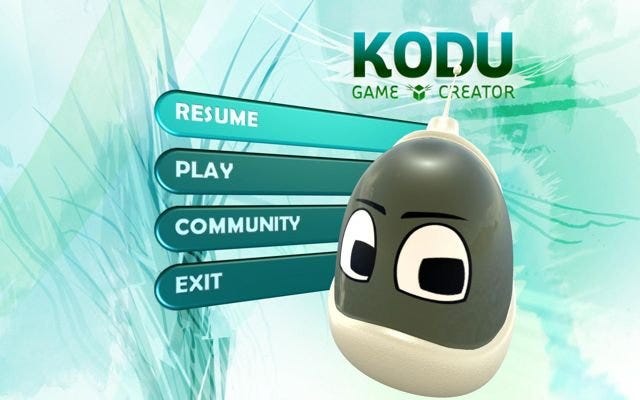
'Care in the Community' Screenshot 3

Is it just us, or is there something slightly sinister about that eggy stare?

On the other hand, they're trying to solve a very different problem. I think gaming is the only truly modern art-form today. Movies are pretty old, radio's been around a long time, so has theatre... Gaming has not been around long, and what separates gaming from those other media is programming. It's truly an artistic media; programming is a way to create art, and we really wanted to make a strong statement about that.

Boyd Multerer: A top goal of ours for Games Studio and Kodu is education, getting people into being able to make games. We're worried that computer-science enrolment is way down; it's seen as a nerdy thing. Everything we can do to make it fun - that's setting the whole industry up for a good future.

Eurogamer: Chris Satchell introduced the Community Games channel at GDC last year. How's it been going? What lessons have you learned?

Boyd Multerer: We're already starting to see that some of the best content is being picked up by studios and will end up showing up in Arcade, which is one of the big pulls. We're very happy with the amount of content coming through the channel, there's lots of diversity both in game concepts and styles. It will continue to be a really fun place for new stuff to emerge.

Eurogamer: There are some games on the Community Games channel which are better than some Xbox Live Arcade games. XBLA games are often indie productions too. What's the deal? Why is a game like, say, Easy Golf a community game, while Death Tank is an XBLA release?

Boyd Multerer: It probably has to do with the amount of risk you want to take as a developer, and with turnaround time. There's a big difference between giving something up to the Community Games channel and getting it ready for a worldwide release.

We've found with Games Studio that when it's time to go off and be professional in the Arcade space, people start to learn about multiple languages and a whole load of other things that kind of raise the bar. As a consumer I know that when I go into the Arcade space, everything's going to be finished and there will be different language versions. When you go into the Community space, it is rougher and a bit more risky from the consumer's point of view. But you're also going to find gems in there.

Eurogamer: But finding those gems can be a problem, and for developers, getting their work noticed can be difficult. Do you have any plans to help people promote their titles?

'Care in the Community' Screenshot 4

Here's the Kodu interface - simple enough for children and thick people to understand.

Boyd Multerer: We're working on a number of things to help with the sorting and the filtering. There's one feature, which exists right now that I think people should be using more - when you go to Marketplace on the web, all the Community Games are there. You can take people directly to your title right there. I look forward to seeing people make more of that.

Eurogamer: Where are all the Microsoft XBLA games? We've had Hexic, Fable II Pub Games and Banjo-Kazooie, but that's kind of been it for the past three years. Why isn't Microsoft producing more titles?

Boyd Multerer: You know, I don't know. One thing we're very specific about with XNA is that we're about helping people make games. We're purposely not trying to play a role in portfolio management; that's for Microsoft Game Studios.

Eurogamer: Also with regard to XBLA, the guidelines for file-size appear to have gone out the window. There's the old excuse of making exceptions for quality titles, but in the case of Watchmen that doesn't really ring true... Why not just scrap the file-size limit? We've all got broadband now, we have the technology...

Boyd Multerer: I can't really speak for why they've chosen the limits they have on the XBLA side. Again, that's a part of how they want to manage the Arcade portfolio, and we're staying focused on the development side.

I know that in the community there are also file-size limits, and partly it's because big files always have a cost. We have to somehow manage the amount of risk that the overall system is taking.

Eurogamer: Have you met any resistance to Community Games from within the industry, perhaps from professional developers who just see it as more competition for them at what's already a difficult time?

'Care in the Community' Screenshot 5

And here's the kind of thing you can create. Not exactly Final Fantasy XIII, admittedly.

Boyd Multerer: B No, I haven't heard that argument. When it comes to the Games Studio, the Community and the Arcade stuff versus the big blockbusters, it's just like the movie industry in the nineties. Indie films came out and that did not kill the blockbuster; it just made the pie bigger. The same thing's happening here. The niche game is there but so is the blockbuster, operating in a different space.

Eurogamer: Has the take-up of XNA Game Studio been as high as you were hoping?

Boyd Multerer: It was almost a year ago we passed a million downloads of the toolset, which was great. There's a lot of people busy experimenting. I suspect some of them are finding the learning curve is a little harder than they thought, if you want high production values - but that's to be expected.

Eurogamer: Isn't the question of production values an issue generally? A few years ago it was all about who could produce the best graphics, but since the Wii came on the scene the emphasis has shifted...

Boyd Multerer: There's a long-term trend that's not going away. Think about 10 or 20 years ahead. It's clear the chips are going to be really, really powerful. It's going to be about controlling your art costs, and you're going to make choices about which market you're aiming your game at and how much money you want to invest in the artwork side.

We see teams now with a 10-to-1 ratio of artists-to-programmers, and that's where all the money's going. I think we're heading towards a world where we'll start seeing 20-to-1. You can see the precursors today. That doesn't mean there won't be blockbusters and high production values - they will still be there. But developers will have more choices about what kind of content they make.

Matt MacLaurin is principal program manager for Microsoft research. Boyd Multerer is general manager for the XNA Game Platform.

Comments (15) Latest comment 3 years ago

Comments threads automatically close after 30 days, but please feel free to continue chatting on the forum!

  • Fixxxer #1 3 years ago

    I don't think there's any question that that egg is up to something.
  • Dizzy #2 3 years ago

    Boyd Multerer scares the shit out of me. The creature from the 80s?
  • Dizzy #3 3 years ago

    "We see teams now with a 10-to-1 ratio of artists-to-programmers, and that's where all the money's going. I think we're heading towards a world where we'll start seeing 20-to-1. "

    Unlikely IMHO. Procedural generated assets will drive the number of artists down again once consoles and PC can generate this kind of stuff in real time (or nearly real time).
    Edited by 1 at 31/03/09 @ 14:24
  • penhalion #4 3 years ago

    @Dizzy

    Naw it's definitely a stupid 10 - 1 split in most studios these days. It's also one of the reasons you get great looking games with really crappy gameplay showing up all the time.
  • Domovoi #5 3 years ago

    Somebody is going to have to tell the consoles and PC's what to generate in real time. The fact that it's procedurally rendered doesn't mean there's no more design involved.
  • Dizzy #6 3 years ago

    >The fact that it's procedurally rendered doesn't mean there's no more design involved.

    Errr????

    That is the whole point.

    Basically you will still need artists to make some assets obviously but software will take over some tasks. The design will be a lot less focused on low level stuff (textures, landscapes, vegetation) and will be more high level. Also I didn't say NO MORE DESIGNERS. I just said that the ratio of 20-1 will probably decline instead. You will build levels more on a meta-level... telling the software what materials to use (without worrying about texture alignment etc...) and where to place procedural items (almost everybody uses SpeedTree now... 10 years ago we were still designing plants ;)
    Edited by 1 at 31/03/09 @ 15:09
  • Spekingur #7 3 years ago

    Yes, procedural will be the future. But the ratio will go up before it goes down. Unless, of course, the procedural future will only keep the ratio from going higher than 20-to-1.
  • Domovoi #8 3 years ago

    Errr????

    That is the whole point.


    It's not, like you yourself concede:

    Basically you will still need artists to make some assets obviously but software will take over some tasks.

    That's a far cry from "There will be no more design involved." which I was contesting.

    The design will be a lot less focused on low level stuff (textures, landscapes, vegetation) and will be more high level.

    Still, somebody will still need to tell the software what kind of trees to generate. Do you want willlows? Pines? Trees with leaves for lush forests? Trees without leaves for dystopias? Somebody will have to set those parameters on the software. Designers will do that, because they get to decide what the place looks like. Sure, they won't have to hand-craft 50 unique pine trees, but they'll still need to determine and tell the software what kind of tree they want 50 unique instances of.

    Also I didn't say NO MOE DESIGNERS.
    No, but you did contest it just now when I said that procedural doesn't mean no more design.
  • Dizzy #9 3 years ago

    >but they'll still need to determine and tell the software what kind of tree they want 50 unique instances of.

    Indeed... but that should take less people.

    >Yes, procedural will be the future. But the ratio will go up before it goes down

    Yeah... at the moment of course we have no way of knowing what the ratio will be, but the ratio and budgets are already getting out of hand so procedural stuff will happen. When? Not next gen (consoles) IMHO... the one after that possibly. PC will start doing this next few years, it almost has the power now.

    Raytracing software has done this for 20 years. A lot of textures can actually be described by math and look incredibly good. It just takes a lot of CPU power.
  • oerhoert #10 3 years ago

    Procedural generation of game worlds could work if you'd first suppose that almost everything in your world will be landscapes and nature.

    As soon as you get your head out of those kinds of "standardized" environments, you'd have to have one hell of a procedural system to cater to all kinds of artistic visions. I shudder to think of a procedural generator that could produce both Viva Piņata and Oblivion, and sure am glad I'm not the one responsible for creating something as flexible as that.

    Also, people should stop equating games with "simulated 3d environments". Games should be a LOT more than just that, in my opinion. Which again implies that content artists will probably not lack work in the next decades.
  • nick_f Verified Senior Producer, Microsoft #11 3 years ago

    re: "Where are all the Microsoft XBLA titles?"

    Uno Rush is a Microsoft-developed XBLA title and came out last week. Banjo-Tooie is coming out later this year.
    Edited by 1 at 31/03/09 @ 16:22
  • Xerx3s #12 3 years ago

    Thinking that having a PGC will drastically reduce artists is an illusion. Models still need to be modelled first, textures still need to be created first, levels still need to be designed first, etc. before you can chop those things into a code that rebuilds them on the fly exactly like the artist intended it to be experienced.

    PGC is nice for disc space saving and area's that warrant little attention but most games don't need the first atm and lack the opportunity for the second (the only games I can think off atm that actually benefited in any real way in terms of timesaving is oblivion and FO3).
  • SwedBear #13 3 years ago

    An interesting question would have been: when will community games be available for users outside US and UK (can Germans and French also get them ...?)? I would love to sample some of the games but last time I checked I still have no access to them (being in Sweden) ...
  • Lawlost #14 3 years ago

    @Dizzy, he scares me too. I'm sure there must be a ponytail at the back there. Shave your head Boyd it is going and not coming back.
  • BoffBoff #15 3 years ago

    Boyd Multerer???

    Boy Murderer judging by that pic!