Bonsai Barber Review

Topiary or not topiary, that is the question.

Version tested: Wii

I've just been bollocked by a carrot. In almost three decades of gaming, I think it's safe to say that this represents something of a first.

A little context: I've recently taken up the position of barber in a town apparently populated entirely by sentient vegetables. Being new to this rather specialist field, I foolishly made the mistake of booking an appointment for Reg Wedge on the same day that review code for Batman: Arkham Asylum arrived. When I took a break from Gotham's seedy underbelly and returned to my role as a cartoon legume stylist the next morning there was a snotty missive waiting on my Wii message board.

You didn't turn up yesterday, dude. I can't waste time waiting around for you like that; I've got places to go, canyons to leap!
Yours disappointedly,
Reg Wedge

That Bonsai Barber goes to these lengths to extend its surreal pleasures outside of actual gameplay speaks highly of the volume of ideas and gags crammed into its deceptively simple shell. That Reg's disgruntled complaint had no immediate impact on the game is sadly indicative of its rather vague structure.

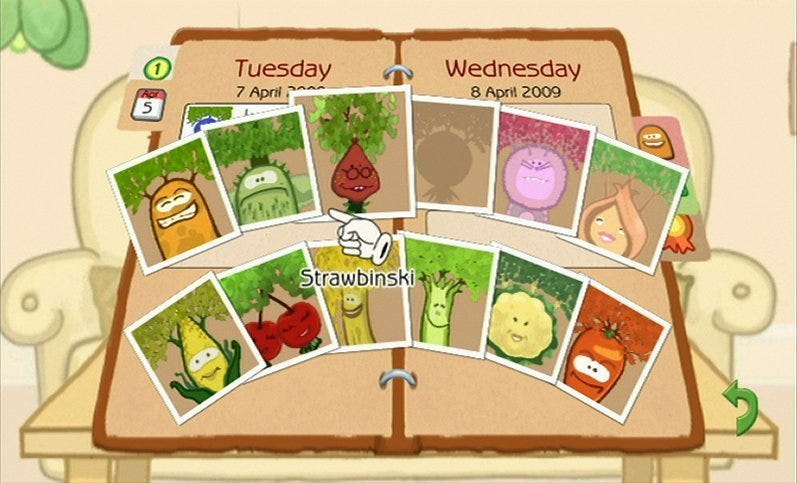
Making use of the Wii's internal clock to dictate your sartorial routine, Bonsai Barber offers up five customers per day. Each will have specific demands to be met. For your first few days it's simply a case of mastering the new hairstyles added to your scrapbook, and getting used to the various tools at your disposal. The more days you play, the more complex the tasks you need to perform and the more daft flourishes and random events you discover.
1

The characters may be bizarre and funny, but you'll soon wish there were more of them.

Having selected your customer, they appear on screen with their bushy green leaves swaying gently above their beaming face. The outline of the desired style is superimposed over the top, and you use the remote to trim the foliage to suit. Scissors are great for rapid pruning, but cut branches too low down and you'll lose huge chunks from the top. A spray bottle grows them back again, should you need to start over.

You also get a comb, which can be used to drag twigs into the perfect trimming position, and a pair of clippers, which can remove leaves without cutting the branches - essential for some of the more fanciful styles you're asked to provide later in the game. Finally, there are some pots of paint, just in case someone wants a change of colour, and a camera for capturing your masterpieces.

Your work is judged on a moment-by-moment basis, with a star rating at the top fluctuating between zero and five stars depending on how the style is progressing. Once you're happy, you can strike a gong to tell the customer you've finished. Satisfied customers may leave you a gift, and there are loads of additional medals to be earned by meeting certain requirements or taking photographs of the right things.

It's a right laugh, to begin with. It's as the game progresses that tensions between its digital toy nature and the challenge-driven implementation start to show some strain. Despite requiring no small amount of skill and a supernaturally steady hand as the days progress, there's no real shape to the gameplay. Reg Wedge may have sent me an angry message for standing him up, but he was back again the next day with a smile on his face. There's no limit to how long you need to take to finish off a hairstyle, and no apparent punishment for hitting the gong on a mediocre three-star cut. The only impetus to keep striving for five stars is your own pride, but when the game doesn't seem to care, why should you?

It's only when you've been playing for a week or so, in real time, that you start to see new rewards for your dedication, but even then the criteria for success feels vague. You're never entirely sure what you need to do, but you keep doing stuff and things happen so you must be doing something right. Such laissez-faire structure can be liberating, but it can also lead to the feeling that there's not really much point. With nothing at stake and no firm idea of where it's all leading, it's easy to drift away from the game, especially given its strict "five customers a day" rationing.

Balanced against this is the simple fact that it's an enormously charming game. Created by former Rare man Martin Hollis (he of GoldenEye fame) there's a clear lineage back to the sort of seriously silly ideas that populated Banjo-Kazooie and it shares a sense of humorous whimsy with Viva Pinata. Wielding the remote like a pair of scissors is a surprisingly tactile experience, calling to mind some of Trauma Center's more ingenious moments, and there's a distinct and immediate pleasure in snipping away and seeing a creation take shape. On a purely instinctive level, it's a game you want to play.

Precision work can feel frustrating though. As the designs become more complex your tools begin to feel rather crude, and you'll be crying out for the option to zoom right in and perfect those lines as scissors and clippers struggle to render the increasingly intricate curves required. Given that the game has an uneven approach to scoring, it doesn't take long to realise that perfectionism isn't always essential.

2

Reg Wedge: carrot thrill-seeker and author of indignant letters of complaint.

Sometimes you'll easily get a top rating for a cut that is clearly a little rough around the edges, other times you'll produce what appears to be a near-perfect style, yet the gap between four and five stars remains an impassable barrier for no apparent reason. Is it that some customers are tougher to please? Or that some designs are judged more severely? The game is too busy pulling funny faces to explain its rather arbitrary criteria for success, and so you'll often settle for four stars, knowing that it doesn't really matter.

A game like Noby Noby Boy can get away with this sort of amorphous structure and hazy goals, purely because it's so far removed from the typical effort/reward mechanisms of traditional gaming. Bonsai Barber tries to have it both ways, setting you a strictly defined series of tasks but then not taking much interest in how well you perform them. After a week of daily play, the initial appeal has begun to wear off and you're left with a game that can be very demanding, yet offers very little in the way of tangible reward.

And that's Bonsai Barber's genius and folly in a neat hairy nutshell. An easy game to admire, the concept is appealingly daft and the implementation rich in wit and charm. It's just too laidback for its own good; an approach that pays dividends in those first joyful days but proves less successful in the long term as the rising difficulty curve chafes uncomfortably against the whimsical lack of direction. It's almost worth checking out just for the bizarre invention on display, but at the top end of the WiiWare price range it's hard to make that an emphatic recommendation.

6 / 10

Read the Eurogamer.net scoring policy

Comments (25)

Comments for this article are now closed, but please feel free to continue chatting on the forum!

  • Loading...hold tight!