Bangai-O Spirits Review

Buy. Play. Treasure.

Version tested: DS

So, Bangai-O Spirits. I think it's amazing. I sort of suspect that if you didn't play or love the first one, it'll probably leave you baffled for a long time. And then suddenly you'll have an epiphany, in which you utterly understand it and what it's trying to do.

Some of the time it's like WarioWare; some of the time it's like Gradius; some of the time it's like Brain Training. But you never know what to expect. You never know if a map is going to be over in two seconds, or if you'll be dodging bullets for five minutes. And there are so many nuances, like the counterintuitive process of putting yourself directly in the path of danger because your bombs increase their power in proportion to the number of incoming projectiles, or grasping the need to switch bullets to solve particular puzzles.

It's glorious; eclectic, furiously inventive, dizzying, baffling, confusing, witty, clever and beautiful. There are mazes, there are races, there are block puzzles, there are platform games, there are sports games, there are playful tributes to videogame classics from Pac-Man to Mr. Driller, there's pachinko, there are giant robots, there are giant giant robots, there are Lilliputian giant robots, and there are screens and screens of bullets.

There is perfection, there are flaws, there are moments that test your patience, there are moments that test your endurance, there are moments that test your timing, there are moments that test your intelligence. But, above all, there are moments that send you soaring skywards.
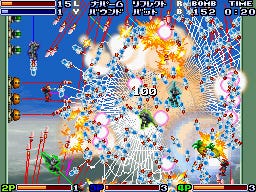
1

Even just the screenshots are full of joy. And bullets.

In essence, it is simply a 2D side-scrolling shoot-'em-up. The original Bangai-O (or Bakuretsu Muteki Bangaioh to give it its full name) appeared on the N64, and, in slightly modified format (and as Bangai-O), on the Dreamcast. It featured a brilliantly incomprehensible storyline in which you piloted a big robot (that was tiny on-screen) across 44 levels. It did three important things. The first was that you could choose from either bouncing bullets or homing missiles. The second was that you had bombs, and they increased in power in proportion to the number of enemy bullets that were about to hit you. And the third was that each of those 44 levels was essentially some sort of a puzzle that you had to solve using the first two things.

One map might be balls-out bullet hell to test your reflexes; the next might be an elaborate maze. One level might see you bouncing bullets round corners; the next might see you unleashing waves of homing missiles in large, open spaces. Several missions saw you racing against a fuse; others saw you taking on bosses who didn't actually fight back. Although it was cruelly overlooked by the majority of gamers and critics, it was a game that was brimming with wit and invention - not to mention screens full of explosions and, rather curiously, fruit that recharged your bombs. It was so brilliant, in fact, that it was even elected one of the top 50 games of all time in Hodder Headline's Game On!: From Pong to Oblivion - The Greatest Video Games of All Time. Widely recognised, at least by the authors, as the definitive selection of best ever games ever. [I suppose we did let Ellie get away with the Guinness stuff. Pass. - Ed]

Bangai-O Spirits picks up where the original left off. It does the above and throws in loads more. There's a wider range of weapons. Instead of a fixed choice between bouncing and homing bullets, Bangai-O Spirits lets you pick your payload at the start of every mission. You can use a baseball bat to wallop your enemies or their missiles, sending them rebounding to carve out a destructive arc; there's a sword; a shield; napalm; 'break' bullets that cut through enemy attacks; bombs that reflect bullets; bombs that freeze opponents; and, of course, the original two weapon types for good measure.

The next new feature is the greater number and wider variety of missions - made possible by all those new weapons (and enemies). The crazy (and generally amusing) narrative continues to send up videogame conventions, just like the first one did, but this time it's restricted to just 17 levels. Disappointingly, that that means the game contains far fewer boss-style encounters than the original. To compensate, the remaining 143 missions contain a variety even more boundless than the original.

There are even more complicated mazes, and races, as well as ball games, and videogames (Pac-Man, Mr. Driller and R-Type, for example). There are levels that spell out words, or levels that just make pretty patterns. One level is a variation on the buzz-bar fairground game, where you have to move a loop along a wire without touching the two; another is modelled on an ant farm; another is actually modelled on the DS itself. Between them, they will tax your brain cells as much as your reaction speed, and sometimes even your patience, and they will confuse, perplex, entertain and delight.

2

Joy, and bullets, and balls.

Beyond those 160 maps, there's also a multiplayer mode, which allows you to compete with friends, or to create and trade maps or replays - sharing them as audio files. Audio files! That you play to your DS! At once, it is an homage to both videogame history and Nintendo's cutting-edge handheld technology, as well as being so much more fantastically haptic than the act of downloading. If you'll allow me to get all poncy: it is yet another example of Treasure's unique understanding of the videogame medium, transforming an otherwise banal element into entertainment. And yet, it is also a means of extending the range contained within a DS card that is already bursting at the seams - extending it infinitely, in theory.

This infinite variety brings us on to the problem with just listing and describing Bangai-O Spirits: as with so many things, the journey is so much greater than the destination. So much of the pleasure of playing Bangai-O lies in discovering that enormous variety, and getting to grips with the twisted logic that underpins it all. As you work your way through the 160 levels, that perplexing logic gradually reveals itself until you succumb. It's when you start to pick up on the jokes, or the tributes, or the experiments, that you'll begin to realise why Bangai-O is so utterly amazing. That's when you'll start to forgive its imperfections and its flaws - because when Bangai-O fails, it fails gloriously, or bafflingly, or interestingly.

That's when you realise that although Bangai-O is just a shooting game, it's far from just a shooting game. Playing Bangai-O Spirits is a pleasure. If I could, I'd play it for every waking moment.

10 / 10

Bangai-O Spirits is out now in Japan.

Read the Eurogamer.net scoring policy

Comments (87)

Comments for this article are now closed, but please feel free to continue chatting on the forum!

  • Loading...hold tight!