Art Style WiiWare Roundup
Cubello, Rotohex and Orbient.

Rotohex
Rotohex, a fairly unchanged port of Dialhex, is easily the most traditional of the Art Style trio, which isn't necessarily a bad thing. It just makes it harder to appreciate its triumphs when there are at least a dozen similar puzzle games doing broadly the same thing.
It's another variation on the old colour-matching formula, in which tiny triangles drop from the sky and must be wrangled into hexagonal groups of identical colour by rotating areas of the playfield. The aim is to create six groups of each colour, at which point you advance to the next stage and another colour is added. From a fairly simple green and orange start, you're soon juggling a veritable rainbow of shapes, trying to cluster them together before the screen fills up. Two power-ups mix things up a bit, either opening a plughole at the bottom to drain some pieces out, or changing the colour of pieces to make matches easier.
That's pretty much it, and while it's compellingly presented, it's hard to ignore that games like Hexic and even Lumines have staked a fairly watertight claim for this kind of puzzling on today's gaming platforms. There are subtleties to the play that become apparent as you battle through the stages - unlocking a couple of additional game modes along the way - but nothing that won't already be second nature to dedicated puzzle fans.
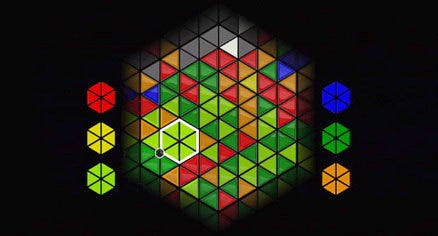
Where Rotohex distinguishes itself is in the aforementioned game modes, with a marathon survival mode and a timed sprint mode both offering different ways to approach the game as a single player. It's the only Art Style game to boast multiplayer as well, with a fun versus mode that uses a similar mechanic to Puzzle Fighter to reward successful play by dumping more pieces on your opponent's grid.
It's really only the sprint mode that is new to this version, with everything else much the same as it was on the GBA. Multiplayer is now available on a shared screen, which is obviously more accessible than having two game cartridges, but otherwise there's a sense that more could have been done to evolve the bedrock of the game, especially since it's arguably the least distinctive of the Bit Generations titles.
7/10
Orbient
Orbient, an update of the GBA title Orbital, is a physics game. A real physics game. Usually when we talk about physics in a gaming context, what we mean is "making stuff falling over". That's not what happens here. Orbient is a game about momentum. It's also about attraction and repulsion. It's a game that allows you to legitimately use big scary textbook words like "geodesics" and "parabola".
You're controlling a small planet, adrift in a series of solar systems. The A button draws you closer to nearby planetary bodies, in accordance with their mass, while the B trigger pushes you away. Colliding with an object of the same size (marked blue) means you absorb that planet and become bigger. Smaller objects (grey) can also be absorbed, but provide no increase in size. Far better to sweep them into your orbit, so they can provide additional lives for the next level, since you'll inevitably lose plenty of these through collisions with the larger red planets, and various asteroids and other space debris which only serve to scupper your plans. Once you've grown large enough, the goal star is revealed. Get that star into your orbit and you're off to the next level.
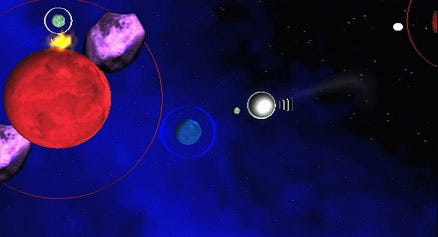
You're at your most vulnerable - and least controllable - when moving freely through space. The knack, you soon realise, is to get yourself into orbit around a larger object and then slingshot yourself nearer to the desirable blue spheres bit by bit. Each level brings a more complex system of orbits and planets to navigate, so while the gameplay is far more hands-on and arcadey than its Art Style kin, relying as much on quick reactions as on strategy, Orbient is still very much a puzzle game.
What's more, it's still completely unlike any other puzzle game, purely because you're controlling physical forces around an object, rather than the object itself. You could perhaps argue that it has a little in common with games like Feeding Frenzy, purely because of the concept of gobbling up small things while avoiding big things, but that barely scratches the surface of the mental gymnastics the game asks you to perform.
As with the other Art Style games, Orbient has a fairly steep learning curve and it doesn't waste much time before throwing seriously challenging levels at you. Crack the controls, however, and you can hit just the right arc to glide into orbit around a planet, scooping up moons, before swinging back round and off to the next one, just shaving past a rogue asteroid with pixels to spare, and it's joyous.
It's a weird game, yes, but a quietly brilliant one if you put a little effort in and are prepared to grapple with the physical concepts at its heart. It's certainly the most interesting and rewarding of the three Art Style games on WiiWare, so far.
8/10