Version tested: Xbox 360
From the duck-and-cover flanking gameplay, to making co-op a pivotal part of the design, to the bullish machismo of the main characters, the original Army of Two was a clear attempt to create an all-formats rival to Gears of War. That it only partially succeeded is probably down to the problems of trying to create something distinctive within the confines of a rigid genre formula, but there was certainly a promising shooter lukring beneath the slightly wonky control map, occasionally flaky AI and endless whooping fist-bumps.
It's to EA Montreal's credit then that despite a predictably quick turnaround time a great many of those grievances have been comprehensively addressed for the sequel. There's a welcome cosmetic overhaul, which makes the rather bland HUD elements more appealing and intuitive, and a general spit and polish to the graphics that results in more detailed and believable environments. The GPS overlay is more informative, weapon purchases and upgrades can be made at any time provided you're not in active combat, and there are lots of other small interface tweaks.
Anyone who played the original for any length of time will also appreciate the much simpler control scheme, which not only strips away the needlessly cluttered button layout of old, but allows you to do more with less effort. It's a bit silly that we had to wait for a sequel before a sprint function was added, but the ability to dash into the open, seamlessly vault over obstacles and roll or slide into cover with just one button compensates nicely. Aiming is also tighter and more fluid, transforming most confrontations into fast-paced action set-pieces rather than tiresome whack-a-mole wars of attrition.
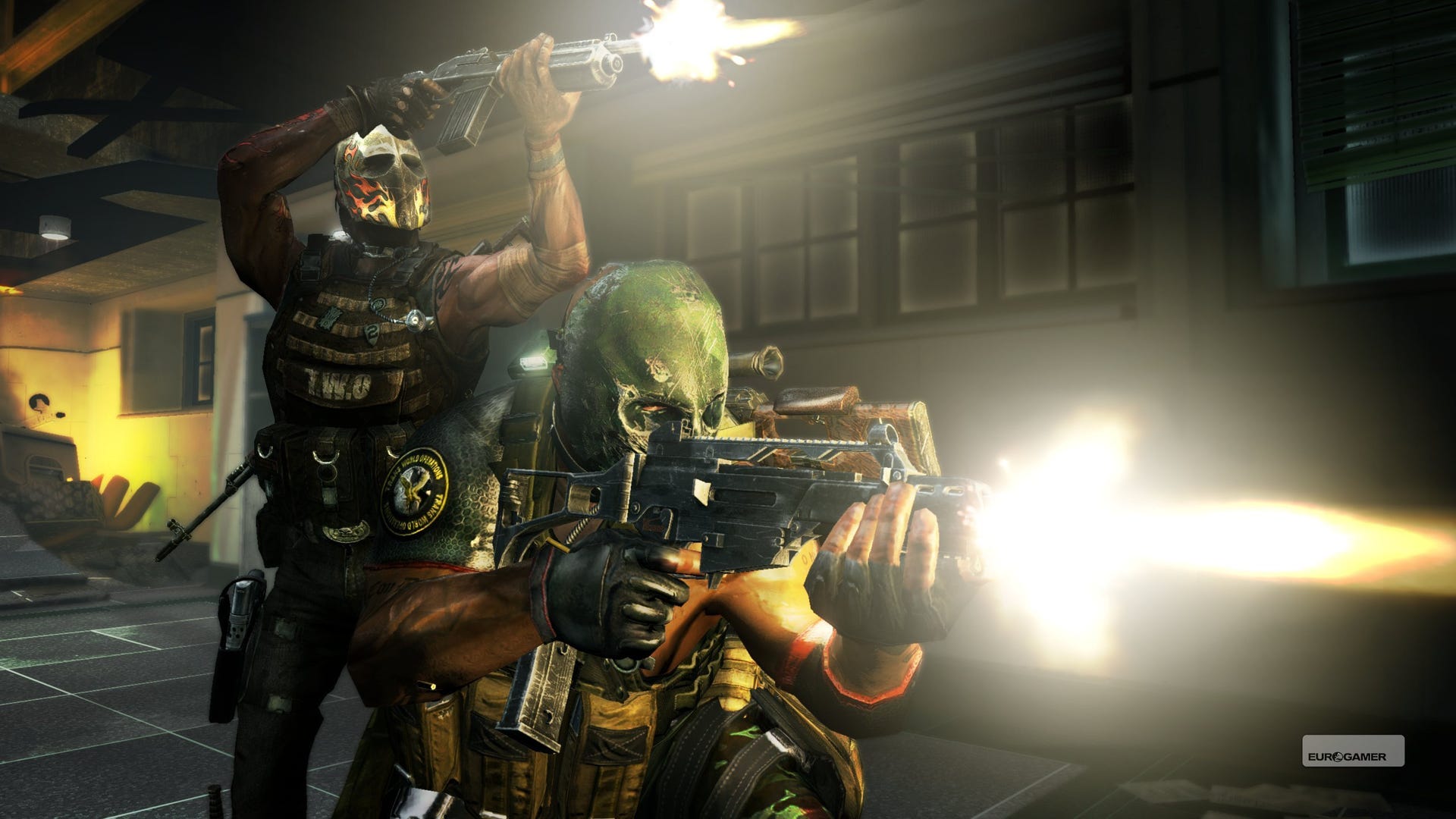
The game gives you a relationship rating based on your interactions with your partner, which makes it feel a little like a hentai dating game for sexually confused western males.
The cover mechanic is another area that's been vastly improved. As Salem and Rios race around their new Shanghai setting, they can stand or crouch next to any surface offering protection from incoming fire and automatically stick to it, ready to blindfire over the top or around the corner. Moving away from the same surface instantly breaks you free, so if you're used to the strong glue of a Gears-style cover system this will take a little adjusting to, and you may sidle into harm's way a few times without realising. Over the course of the game, however, it's effective and intuitive, as you gain an instinctive understanding of when you're safe and when you need to keep moving. This ability to enter and leave cover on the fly also proves essential, especially when you reach the larger stand-offs where attacks come from all sides.
Yet more advances can be found playing solo, particularly in the much more flexible and dependable AI of your ever-present partner. Context-sensitive commands mean the other character can be used to perform pretty much any task you can do, from opening doors to grabbing enemies as hostages. The four-prong command system remains, with its double-tap for aggression simplicity, and as the character makes sensible use of cover, takes useful initiatives in combat and mostly acts as a genuine help, you'll find that it's easy to forget that your gun-toting pal is making his decisions based on algorithms driven by ones and zeroes.
Of course, this does mean that the moments when the AI stumbles are more noticeable and problematic. You can come to rely so much on the partner character that for him to suddenly develop a death wish and stand in an open doorway, blasting randomly and forcing you to make your way to his location to save him, really mucks up your game. It's more problematic when confronted by one of the game's many hostage situations, where you come across civilians held at gunpoint by the enemy mercenary army.
Saving these hapless souls isn't essential, but it does result in sizable cash bonuses as well as access to new weapon parts. Trouble is, trying to pull off such tricky extractions with the partner AI is like performing keyhole surgery while wearing mittens - you can only get so far before the lack of sensory feedback makes it a right old fumble. In one such situation, I painstakingly sniped a guard, crept beneath a window and was about to quietly open a door to grab a commanding officer as collateral, when my partner, in direct contradiction to his defensive stance, simply strode up to the window and started shooting.
But of course, the idea is that you're playing with another human, with whom you can coordinate such things. Later hostage encounters, however, seem insurmountable even for the best flesh and blood operatives. While the attempt is welcome, Army of Two just doesn't suit these quasi-stealth moments, and while they are optional, so it's not a game-breaking problem, it also means there's no real incentive to grapple with the game's clumsy idea of subtlety.
Environments are admirably detailed, but few stick in the memory. Shanghai's streets and corridors soon become samey.
It's here that the game starts to take steps backward. While the moment-to-moment gunplay is much better than it was in the 2008 model, the structure on the whole remains much the same, with lots of peripheral features and abilities that the game design never requires you to use let alone master. Weapon upgrades, for instance, are much less linear now - you can swap and change parts from any weapon in the same class to create your ideal hybrid arsenal - but although I tinkered and toyed with these options to see what they were like, my trusty default assault rifle was more than enough to tackle the vast majority of situations. The same is true of the more specialised co-op manoeuvres, like mock surrender. These can be a fun way to vary the experience, but are often no more effective than the basic suppress-and-flank pattern that works so well the majority of the time.
The token inclusion of moral choices also feels a bit uninspired. At set junctions in the story you have to make a snap decision regarding the fate of a character, and it generally boils down to kill or don't kill, and the repercussions of each choice are played out in stylish comic book panels. Sometimes there's an unforeseen twist in the tale, but apart from one moment where your past actions can prevent access to additional weaponry, there are no tangible consequences - and therefore no real point - to such interludes.
Those slo-mo back to back Michael Bay moments return, providing your recommended daily dose of Exploding Barrel.
Much like its predecessor, The 40th Day only offers a rather short-lived campaign with little replay value. Seven chapters await you, a few of which are of decent size, but most are either too brief or generic to really register. My game clock stood at just over six hours by the end, but the slimline narrative makes it feel less substantial than that. The 40th Day's story only really comes into focus in the final level, and even then it doesn't begin to explain the constant slaughter and terrorist atrocity that has peppered the screen up until that point. That you're moving forwards, killing as you go, is presumably explanation enough.
There are no diversions from the formula this time around, such as parachuting or driving. This is a blessing in many ways, as anyone who suffered through the previous game's hovercraft level will attest, but it also means there's nothing to break up the seemingly endless array of enclosed spaces dotted with convenient cover that you must advance through. With gimmicky locations (such as a zoo full of animal corpses) substituting for genuinely enervating combat situations it all settles into a rhythm more soporific than the bombastic presentation would suggest. Suppress. Flank. Eliminate. Rinse. Repeat. The aggro system makes the pattern mechanics easy to identify and follow, but it's not enough to mark Army of Two out from the dozens of other co-op titles that gamers can now choose from.
The game's two stars have also been neutered somewhat. Obviously stinging from jibes about the weird amoral hyper-violent homoeroticism of the original, EA Montreal has dialed down the fist-bumps and frat-boy whoops, but it's arguably an overreaction, stripping the game of its character. It may have been an obnoxious and very silly character, the sort of nihilistic cartoon that makes Bad Boys II look like Jane Austen, but it was the most memorable aspect of an otherwise-underfed third-person action template. By saddling its gleefully brutish protagonists with a flimsy conscience, and setting them in a story that requires them to stomp aimlessly from one side of Shanghai to the other rather than detonating stuff in the four corners of the world, The 40th Day makes surprisingly poor use of its most iconic assets.
So for all that has been improved since the underwhelming quite-goodness of the first game, there's still a perfunctory feeling when the end comes a second time around. A sense that, while diverting and sporadically entertaining, you could have made more memorable use of the time spent popping headshots into hundreds of identikit soldiers. It's a game that draws inspiration from many superior games, and then relies on game design that is never more than merely okay to make the comparison more favourable.
Mock surrender, just one of several co-op features that never prove essential.
Multiplayer may yet prove its saving grace, of course. The servers were unavailable at the time of this review, so split-screen co-op was the only element that could be tested. The servers will be region-free this time around, so there will be more games to join, but it remains to be seen if the base-capture variant Control will be a worthy replacement for Bounty mode, and if the decision to turn Extraction into a long-haul survival mode (and one that is unlocked by a pre-order code, no less) will be enough to build up a worthwhile user-base.
There's little doubt that anyone who fell in love with the first game's slender charms will be enthused by the prospect of more of the same delivered with a higher degree of HD polish. With its A-list production still held back by B-list ambition, though, there's ultimately not enough of substance to lure players away from the multitude of other co-op gaming experiences for more than a few days.
7 / 10
