Version tested: Xbox 360
The legendary agent whose presence looms over Alpha Protocol's Michael Thornton isn't Bauer, Bourne or Bond - although the game is eager to invite all these comparisons. It's Shepard. Obsidian has borrowed a lot from BioWare, a developer it's always had a close working relationship with, and at times Alpha Protocol can feel a little like a Mass Effect mod as much as an original game in its own right.
A contemporary super-spy mod of Mass Effect would hardly be something to complain about, though, and while Thornton's earthbound adventure isn't as gripping - and is hardly as polished - as either of Shepard's galaxy-spanning suicide missions, it's a still decent action RPG.
The narrative, unfolding in a kind of French plait of chatting and blasting people in the face that will be instantly familiar to veterans of any Normandy away missions, is a pleasingly sinister muddle. While agent Thornton hops around the globe, having flirty conversations with enigmatic ladies on planes and making deals - or, like, totally not making deals - with sheiks, Russian crime bosses and Triads, Alpha Protocol slowly starts to pull together a story of international intrigue, as a weapons manufacturer tries to trigger a new cold war arms race so it can cash in on the ensuing panic. (It's worth noting that this firm definitely isn't in any way at all based on former Vice President Dick Cheney's delightful paymasters Halliburton.)
You can customise Thornton's beard, headgear and glasses, but can't mess with the face. You might want to cover up the eyes, because they're creepy and dead-looking.
While there are plenty of serious things to think about while you're reloading - commercial jet liners get shot out of the sky, private military contractors storm embassies and the corruption might go all the way to the top on this baby - the game never forgets to revel in all the cheesy aspects of being a member of the air-miles-heavy, neck-breaking elite too. This is espionage depicted as a delightful confection of plush safe-houses, video walls, one-liners and gadgets, a game built from show homes and weather-beaten military installations.
A handy indicator, if any was needed, of its reckless handballing of reality comes in the first five minutes, when a slick military industrial complex type conducts a debriefing in an office suite with a lit cigarette in his hand. You can get a license to waterboard at Boots the Chemists these days, buddy, but not even Tier One special forces are allowed to do that anymore.
Reading a character's dossier may give you perks and advantages when you inevitably have to blow their head off - or talk them out of trying to shoot you first.
While the plot spools around your feet one hotel lobby or snowy train yard at a time, the game's missions themselves take their cue from the first Mass Effect rather than the second. It's a blend - and often a slightly wonky one - of RPG and shooter, meaning that it's happy to give you a shotgun to pose with, but if you want it to actually behave like, well, a shotgun, you're going to have to pour money and upgrade points into it.
Although that's frustrating in the early levels, as you feel like you're bursting from cover to pop super-soldiers in the face with tangy bursts of Glade, once the game actually gets cooking you'll start to feel enjoyably super-powered yourself, whichever munitions you're choosing to specialise in. Each trip to the character sheet or the weapons clearing-house becomes a treat, and while certain classes of gun never have that much character however good you get with them - I struggled to love either pistols or SMGs, as they both seemed ineffectual - if you like stock-shopping and comparing the buffs offered by a handful of recoil dampeners, you'll be pretty happy about things.
You won't be consistently happy, however. More than with almost any other RPG I can remember, your experiences at the two-hour and the eight-hour mark will be noticeably different with Alpha Protocol. While the plot moves very swiftly, this is a slow burn as an action game, and it delivers little enjoyment in the first few missions as you get to grips with initially-overpowered enemies and the fact that the whole experience is sorely lacking in polish.
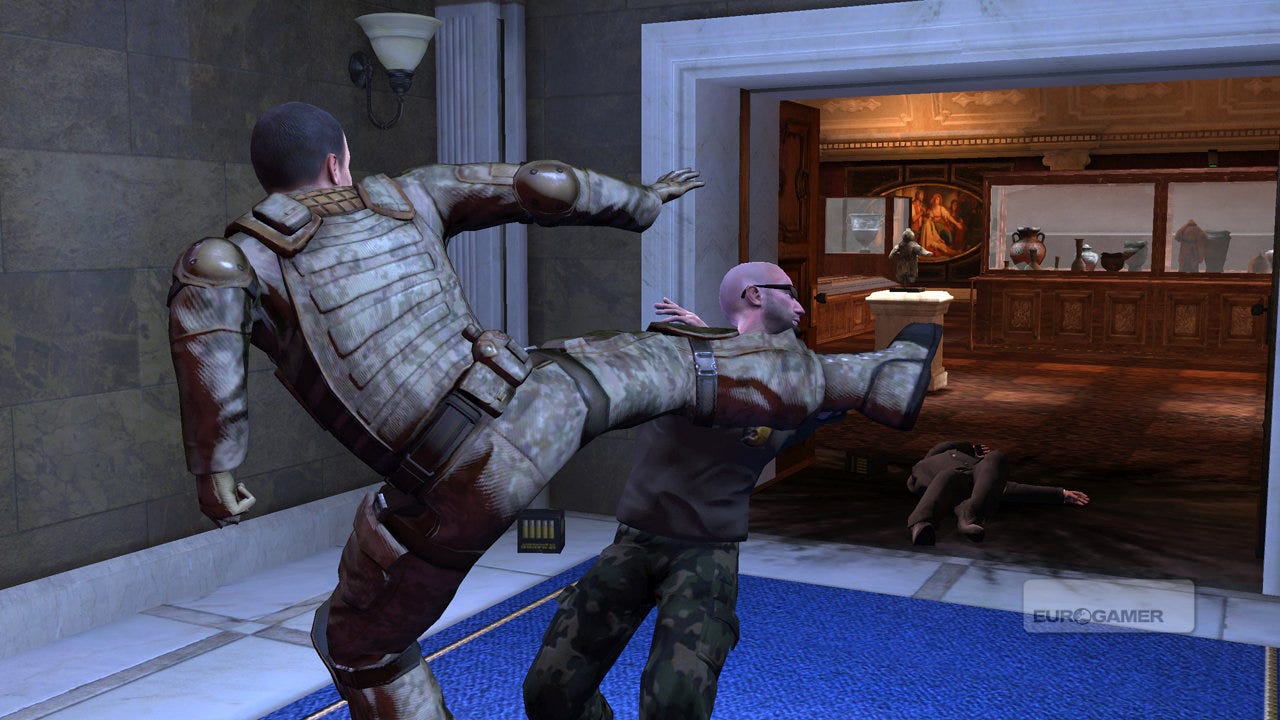
Instead of moving from one charismatic chunk of espionage mayhem to the next, you'll have plenty of time to fixate on all the little - and not so little - things that don't feel right: the arthritic cover system, the poor animation and even poorer enemy AI, and the horrible mini-games that erupt whenever you want to poke around the outskirts of a level, turn off an alarm, or open a particularly important door. Too often, Alpha Protocol feels like a B-team effort, as you fumble with problems that have already been solved in other, glossier games, and learn to make use of mechanics that have already been refined by other developers.
At the eight-hour mark, if you've persevered, you may well have had time to come to terms with all that. If you accept Alpha Protocol as a project made by a plucky team working to a faintly cruel budget, it's surprisingly hard not to get behind it.
The game's flashback structure works fairly well, and picking up the plot strands after a few days away shouldn't be a problem.
While the shooting's ordinary and the melee combat is even less distinguished, Obsidian has really excelled in certain areas, in smart ideas like holding back character class choices until you've tried out the first mission, or in the way it uses a range of colour palettes to create distinctions between the parts of the world you're exploring. A crate in Saudi Arabia may be very similar to a crate in Moscow - I've checked and everything - but the dusty orange light of the Gulf and the frigid blues and purples of Eastern Europe make you feel like you're really travelling the globe.
Equally, the levels you play through manage to temper linearity with just enough flexibility in terms of how you move through them, and there are often multiple routes and different approaches depending on whether you're a stealthy creature of the shadows or a heavy-booted nose-pulper who trips alarms out of sheer love of the game.
While standard enemies tend to be drab, the boss battles offer sudden blasts of deranged colour, whether you're taking on an eighties-obsessed Russian crime punk who can blind you with the light display on his custom-made disco floor (not joking) or a frosty German lady-monster who gives you a sense of what Girls Aloud might have looked like if they were managed by Saddam Hussein. It's not Metal Gear Solid by any means, but it makes a nice change all the same.
As the cast list expands and the action abilities opened up by the levelling process become increasingly cartoony - two favourite unlocks are an evasion skill which allows you to go unnoticed for a few seconds even if you absolutely blow your cover, and a temporary shotgun boost that lets you knock down enemies as you hit them - Alpha Protocol starts to come to terms with itself as a slightly tongue-in-cheek enterprise. Helpfully, the script has plenty of classy moments, both in terms of the cut-scenes and the text, if you're willing to plough through the emails you'll constantly receive from both friends and enemies. Even the action, formed from pieces which are only really second-rate by themselves, eventually comes together into something that tugs you forward with surprising insistence.
And while it's a linear adventure at heart, the game takes its commitment to player choice fairly seriously. It offers plenty of moments where you have control over the big things - who lives, who dies, who becomes an ally and who becomes a boss battle - as well as the little things, like how your approach to a mission changes what your handler thinks of you.
The game's reputation system is fun, if limited - a lot of the time, you're really only accessing another layer of buffs if a handler likes you, and de-buffs if they turn against you - but it ties into the game's Mass Effect-cribbed dialogue system pretty smartly. With options allowing you to respond to questions in either a suave, aggressive, or professional manner - Bond, Bauer, or Bourne by turn - the whole thing is given a snappiness that BioWare's game lacks as you automatically answer questions after a certain time limit even if you haven't made a choice. Sure, it's not rare to come back from making a sandwich to discover that the game has ploughed through an entire conversation tree without you, and all your friends now think you're a bit of a dick, but it also means that dialogue has a genuine sense of flow.
Levelling your character works very similarly to the first Mass Effect, but too many of the really enjoyable skills are reserved for too late in the game.
Either way, it's a regular pleasure, if not a deeply engrossing one, to work out how to speak to a particular character to get the best out of them, and the responses are often handled with wit. With a story that's as deep or shallow as you want it to be, the writing in Alpha Protocol, while far from perfect, is definitely more of a strong point than the game's technical aspects, and it's worth lingering over some of the finer detailing.
Like Worcester Sauce, Alpha Protocol's separate ingredients might be slightly unappetising, but they come together in a quietly effective manner. Unlike Worcester Sauce, it will certainly frustrate you more than it should, and in between the deathlike character models and bizarre misapplications of things like depth of field effects, it will struggle to convince you the team had enough time to finish it up.
But, if you're willing to put in the effort, it can steadily win you over. Obsidian can't really compete with the bigger boys in the RPG field, then, but it's carved out a little space to call its own. With ambition instead of budget, and integrity instead of polish, in the end the choice of whether to persevere or not is pretty easy to make.
7 / 10
