Alice in Wonderland Review

Curiouser and curiouser.

Version tested: DS

We often talk about videogame bastardisations of films, but games' relationship with literature isn't often pored over - mostly because games rarely dare to engage with, plagiarise or sully written source material with the same wanton abandon.

It's wonderful, then, to see that Etranges Libellules' interpretation of Alice in Wonderland has more to do with Lewis Carroll then Tim Burton; visually, the game draws on Burton's surreal caricature, but its cleverness, humour and wonderful sense of nonsense are true to Carroll's twisted fairytale.

It's beautifully presented from the menu screen onwards, where wide-eyed little Alice chases a purple-jacketed white rabbit down the rabbit hole and into the Underland below. Option screens are hidden behind doors, which you knock upon twice to get Alice to throw them open with visible enthusiasm. Characters are distinctively designed, delineated in thick, Okami-esque ink strokes, and have a visual affinity with Burton's earlier work, if not with the film that's ostensibly its inspiration.

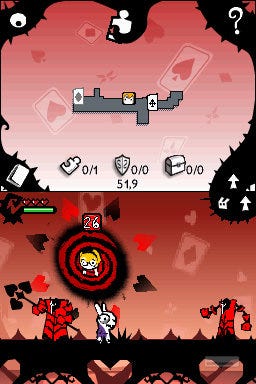
It's the dreamy surrealism of the music and presentation that draws you in, but the deft and creative execution that holds the attention. Alice in Wonderland is a partner-based 2D platform puzzler - mechanically, think LostWinds meets ICO. You control McTwisp, the white rabbit, and Alice skips or runs along behind him, asking for an occasional helping hand to get up a ledge or across a wide gap. Tap her once and Alice stays where she is, staring wide-eyed and slightly gormless around her - leave her alone too long though and a vortex opens up and swallows her.
1

It's far more than just the usual boring team puzzles - at no point do you have to get one character to stand on a switch while the other runs through a door. Alice and McTwisp are joined, later on, by Absolem the giant caterpillar, Chessur the cheshire cat and the Mad Hatter, and all of them have different ways of interacting with the dreamscape.

McTwisp can manipulate time, reversing it to make a fallen apple leap back to its branch to form a platform, or accelerating it to make roots grow into bridges across gaps. Absolem can reverse gravity at certain points, sending Alice skipping across the ceiling, while the Cheshire cat makes objects appear and disappear, and the Mad Hatter can flip the entire world on its axis, Super Paper Mario-style, to see what's hidden behind.

Each new ability is gently introduced, but they're applied more creatively as the game goes on. Old levels are suddenly full of new opportunities with the discovery of a new power. Puzzles will rarely make you scratch your head for long, but they do make you smile - and so will the script. The game is unexpectedly well-written, full of nonsense and slapstick and even the occasional laugh-out-loud moment.

Backtracking is part of the game's makeup, but thanks to the gradual introduction of new toys to play with, it's usually a pleasure. The map of Underland is a jigsaw that you can manipulate and reconstruct at will, creating shortcuts between faraway levels. You find new pieces at a gradual pace, and for me, wrapping my head around the subverted, distorted reality of the gameworld was Alice in Wonderland's most challenging and inventive concept.

There are plenty of lovely DS-control-based moments - blowing away stacks of cards, or boats with playing-card sails across rivers. Walking and jumping work well, assuming you remember to point the cursor exactly where you want to go, and Alice only occasionally has attacks of stupidity and fails to follow you. You activate character powers by holding down any button and tapping the screen.

But Alice in Wonderland asks rather a lot of touch controls alone. Basic combat is needlessly fiddly, involving a confusing combination of frantic tapping and precise swipes. From time to time, the Red Queen sends her knights to try to capture Alice; they appear from a vortex, sending Alice running away screaming. You attack by tapping, but sometimes you're required to roll or block with accurate timing, and it can all be a bit of a muddle.

2

Boss fights are much better, as they're usual more puzzles than straight combat. They look fantastic, too - the character design and animation standards are strikingly high. The Cheshire cat runs and leaps with grace, giant dogs lumber menacingly, McTwisp runs with a spring in his step, the Mad Hatter ambles distractedly and Alice always follows along with an appropriate expression of wonder.

Alice in Wonderland is rarely actually challenging. Even if one of the Red Knights does get the better of you, you simply get up on your feet again after a few seconds. Health pickups are in absurdly bountiful supply, bursting from every enemy and patch of grass in the Underland. Save points crop up every few minutes. The enemies wandering around are superfluous, as there's never even a remote danger that they'll prove fatal.

It all serves reminder that Alice in Wonderland is designed with children in mind, which of course isn't necessarily a bad thing. Kids will appreciate the game's warped, cartoony look, cleverness and sense of humour more than its difficulty concessions.

Alice in Wonderland is surreal, dreamlike, well-crafted and very beautiful. It's always an unexpected pleasure to find a game that both understands and respects its licence, but more than that, it understands its audience - it's child-friendly without being patronising, and endlessly creative in its puzzle design. A few control quirks and repetitive combat hardly dull its appeal.

8 / 10

Read the Eurogamer.net scoring policy

Comments (29)

Comments for this article are now closed, but please feel free to continue chatting on the forum!

  • Loading...hold tight!