Age of Conan: Rise of the Godslayer Preview

Die another deity.

Age of Conan game director Craig Morrison is presenting the game's first expansion, Rise of the Godslayer, to the press in a darkened hotel suite in San Francisco, a stone's throw from the Game Developers Conference. He's got a neat slide summarising how Funcom's focus has shifted during the development of its MMO, from the three Cs of "combat, combat, combat" at launch to "combat, community, content" as it consolidated an initially shaky live game over the last 20-odd months. The mantra for the expansion, he finishes, is "combat, choice, consequence".

Neat, but a little disingenuous, because content - that C in such desperately short supply when the game launched in 2008 - is actually still firmly at the top of the agenda. The need to flesh out Conan rather than stretch it further has dictated the structure and style of this unusual expansion which, despite adding a huge new continent to the world map, doesn't raise the level cap. Nor does it add new classes or professions or player-versus-player systems, or generally get involved in the feature box-ticking that characterises the standard MMO add-on. It's just a lot more adventure and exploration for solo players and groups, presented in an interestingly organic fashion.

"The expansion is very specifically designed to address the content shortcomings that the game had when it launched," Morrison admits afterwards. "The expansion has really been about adding more and more content for players to play through."
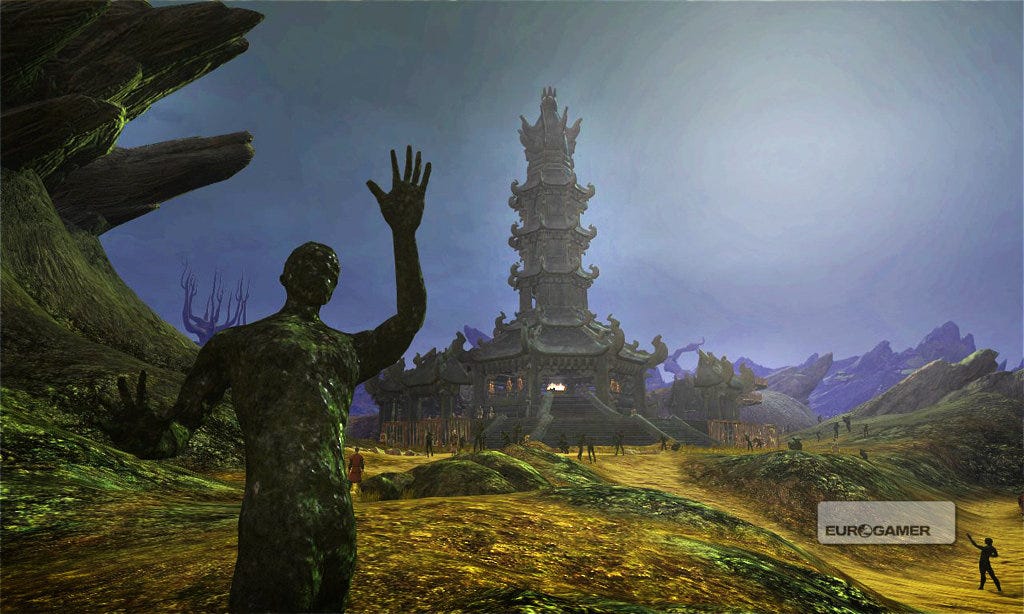
'Age of Conan: Rise of the Godslayer' Screenshot 1

It was nice of them to give the monsters a /wave emote.

You'll find most of the thinking and much of the detail behind Rise of the Godslayer in our original preview from Gamescom last summer. The headlines: the expansion opens up the visually striking, Asian-themed continent of Khitai, as well as the Khitan playable race; the questing - mostly for max-level players but also including some mid-level content - is largely based around sets of warring factions, who reward players' loyalty with armour sets; you'll be able to capture and train tigers and wolves as pets, combat companions and ultimately mounts; and instead of levelling, players will use both earned points and EVE-style offline skill training to make their way through an "alternate advancement" system.

The latter is what Funcom revealed least of last year, so it's the principal point of interest in this GDC presentation. Morrison shows the huge talent tree that will be available to a single character, broader than it is deep and studded with dozens of skills. These are divided in rough thirds into general abilities for all classes, abilities specific to the four character archetypes, and finally those specific to the twelve actual character classes.

Each skill has ranks, and you can choose to spend your points - or offline training time - on acquiring more skills or ranking up the ones you have, advancing or diversifying your character. Given the sheer breadth of skills available and the number shared between classes, it's an extremely free-form system, intended to reward players with flexibility as much as power. There's no cap as such, and since skill points might run out but the offline skill training never will, with enough time you'll be able to collect and rank up the entire set.

Which, naturally, raises a couple of questions. How will Funcom prevent players from becoming massively overpowered, and from drowning their screens in buttons? The answers lie in "an evolution of" a system pioneered by Guild Wars, of which Morrison declares himself a fan. You'll have a limited deck for skills earned through alternate advancement, meaning you'll have to choose which abilities to use, but you will have freedom to swap what's in these slots out of combat. Some particularly powerful skills might use two slots.

"Yes, if we were going to layer all of those abilities that you saw on top, we'd be screwing ourselves," Morrison laughs. "You can't possibly have a player having another 150 abilities active on top of the ones they have.

"By using those slots, it really allows the player to still be collecting abilities and feel they have options to change their role. In MMOs, players can get very pigeon-holed... It gives them a lot more choice in how they play through the content. They're not going to be better [in another role] than someone who's designed to do it, but if they put the right abilities in that bar, they might be able to hold down, in a pinch, a role that they don't have."

This free-form model for character progression has its reflection in how you'll move through the lands, and quests, of Khitai. Funcom certainly has a flow in mind, the huge, contiguous zones having their climax in the final area Pai Kang, which has been designed as a microcosm of the whole continent with its dense jungle, tropical coast and magnificent city furnishing the endgame content.

'Age of Conan: Rise of the Godslayer' Screenshot 2

No-one needs that many tusks.

"There is a difficulty curve," Morrison confirms. But with all but one of the zones being for maximum-level players, it's an organic and loose progression at best, suggested by the skills you earn - which answer certain skills used by the enemies you face - rather than strictly gated by level band. Without raising the level cap, Funcom has no way of strictly controlling your movement through Khitai. Nor, says Morrison, does it really want to.

"It's kind of a meta-levelling system," he says. "We could have called it numbers, but rather than a scale going straight up, it's more of a curve... it allows us more flexibility and to spread things out more, so [players] can explore the content more openly. There's nothing worse than getting to a new expansion and knowing that for the first two weeks, all I'm going to see is this playfield. And then, if I concentrate and level, I'm going to be high enough so that the first thing I see in the next one doesn't insta-kill me."

It's all intended to give the game more variety, something else it was missing at launch, and something that would probably have been an official watchword for the expansion if it didn't start with the wrong letter. Morrison shows video of a team of testers making their way through a dungeon called the Celestial Necropolis in the Khara Khorum zone, which has some unusual mechanics that he's particularly proud of. Players have to use emote animations while standing on pads to form a bridge, three of them holding their poses while the other three run across and fight. The gimmick returns in the final boss fight, where players actually have to copy the emotes used by the dungeon's overlord. (Every playfield has three dunegons, Morrison adds, and they all have a hard mode.)

The principal variety and replayability in Rise of the Godslayer come from the factions. There are 10 factions for players to ally with, coming in antagonistic, mutually exclusive pairs. They have entirely separate quest content - so two playthroughs of the Khitai zones could go very differently, depending which factions you choose - and most players are only expected to engage with three to five of them at once. There are also a further two "hidden" factions: "They're two key groups that are very pivotal to the situation that the players will discover in Khitai, that they may get to align themselves with based on how they go through the quests," Morrison says.

But if anything, Morrison is as interested in the factions' impact on the tone and themes of Age of Conan as their gameplay implications. He wants the choice between them to be more meaningful than whose armour set is coolest, or whose enchantments are best suited to your class - and not drawn along strict good-and-evil lines, either.

"The Priests of Yag-kosha are one of the factions in the game, and the writers introduce them as a very humble, very noble sect of priests who used to worship Yag-kosha as a god, and they're very visible to the player as good guys," he says. The problem is that Yag-kosha is the elephant god Conan killed in Robert E Howard's story The Tower of the Elephant, lending this expansion its foothold in Conan lore as well as its title. It was a mercy killing, but it had terrible implications for Khitai and remains pretty unpopular with the god's followers.

'Age of Conan: Rise of the Godslayer' Screenshot 3

Rise of the god-ray, more like.

"These people are helping their community, they're dedicated, but their goal is to kill Conan because he killed their god, and he must pay. And Conan's your King. So it presents players with this kind of morally ambiguous choice," Morrison continues. "Robert E Howard always wrote about shades of grey. His world wasn't black and white. He believed society was corrupt and civilisation would destroy itself from the inside out. Khitai is really the embodiment of that, we're really trying to drive those themes that Howard wrote about."

With Khitai only existing on the periphery of the Conan universe, Funcom's had great freedom to develop this expansion as it sees fit, to take possession and control of its virtual world. But Morrison believes that, if anything, it's taking Age of Conan closer to the source material than ever before. "Howard only wrote four or five lines about Khitai in his writing and it gave us some great visual licence to create a world that hasn't been created before. But in terms of themes, I would love to think that if Howard was still around today, this is the Khitai he would have written about."

Age of Conan: Rise of the Godslayer is due for release in the first half of 2010.

Comments (34) Latest comment 2 years ago

Comments threads automatically close after 30 days, but please feel free to continue chatting on the forum!