Again Review

Thanks for the memories.

Version tested: DS

Hi, my name's Simon Hardnosedcop, recruited by Eurogamer to investigate games. I'm good at my job, and this is a significant case, reporting on DS adventure Again. I think the Chief is going to be impressed with my work, and I'll finally get the promotion I'm so overdue.

Hey, you, I'm FBI Special Reviewer John Walker, and I'm claiming jurisdiction here. This is now an FBI review.

No way, man! No way are you suits just marching in and taking this one from me. I've been working this case for months, and there's no way I'm just going to hand it over to a bunch of Washington nobodies.

Listen, I'm going to have to ask you to hand over all your review notes, and a copy of the game. Please do it quickly, detective. Don't make me remove my shades.

I'm taking this to the mayor!

The onion-like layers of a Cing game are fascinating. Like Another Code and Hotel Dusk before it, Again is bubbling with ideas, a game that asks questions, manipulates design, and experiments with time and memory. It's a game that asks the player to think more deeply, or at least demands that one be slightly pretentious when discussing it. But rather sadly, it's also rubbish.

Ostensibly an adventure game, Again's premise is not stunningly original. You're FBI Special Agent Jonathan Weaver, investigating a series of killings, and for all the elaborate and peculiar oddness that this involves, it's inescapable that this is yet another adventure game about a man solving some murders.
1

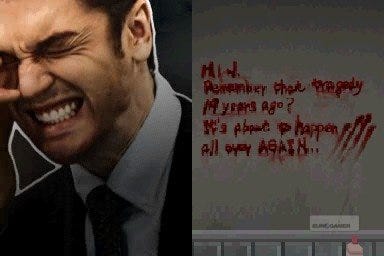
The photograph characters are never cheesy, which makes for a change.

It's a nice enough idea. 19 years ago a serial killer murdered six people over two weeks, including the mother and father of our protagonist. The murderer was never caught, and now it seems the same pattern of deaths is occurring again. It's about the past infesting the present, both literally and figuratively.

The game splits into two styles. With the DS held sideways throughout, there are information-gathering sections which see you chatting with colleagues, questioning witnesses and gathering evidence, alongside first-person portions which offer a much more hands-on experience. The latter require you to take advantage of an unusual investigating skill.

J, as he's known to his chums, possesses a rather strange ability. He has psychic powers that enable him to see into the... past.

Er, me too. Tickets are available if you would like to see me demonstrating this extraordinary power. I call it: "Remembering". I am able to accurately predict (or as I call it, "recollect") the events of yesterday with extraordinary clarity!

But I'm not being fair. J's talent is rather more impressive, if somewhat cumbersome to use. Entering the scene of a crime, he is able to psychically see a vision of the location at the time the incident occurred. The right touch-screen shows the present day, which is navigated using the d-pad (or face buttons for witches), your view moved by the screen. The left screen shows a sepia-toned version of the same place, viewed from the same perspective, however many years ago.

In order to make use of this, rather weirdly, you must make the present day version of the scene match the original, turning things into an elaborate, first-person game of spot-the-difference. Find what's different, then focus on it (hold the stylus down on it for a bit) and you'll have a brief vision confirming that it needs altering. Find a way to do so (this can be very simple, like pulling a shower curtain, or far more complicated involving finding other inventory items, manipulating the environment and so on) and J will have a strangely green vision of the crime taking place. Find all the elements involved and then arrange them in chronological order, and J will see the original crime in glorious technicolour clarity.

It's a great idea. It's not done well. Which captures everything about the game. The primary issue with Again is how clumsy everything feels. Even having a conversation with someone can become tortuously slow, as you watch the figures of those taking part slowly swooshing back and forth on the left screen, their comments eventually appearing on the right.

"Shall we leave?" Swoosh. "Sure." Swoosh. "OK then."

What's more, conversations make up the majority of the game. They're not especially poorly written, but revel in murder fiction cliché. Retired cops are grumpy about recalling cases, witnesses look shifty as they obviously lie, coroners overtly flirt before they hand over evidence, and of course police are furious that the FBI are involved. But it's the pace at which they're delivered that makes them so frustrating. Further, when you're done questioning someone, rather than the game prompting you to move on, you're left with the conversation screen up but empty, and required to back out of it, choose "move", and then watch as the characters continue the closing parts of the chat.

2

Endless dialogue portrayed so very slowly prevents any feeling of pace.

It's one of the many ways that you're left feeling completely uninvolved in the unfolding of events. You've a phone, but use it when the game hasn't prompted you to and you'll get voicemail. And when the game does prompt you to, it locks out any other options anyway.

Another strange feature is quite how weak an FBI agent you are. While local cops are enraged that the FBI has turned up, you are constantly ordered around by those police, your colleagues, even witnesses. If a witness tells you to come back later there's no conversation option saying, "We're the FBI. You'll do as you're told." Instead you're forced to politely agree and be on your way. Don't you have a gun and a badge?

The Vision sections are broken in their own way. Movement is hilariously slow, not only as you trundle about an area like an arthritic snail, but also as you sweep at the screen over and over to attempt, say, looking at the floor. Reconstructing the past requires you to have what it calls Vision Flashes, which feel superfluous and frustrating. If you've solved how to reconstruct something, the game simply won't let you before you've flashed. But then it also penalises you for attempting to flash in the 'wrong' place. What's right and wrong is extremely ambiguous, plus you've a limited bar of psychic power to attempt this – and if it runs out, you die. Which is odd. It seems to be emulating Phoenix Wright, but managing to get the idea even more wrong.

As the game progresses you have very many accessible locations at any one time, and no useful direction. It's most peculiar, the game grabbing you roughly by the wrist and dragging you through acres of linear, choice-less conversations in the order it prescribes, then suddenly dumping you confused with no idea about where to go next. At one point you've got to find some cigarettes (for a completely ludicrous puzzle) and the expectation of the player is to visit every available place and aimlessly ask about it. When the completely unlikely correct place is found, even the game's characters comment about how unexpected it was to find them there.

All of which is to ignore Cing's trademark intelligence. Like Hotel Dusk, characters exist in a real-world/artistic hybrid. Here photographs of real people are used, smartly animated and without looking tacky. But their pictures are surrounded by a thick, white outline against the photographed backgrounds, and even more interestingly, their forms degrade into animated scribbling. When you enter a new location, the silhouetted form of J walks across a black background, painting in the scene behind him. (The effect is somewhat spoiled by his form looking rather like his penis is hanging out and flapping around, which is more than a little distracting.)

3

That freaky eye on the back of a dollar bill is key to the entire plot.

This sophisticated understanding of mise-en-scène, and the questions it asks about reality and fantasy, is Cing's trademark. Moving from Hotel Dusk's pencil sketches to Again's eroding photographs is fascinating. (Sadly, the studio has now closed, so it seems unlikely we'll see the Hotel Dusk sequel, Last Window in English.) The trouble is, I'm left far more interested in sitting down with Cing's designers and talking about these themes and their fascination with Verfremdungseffekt than I am in finding out more about the murders.

Unlike Another Code, where the loveliness of the story and the brilliance of a few of the puzzles overcome the weakness of the core game, and unlike Hotel Dusk where the depth of character, extraordinary use of art, and exploration of coincidence overcomes poor puzzles and dodgy pacing, Again doesn't offer enough to forgive its poor construction. Each of their games has been a study of memory and the role the past plays in the present, and it's clearly wonderful that there are (or were) people wanting to tackle these themes in games. Again, even by its title, grapples with this, but it does it in a plodding, tiresome game that is only able to frustrate. It's a great shame.

4 / 10

Again is out now in North America. There are no plans for a European release.

Read the Eurogamer.net scoring policy

Comments (31)

Comments for this article are now closed, but please feel free to continue chatting on the forum!

  • Loading...hold tight!