2D Boy, creator of indie hit World of Goo, is made up of just two people. Ron Carmel and Kyle Gabler met at EA, where they were both struggling to function within the then-enormously-corporate machine, and both bursting with ideas that couldn't get out. Later they escaped, and made World of Goo, which we adored on the PC and loved even harder on Wii.
A few months on from the game's release, we grabbed them and demanded they tell us everything, from leaving their jobs to the process of creating the blobby puzzle game that's had us all swooning.
Eurogamer: How did 2D Boy meet?
Ron Carmel: At EA, through our mutual friend, Amin Ebadi. It was pretty random. Who leaves their perfectly good job after meeting their future business partner only a few times?
Kyle Gabler: We were having a similar existential crisis. I got a bunch of books on how to 'Do Business', because not having a job sounded scary.
Ron Carmel: You know that feeling when you've been meaning to do something and then you find out someone else wants to do it too? But it's actually not as scary as working 9 to 5 in a cubicle farm for the rest of your life.
Eurogamer: So was there a plan when you quit?
Kyle Gabler: The big plan was to make a game, and hope people like it
Ron Carmel: At first we were working on a game about the life of a tree that takes place over 100 years.
Kyle Gabler: If you're curious, it was based on Big Vine.
Ron Carmel: But then we switched to something based on Tower of Goo.
Eurogamer: Why Tower of Goo? Was there something specific you were both interested in heading toward, or were you experimenting?
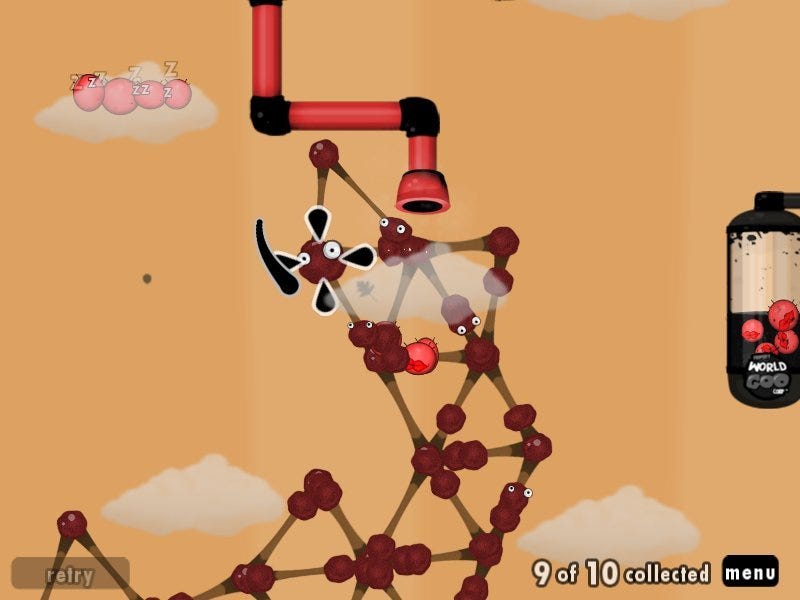
Kyle Gabler: Around the same time, we noticed a shady company trying to make a Tower of Goo clone for mobile phones. It was like Tower of Goo but horrible. And it hurt, and made me feel sad that someone would so blatantly borrow a game design. Ron and I were lazy up to that point. Then we decided we had some good competition, and we could make Tower of Goo bigger and better.
"Tower of Goo always seemed like it could expand well into a bigger game. Originally it was going to be a very casual game. With fireworks at the end of levels, etc."
Eurogamer: So you had Tower of Goo, and you wanted to develop it. Were there goals?
Kyle Gabler: Tower of Goo always seemed like it could expand well into a bigger game. Originally it was going to be a very casual game. With fireworks at the end of levels, etc.
Eurogamer: Ode to Joy?
Kyle Gabler: Exactly. But then it turned out to be a bad thing we were making a game based on Tower of Goo. It generated a lot of self-consciousness. Because we knew people assumed that every additional level would be crappy extensions of the main Tower of Goo prototype. Like, Ice Level. Or Generic Bridge #14.
Eurogamer: Lava Level.
Kyle Gabler: Egypt World.
Ron Carmel: Oh, good one!
Kyle Gabler: So, fuelled by self doubt, the game kept evolving because it never felt good enough. We had never directly made something that people paid money for. And it felt wrong to try and charge money for a crappy game.
Eurogamer: So how did your day-to-day lives work? Did you have a base of operations?
Ron Carmel: Our base shifted. I remember one meeting about the tree game we had in a park in San Francisco. Seems like the right place to brainstorm about trees, right? But most of the time we worked at various coffee shops. Probably three or four times a week. The rest we just worked from home.
Eurogamer: Why in public, rather than going to one or other's home?
"We never had any assigned roles. At first both of us were doing programming. And over time, clear roles emerged based on our individual strengths."
Kyle Gabler: Working at home is lonely. It turns out there is a whole secret underworld of slackers who "work from home" out of coffee shops. I met one guy with a bunch of circuit boards plugged into his laptop, doing embedded programming right there.
Eurogamer: What were the roles you each played then?
Ron Carmel: So, it was a little weird. And changed over time. We never had any assigned roles. At first both of us were doing programming. And over time, clear roles emerged based on our individual strengths. I think it took a while for me to get to trust Kyle's game design sense and took him a while to get to trust my software design sense. Once we realised, "Oh, they have that end of things covered," about each other, things really flowed well. It became clear who should make what call.
Eurogamer: So who was Allan Blomquist? He's the other name on the credits.
Kyle Gabler: Allan is a friend from grad school. We made Virtual Reality 3D Pong together. He's in the top five best developers I've ever worked with. Ron and I made the PC game, which Allan then took, and made it run on the Wii
Ron Carmel: He got the game running on Wii in under three weeks. Who does that kind of thing?!
Kyle Gabler: He did amazing things, like optimise which CPU registers are used, and memory alignment. Those things, of course, don't actually mean anything, but you can notice it, if you play the game, and it feels like butter. Some other facts about Allan Blomquist - he is nourished entirely by Snapple, Subway sammiches, and episodes of Felicity.
Eurogamer: What was the first big evolution World of Goo took from its Tower origins?
Ron Carmel: I'm not sure there were any big evolutions. Or revelations. It was a very slow process, like... evolution!
Kyle Gabler: It took an obscenely long time to figure out how the levels would be laid out. It took a wall of Post-It notes to figure out that the game should be divided into "islands", and then each "island" would contain "levels".
Ron Carmel: At some point we're going to put out some early versions of World of Goo. They're hilarious, and really not right. A lot of small steps. We were still adding and changing stuff up until a month before the release. OCD didn't make it in until the last second. Last night I played an old version where all the islands and all the levels in each island were laid out on a single screen.
Kyle Gabler: With the giant rocket ship?
Eurogamer: There was a giant rocket ship?!
Kyle Gabler: You'll see how much the art evolved, if I remember right. At that point, I think the whole game was a giant joke about international outsourcing.
Eurogamer: When did the World of Goo Corporation appear instead?
Kyle Gabler: Oh, that was another one. We didn't know there were pipes in World of Goo. At first, the end-of-level goal was a glowing vortex thing which would have been horrible. Then pipes seemed to make a lot more sense. And of course, a giant global pipe system must be connected to a giant corporation. The corporation helped tie the islands together. But the real glue that brought everything together was the Sign Painter.
Ron Carmel: I remember the day Kyle had the idea.
Kyle Gabler: That little guy (or girl) was a life-saver.
"You'll see how much the art evolved, if I remember right. At that point, I think the whole game was a giant joke about international outsourcing."
Ron Carmel: I didn't give it nearly the credit it deserved. I just wasn't seeing it. And it turned out to be one of the things that people really love about the game.
Eurogamer: What about the level-creation process? How did each level come into life?
Kyle Gabler: I try to think, "What level will look good in a trailer?" Since we have no marketing budget, the videos and screenshots have to sell the game, so the game should try to be as interesting-looking as possible
Ron Carmel: Kyle, I didn't know you were such an evil marketing mastermind.
Kyle Gabler: Fisty the Frog got posted around the internet a lot. It made him so happy! So I tried to make more levels that had humanity, or at least giant eyes or vomiting creatures. So I would sketch on paper, take photo with my cell phone camera, and trace over it in Photoshop. And for the level gameplay, it's similar. Sketch out geometry, try playing and see if it's fun using just squares and circles, if so, then proceed with art. [There's a video of this process on the website. - Ed] The painful part happens, occasionally, if a level is made with full art complete, and it's still just not fun. It happened more than I'd like to admit, and they all had to get cut out of the final game.
Eurogamer: Was there a level in particular that was hard to let go of?
Kyle Gabler: There was a level called Crash. Where there was a giant spiky ball, and you had to build a bridge with Skull Goos for it to roll across so it could plough into a tower of Gray Goos, destroy them, and allow a big level to fall, and more Goo slides down out of that. I just couldn't make it work. But the Giant Spiky Ball eventually became the Beauty and Ugly Goo Balls, with puzzles where you had to indirectly guide them through dangerous situations.
Eurogamer: The beauty theme really stood out to me. Where did that come from?
Ron Carmel: Project Runway?
"The reception has been surreal. One of my childhood heroes, Tim Schafer, actually played the game. With his baby!"
Kyle Gabler: I watch a lot of America's Next Top Model. And Project Runway.
Eurogamer: Me too. The shame. Those big beautiful Goos, smashing the ugly to make their pathways. It seemed a strong statement.
Kyle Gabler: One of my favourite characters is Norma Desmond, from Sunset Boulevard. She makes a bit of appearance through the Beauty Balls, and especially MOM. A silent film icon, who never let go of her former beauty and fame, ends up going mad. There is something really sad about beauty, and time passing. But the game isn't serious at all. It was really important for the game to never take itself seriously.
Eurogamer: There are other sad tones, of course. The lonely Sticky Goo especially.
Ron Carmel: Poor Pokey. I so badly wanted to see him go into the pipe with the other Goo Balls.
Kyle Gabler: Yeah, that horrible Pokey Ball. There was a limitation with that one, where we couldn't have two Pokey Balls in any one level. Or the game would explode.
Ron Carmel: No! I fixed that!
Kyle Gabler: You did?! Well, that's why he's lonely. But apparently he could have been a social butterfly.
Ron Carmel: A perfect example of how technology influences game design.
Eurogamer: The MOM character is fascinating. I don't think there was anyone playing who thought, "I was totally expecting MOM to appear." Where did she come from?
Kyle Gabler: Full Throttle. What was the name of the character on the motorcycle in the 3D fighting road? Father something.
Eurogamer: Father Torque.
Kyle Gabler: Yeah! He felt, to me, to be like an angel, or god-esque character. There was choral music playing in the background. MOM is a combination of him and Norma Desmond, if they were a web 2.0 app. Tragic, lonely. And she inadvertently sets up the events that lead to the climax of the game. MOM was the biggest risk. I was afraid people would get to her and say "WTF", and close the game and never come back.
Eurogamer: And what has the response to her been?
Kyle Gabler: In the first revision of the game, it was too difficult in the build up to her. So everyone was grumpy when they met her! So we quickly fixed that difficulty spike. Somehow, nobody complained about her. People knew what to do, and she seemed to be perceived as a natural part of the game's progression. We were terrified people just wouldn't get the MOM to 'terms and conditions' acceptance to 'deliverance' progression. Foreshadowing her helped. There are bulletin boards in each of the chapters leading up to her, old advertising messages for MOM.
Eurogamer: How have you felt about the critical reaction?
Ron Carmel: We ran into the streets gloating and acting like asshole rock stars. But nobody knew who we were.
Kyle Gabler: Every sentence of every review is like an emotion-coaster. Negative comments sting, even now, a couple months later. When a small team makes a game, or any project, I suppose it's easy to directly map criticism about the game or project directly onto yourself, which probably isn't the healthiest thing.
Ron Carmel: We kinda grew slightly thicker skin after the backlash from the announcement about the more expensive retail release in Europe. That freaked us out. I think people forgot we were humans too. Some nasty things were said.
"The real glue that brought everything together was the Sign Painter."
Eurogamer: But your Metascores are 90 and 94!
Ron Carmel: It was an incredible thing. I'm not proud to admit it, but I checked that thing every morning to see if the 4th score had come in. It's strange. When you have a boss, and you get a year-end performance review and bonus, that's how you get validation for doing a good job. But as your own boss that part is missing. We still need external validation, so we get it from people who write to us to say that they enjoyed the game, and from reviews and, yes, even Metacritic.
Kyle Gabler: The reception has been surreal. One of my childhood heroes, Tim Schafer, actually played the game. With his baby!
Eurogamer: A lot of reviews have talked about the amount of love that seems to have gone into the game, and the way it makes people feel so happy to play. Was this something you couldn't help doing? Or something you didn't do and it resulted anyway? Or something deliberate?
Kyle Gabler: I'd say the first two. It's Stockholm Syndrome. You can't help but fall in love a little bit with the thing that's endlessly occupying your life. But I don't think we ever felt self-satisfied about the game. It was probably good that we always hated it a bit too.
Eurogamer: When Jon Blyth reviewed the PC version on Eurogamer, he said that he feared for you both having to follow it up. Do you feel that way at all?
Kyle Gabler: Yeah we don't want to make a Temple of Doom. But the next game will be a dumb arena shooter.
Ron Carmel: Hey, how did you know about my idea? I was going to tell you about it tomorrow.
Eurogamer: So apart from the arena shooter, are you working on anything now?
Kyle Gabler: The next step is to prototype a bunch of new ideas. One week each.
"[Allan Blomquist] got the game running on Wii in under three weeks. Who does that kind of thing?!"
Ron Carmel: We have a bunch of ideas laying around, none of which is one of those "oh, that's a game" kind of ideas.
Kyle Gabler: Yeah, the plan is to make a bunch of stuff, and see what sticks.
Eurogamer: After it all, would you encourage others to do the same? If they've got a great idea and the skills, should they strike out on their own?
Ron Carmel: Hell yeah! And it has nothing to do with money, by the way. It was about doing what we love, not about starting a company. That sounds really cheesy, but it's true.
Kyle Gabler: To anyone thinking about quitting everything and making an indie game, it's good to remember that you can always go get a job if it doesn't work out.
Ron Carmel: There are so many game developers being laid off now, it seems like the perfect time for people to go indie. Yay for severance pay!
