Saturday Soapbox: 3DS Six Months On

Charting a troubled launch.

In hindsight, I should have listened to my mum. You see, mum loves Nintendo handhelds, and has owned every single major new model since the original Game Boy.

So she was as excited to see 3DS as I was to show her when I took one back to my parents' house with a bunch of games just before it launched in the UK in March.

And, for the first time ever, she was utterly underwhelmed. "The 3D is annoying. What's the point of it? And I don't like any of these games". More damningly, she said it felt like a "backward step" from her beloved DSi XL (her platform of choice because of the screen size).

At the time, this was the first unequivocally negative reaction I'd encountered. The pre-launch hype from all quarters (including myself) was overwhelmingly positive: Nintendo was the company to single-handedly popularise stereoscopic 3D with its glasses-free revolution.

In the UK, Nintendo was reporting record pre-orders and the trade (again, myself included) fully expected it to smash the PSP's sales record to become another instant smash-hit for the company. And then it launched.

The first sign something wasn't quite right was how long it took Nintendo to announce launch sales. The press release announcing sales of 113,000 in the UK didn't come until the end of the following week - and tucked away in the small print was the line: "Sales figures source: Nintendo UK internal Sell-thru Panel w/e 26th March 2011".

The reason why that was interesting is because it is, shall we say, highly unusual not to use data from Chart-Track, the official body that collates hardware and software sales in the UK.

Chart-Track issued its own figure to subscribers earlier that week (which can't be reported, but you can assume it was lower), and Nintendo decided to issue its own. Curious.

To be clear: in no sense is 113,000 consoles sold in two days a "bad" launch or a "low" figure - it was, after all, one of the best console launches ever. No, what surprised industry watchers was that it wasn't bigger.
1

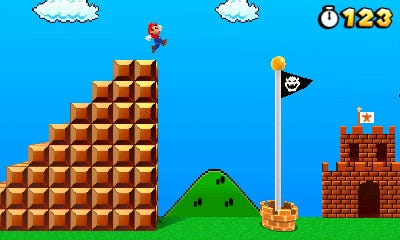
Super Mario 3D Land looks to give the handheld a boost, though some would argue that it should have launched sooner.

After all, Nintendo had trumpeted pre-orders of 140,000 in the UK - which apparently and strangely did not convert directly into sales. More telling, though, were the software sales figures. Lego Star Wars made it to No.2 in the all-formats countdown, with Super Street Fighter IV the top 3DS exclusive at No.4. But that only paints half a picture.

Again, I'm not allowed to share the numbers, but the total figure for the top ten 3DS games added together was fewer than Crysis 2 sold to top the chart that week.

As many, many people have since observed, there were some very good games in the launch line-up, but no obvious, system-selling 'killer app'. No Mario, no Zelda, no Pokémon. And that's because Nintendo actually treated 3D as the killer app. And that proved a serious mistake.

"3D TECHNOLOGY EMBRACED THROUGH NINTENDO 3DS", screamed the post-launch press release. All the messaging, all the TV ads were focused on 3D. Then all that awkward '3DS causes headaches' business started in the press and sales began to tail off.

Few, least of all Nintendo, had expected this and suddenly the company found itself with an expensive new handheld console whose sales were going south, and a dearth of exciting software to fire it back into action.

Nothing showed more clearly where things had gone wrong than the launch of the Ocarina Of Time remake - a game well over a decade old, but one of sufficient stature to bring 3DS owners out in force and make it by some distance the system's fastest-selling game.

But then what? Very little, as it turned out. And with sales still flagging Nintendo - to its credit - responded with a drastic and unprecedentedly early price cut, with the console plummeting to a far more attractive Ł115 at some retailers.

Just as critical, the advertising campaign around the price cut marked a dramatic change of tack. "The next-generation is here"; "amazing graphics"; "This is not DS, this is 3DS" - a tacit admission that these were the things Nintendo should have focused on in the first place. And not a single mention (other than in the small print) of 3D.

As hard as Nintendo, Sony, Sky and movie companies flog it, stereoscopic 3D still lacks any sense of irresistible momentum. Nintendo's focus on this feature - and to be fair, I doubt any marketing team would have done it much differently - obscured the vital fact that 3DS is far more powerful than DS. But the messaging - and even the name of the console itself - failed to communicate this.

This effective relaunch was good, positive stuff and console sales almost tripled in the immediate wake of the price cut. But without any massive games to back it up, sales soon dropped off again. Nintendo's biggest recent release, the 3D remake of Star Fox, did not do anywhere near Zelda's numbers, charting at No.9 in a slow week.

The sudden appearance of the bizarre Circle Pad extension further complicated matters. On the one hand it meant an exclusive Monster Hunter title for the platform (a huge, huge deal in Japan); but on the other it served to highlight a fundamental limitation of the original design and suggest to would-be buyers that a full revision may be on the horizon.

It's been a tougher first six months for 3DS than anyone expected. Irrespective of any missteps Nintendo may have made, iOS has in the meantime continued to explode in popularity as a portable gaming platform, offering pick-up-and-play fun often at a fraction of the price of handheld console games.

2

Starfox 64 3D underwhelmed at launch, only reaching number 9 on a relatively slow week in the UK charts.

Both Sony, whose Vita launches next year, and Nintendo should be worried about the price pressure Apple's success is putting on their full-whack portable products. To argue about the relative depth of content is to miss the point.

For Nintendo, it is at last about the games. And as 3DS's first Christmas approaches, hope comes in the shape of its greatest asset, with Super Mario 3D Land and Mario Kart 7 both imminent.

In other words, exactly the games that should have been there from day one. Games that will define the system with exclusive, fresh content to set it apart from rival platforms. You know, they type of games Nintendo has always made.

It seems so obvious in hindsight, but Nintendo's success has always been driven by a focus on amazing, surprising gaming experiences facilitated by great tech. Even with Wii, the technology was never an end in itself, and it would not have been the breakaway success it was had it not come packaged with its definitive experience: Wii Sports.

The reason 3DS has struggled to capture the imagination so far, then, is because it's been too much about the technology, with too little in the way of games to show us why we should care.

So my mum was right: it's all about the games. When they come, she may well learn to love 3DS, too. But for Nintendo as well as existing 3DS owners, they really can't come soon enough.

Comments (55)

Comments for this article are now closed, but please feel free to continue chatting on the forum!

  • Loading...hold tight!