I thought it would be a good idea.
After writing a couple of retrospectives of some entertainingly awful games (Driver 3, Soldner), when a developer approached me saying he'd worked on Driver 3, but suggested I try out another game he'd been involved with that was even worse, how could I resist? Someone telling me that a 2006 PS2 game so obscure it hasn't even troubled Wikipedia, let alone Metacritic, is so bad that it deserves attention. I went straight to eBay and found myself a copy.
Games like Daemon Summoner can slip through the cracks. They can go forgotten by the mainstream media, and by gaming at large, and that's a tragedy. Because when a game is as bad as Daemon Summoner, not being aware of what it's up to can only be dangerous. It would be like discovering a portal to hell, and thinking, "Meh, best left ignored." No, that's how the end of the world begins, and I'm not about to let that happen.
So with high expectations for low expectations I sat before the PS2, creaking controller in hand, and settled back to enjoy the misery.
But, see, the thing is, there's so bad a game can be that this isn't even possible. Because sometimes a game is so bad that contemplating getting past the second level is beyond even my steely will.
Things begin in some mad amalgamation of late 19th century London. Long, stretching streets of identical buildings disappear to vanishing points, criss-crossing in perpendicular grids, decorated only with the odd cart or crate. And through it you must pursue Emily, a vampire who has been killing prostitutes and letting Jack The Ripper take the blame.
Let's have an aside on old JTR for a moment, shall we? We are a strange bunch, with our tolerance for the most grotesque content in our fiction so long as a lot of time has passed. For instance, I don't imagine we'd be all too keen on a game loosely taking the events of the Yorkshire murders of the late '70s, claiming vampires were responsible for Sutcliffe's crimes. But because these prostitutes died 120 years ago, outside living memory, they're fair game. It's a weird flippancy, and it's not like Daemon Summoner is especially worse in the broad crowd.
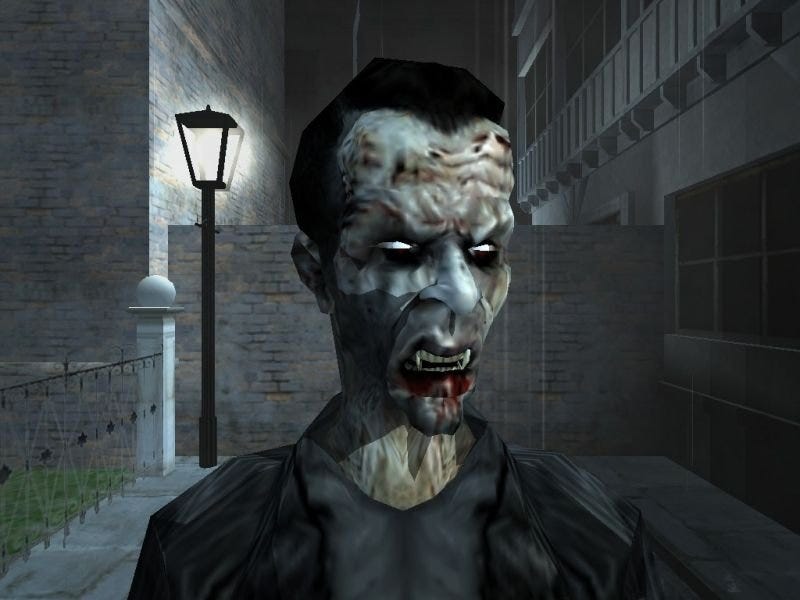
Surely fangs set that far back are no use at all?
Any how, this vampire, Emily, is letting the fictional Jack T. Ripper take the flak for her bloody-sucking ways, and apparently you're someone trying to stop her. Why? Uh, I don't know.
It's perhaps not quite far to say that Daemon Summoner doesn't explain its own plot properly. Because it's almost impossible to hear any of it under the sound of the four seconds of looping rain/background noise. But I think I'm fairly sure that there's no moment that explains who or why or what anything is about. And not being able to get past the second level, I don't know if there's anything about summoning daemons at any point.
The opening level's London streets eventually give way to some sewers, in which you meet the first enemies. Skellingtons. These buggers are so determined to gnaw you to bits that they'll even continue biting you after you've exploded their heads! Their heads are especially prone to exploding, bursting bloodily when you shoot an arrow at their chests.
In case shooting at these beasties was any fun, you're given a crossbow that takes about five seconds to reload. This means you have to run backward down the near-infinite sewer corridors, which as you'll probably have guessed, makes you invincible. Get caught on an invisible wall of course and you could be in trouble, as an absent head starts angrily biting you.
The sewers make the streets above look positively picturesque. These are massively long grey tunnels, again criss-crossing each other at such enormous length, and with no clear clue about which direction to head in, that it feels like an attempt to build the world's dullest maze. Award them a blue plaque, because they achieved it. Escape this tedium and it's back up to the London roads and more aimless nonsense. Two vampires to fight, who again can't hurt you if you run backward, and then if you're lucky enough to follow her quickly enough, and don't have to wander around the enormous identical streets for ten minutes first, a fight with Emily!
A fight that sees her fall the ground, having been filled with crossbow bolts, and then in a cutscene stand up, gently poke you so you fall uselessly to the ground, and then scarper. Level finished!
Level 2 changes things up. A pistol is mysteriously added to your arsenal, and then you're told if you use it it's game over.
It means game over.
When you lose in Daemon Summoner, you don't go back to your last checkpoint, the beginning of the level, nor even the load screen. You find yourself unceremoniously dumped at the "Press Start" screen! Then after agonisingly accessing the memory card, choosing the save position to load, waiting for it to say it's finished loading, then for it to actually load, then the unskippable cutscene at the start of level 2, and you're off!
In this level you must sneak aboard a boat on which the vamps are scarpering. To do this you are told you must get across via a crane from a nearby warehouse, packed with the undead. If you're seen, game over. And you are. Whether you're visible or not.
I have watched that opening cutscene so many times I know it off by heart, right down to the insane grimace offered by head vamp, Cheesy McBitington. I then sneak into the warehouse, and through trial and error know to hide in one area as some of the guards suddenly sprint for the entrance for no reason. Then it's to the steps, and the walkways, where you must reach the crane which is in no way possible.
That's as far as I've gotten. I've essentially written you a walkthrough for the areas of the game I can reach. It isn't possible to get across that walkway, because the vampires patrol it in such a way that there's never a clear gap. Oh, and can see you when they're not looking. Which cuts to a little death scene taking place somewhere other than the walkways, where one vampire waggles his leg about a foot behind your head, you fall down, and then watch the unskippable to cutscene of the boat pulling away, sailing off to sea, and the camera slowly drifting down behind some crates, before we're back at the main menu.
It's too much. Far too much. How did it happen? I got in touch with that developer and asked, "Why?"
"We were told to," he replied. Before adding, "Well, ok, slightly more substantial answer: This is somewhat the destiny of being a small independent studio that has to pay wages and for office space that hasn't got the resources behind it to develop their own IPs. It seems like a vicious circle of trying to make money from outsourced projects to pay for staff to make outsourced projects, and if you're not careful it can lead to a dark place."
It seems that Daemon Summoner was made in around three months. Which is... extraordinary. The FPS engine was in place, but they put together an entire game, no matter how dreadful, in just a few weeks.
This weapon appears to be firing those sucker darts, except facing the wrong way.
"Timescales get shorter, budgets get tighter, teams get smaller," my mole tells me, who is in fact Chris Simpson, now of Indie Stone fame. "Until you get to the crazy situation where one sole programmer is responsible for development of an entire game in just a few months."
The situation was not fun, and it's defined the philosophy for his current independent team. "Obviously this was the worst case situation and going into our own indie endeavours it's what's prompted us to have the policy we'll never hire staff, never have office space. Because as soon as you have those financial commitments you end up losing ground with each project, and when you have staff to pay and haven't got the money to do it, then you end up getting outsource work to pay the bills, and it just descends from there and is very difficult to recover."
It's interesting to see a bad game in this light. It doesn't make it any less of a bad game, and as soon as money is charged for a product, it's always fair game. And Simpson agrees entirely. But a few years later, it's interesting to allow a more human angle on it all. Simpson explains that blame for such things is easy to throw around. "While working on it it's easy to feel like its your bosses fault, or the designers fault, or your own fault, but really it's just about a company trying to make its way with limited resources."
Does that make mocking a shitty game unfair? I certainly don't think so. Simpson is perhaps more balanced. "It's easy to judge a game on how it turns out, but it's never the full story." I'd argue it is for the player, of course. "Everybody enjoys reading bad reviews. I've enjoyed bad reviews of games I've worked on, mostly when I knew from day one what I was working on was shit and never had a chance of being anything, but you stop feeling shame after a while, because you're sure it's not you that's personally responsible."
Which seems to be a dangerous path to head down. But Simpson suggests it can eventually be the inspiration you need. "It is that that drives you to eventually set off doing your own thing, not only to try and finally make a success of yourself, but to prove that all that time you were right, and it wasn't you, it was the situation, or everyone else on the project, or your bosses, or whatever else."
If it took Daemon Summoner to get us the potential of Project Zomboid, was it worth it? Certainly not if you bought the thing, I'd ponder.