Version tested: DS
Fetch the violins: I love football, but have always been crap at it. Whoever at Level-5 is responsible for Inazuma Eleven's concept is, I'd bet, in exactly the same boat: an enthusiast rather than an expert, the first to every match but one of the last to be picked. They know the dull ache of the substitutes' bench, or something like it. Inazuma Eleven isn't just a football game; it's a game about the love of football.
And one that's knocking on a bit. It's taken Nintendo over three years to release Inazuma Eleven in the UK, in which time it's not only been available in Japan, America and the rest of Europe, but has had two DS sequels and a Wii spinoff. Its age isn't nearly enough to warn you away from this, but Inazuma Eleven can feel clunky in terms of its menu screens and overall interface, which are aspects the series has since refined. But hey, this is Nintendo Europe, so let's party like it's 2008.
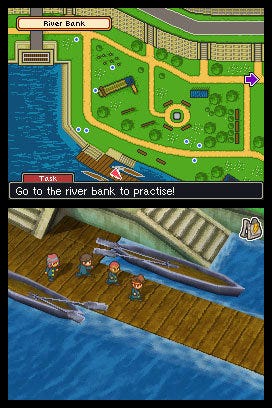
You play Mark Evans, a plucky young goalkeeper who's football-mad and the captain of his school team - which, at the start of the game, doesn't even have enough players for a match. The school is the hub for Inazuma Eleven, with most chapters constructed around a single match against a themed opposition team, and another chunk of the story to take you around the world map - a still screen that lets you jump from place to place.
These sections of the game are pure RPG and, while Inazuma Eleven has plenty of byways and side streets to be explored, the story's linearity isn't helped by a massive arrow pointing to where you need to go next and the objectives constantly being spoonfed.
Three team-mates follow Mark around, and you can chop and change them to prepare your random battle team.
As the game progresses the story ascends into true lunacy. What begins as a quest to get together some mates for a kickabout soon turns into a Power Rangers-style battle for life as we know it, with high-school football deciding the fate of the universe and waves of flaming, teleporting footballs fired at hapless goalkeepers.
Like Power Rangers, there's some pretty terrible dubbing going on. Mark sounds suspiciously similar to Professor Layton's irritating assistant Luke, and when Inazuma Eleven has its story moments you'll swiftly learn to pray for the ones that are text-only. Perhaps it's just me, but high-pitched faux-Cockney does nothing so much as conjure up the ghastly spirit of Dick Van Dyke.
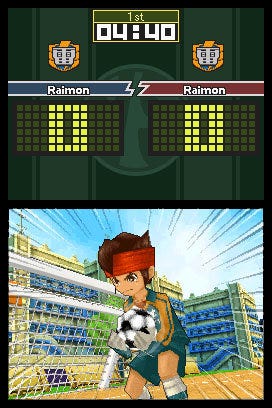
After the introductory hour, walking around the overworld will begin to trigger random battles - miniature football matches with four players on each side, and a specific objective like scoring the first goal or simply acquiring possession of the ball.
There's a whole world of Inazuma Eleven stuff out there, including an anime series, and it all started with this game.
They're quick to set up and the time limits are tight (each one's a quick blast rather than a drawn-out encounter) and though there's a penalty for losing these matches (a few Prestige and Friendship points, which are used to buy items and attract new players) it's never so onerous you'll dread a defeat. The game gets on with things, and so do you. Though you may wonder why a draw counts as a defeat.
Inazuma Eleven's main matches, on the other hand, are where it absolutely shines. These are full 11-a-side matches and show off the unique take on football at its best: a strange mix of stylus gymnastics and turn-based strategy. Drawing lines on the touch-screen sends players running in that direction, and when in possession they'll automatically run towards the opposition goal. You tap another member of the team to pass, or tap the player to speed them up.
Getting the hang of the basics is easy enough, but this is a game of hidden depths - not the least of which is the simple 'Time Out' button. It's absolutely essential. Only about an eighth of the pitch can be seen at once, and panning around it when everything's moving is like rubbing your tummy and patting your head. Using time-outs lets you prepare runs for every member of your team, as well as the next pass.
It turns a system that initially feels too automated into an interpretation of football like nothing else out there - a cross between direct tactical instruction and real-time action that's almost brilliant.
There's an unusual stop-and-start rhythm to play. When a defender is close enough to the man in possession, the match pauses while you select the next action. These are rock-paper-scissors decisions on the surface, but underneath is a bubbling mix of stats and elements that works like a simplified version of Pokemon - each player is associated with one of four elements, which is largely irrelevant in the first few hours of games but soon becomes a key focus of your formation choices. Having a fire-based winger against a wood-based full-back basically minimises the element of chance in every challenge and guarantees a steady supply of crosses for your front men, for example.
From one perspective, these challenges are the tensest moments in each match. Waiting to find out if your last man can stop their star striker breaking through is nail biting. But the way the results play out, in animated cut-scenes of varying length, soon proves one of Inazuma Eleven's annoyances. These can, especially in the case of special moves, take a long time to play out, can't be skipped, and the ever-stingy match timer keeps on ticking down.
This combines with the worst aspect of the football: certain story matches have to be completed in a very specific manner, with the worst offender creating a massive difficulty hump a mere two hours into the game. This is against the Occult team, a bunch of black-magic emos who relentlessly cheat - the game guarantees them a goal in the first half, and after a few minutes have been played a cut-scene skips straight to the second half.
1-0 down (or 1-1 if you can score in the first few minutes), the only way to win is to have a shot with a specific player, which is saved but unlocks a special shot you can actually score with - and then, after that, you have to win the game before time runs out.
The special moves, it has to be said, are too plentiful in matches - some players can use them five or six times per match.
It's clear why these restrictions are in place - the match has to fit in with the conversations that happen throughout it - but the effect is bizarre, turning a normal match into a nightmare of specific conditions that seems to depend on luck rather than skill. Watching the 'challenge' animations sloooowly play out while the match timer ticks down quickly is as frustrating as Inazuma Eleven gets, and the fact it happens so early on is a terrible misstep.
Later matches have their own conditions, but none is as obtrusive as this - and when Inazuma Eleven just gets on with the game, it's so much better. The way it plays football isn't like any other video game interpretation of the sport, and despite the pyrotechnic specials this at times captures the purity of the beautiful game: last-minute goals, crunching tackles, dodgy refereeing and highly questionable offsides.
The football team is made up of Mark's schoolmates at first, but soon a scouting network is unlocked that lets you hunt out other players. There are around a hundred that can be acquired, though the number present in the game is much higher, and some have the potential to learn unique special moves - a very big deal - while all can be moulded in the way you see fit, through in-world training spots that boost particular stats to moves that can be learned by any player.
On the special moves for a moment, they're the source of a few beautifully judged cross-game references, the best of which is Andy's first goalkeeping special move: the God Hand. Not only does the name hat-tip Clover's incredible swansong, but the move itself is a straight transposition of Gene's palm strike - the only black mark is that shots will on occasion beat it, which struck me as absurd.
The scouting system's major annoyance is that you can only search for one player at a time, and have to track them down in person to join the team.
Training up your players into specific roles is overlaid on a more straightforward levelling system, but it doesn't prove necessary to immerse yourself in the minutiae - the starting players can develop into unrecognisable behemoths, and you've got a top-tier keeper and striker pretty much from the start. It strikes you as a missed opportunity in the absence of proper multiplayer - which has subsequently featured in the series - because when your dream team's just for use in the storyline it's not so essential to nurture every stat.
That's Inazuma Eleven writ large: it's a game that bodes well for the future of the series. But that future already exists, much-improved and with features that this first stab is missing. The story, for all its daftness, is a charming one that pulls you in, and this being Level-5 the characters are superbly drawn and animated.
Still, you can't help feeling like a second-class citizen playing Inazuma Eleven. It has been subsequently improved upon, and that's all there is to it. It plays a good game regardless, and there really isn't anything else like it on DS - in the UK, at least. But it's like hearing the scores before Match of the Day: you'll still watch, but knowing how things end up makes it feel like going through the motions.
7 / 10
