It's a big year for Bungie. Not only does it celebrate its 20th birthday but, with the impending release of Halo: Combat Evolved Anniversary, it's also formally signing off custodianship of Master Chief to 343 Industries.
With an hour-long retrospective documenting its two decades in the video game business now live on Bungie.net, community manager Eric Osborne sat down with Eurogamer to discuss leaving the lucrative bosom of one of the most successful game franchises of all time in favour of new, uncharted territory.
Eurogamer: So, is this film intended to bring down the curtain on your involvement with Halo?
Eric Osborne: We transitioned support away from our online matchmaking as of yesterday. We still have stats and a file-sharing community on our website. Obviously we're pretty proud of the Halo legacy and will never really let go of that, but the documentary itself encompasses the entire span of Bungie's past and present. We go through the company's inception, time spent in Chicago, the Microsoft acquisition, the Halo trilogy, the independence and a little bit beyond. So it's actually bigger in scope than just Halo, though obviously that does play a major role.
Eurogamer: Looking back, did you ever anticipate that Halo would last as long it has and grow into such an enormous brand?
Eric Osborne: Just talking to a lot of the guys who were around before Halo shipped - they were working on Myth and they had some other projects in the works. They were basically looking to build kind of a third person top-down RTS action game in the vein of Myth. In fact they were working in the same engine. Then, through a series of natural events while working on the game, they came to what is known as Halo.
None of those guys ever thought it would get as big and as grandiose as it did, but of course as game-makers and storytellers they want to have as big an audience as possible, so that's always a goal that they had in their heads. At certain points throughout the project they'll say, while they never expected it to get this big, they kind of knew they had something really great. There's these moments that call out -going into first person, getting in the warthog and driving around - where it just started to cement.
But I think that's something very different. Knowing you have something fun, knowing you have a game you're going to be really proud of and excited about playing, and that will resonate with a lot of players is very different from saying 'we're going to design this thing to sell millions of dollars in software'. That might be the wrong approach to making video games.
I don't know if anybody really believed it was going to sell millions of copies in the way that it did. They definitely knew they had something fun. We have a bunch of old footage of these guys playing the game and working on it and once they have a product that gelled and they're in there playing multiplayer and you can see them having a ton of fun.
Eurogamer: So, is this film intended to bring down the curtain on your involvement with Halo?
Eurogamer: Is there a studio consensus on the series' finest hour?
Eric Osborne: It would really depend on who you talk to. There are so many different opinions and roles that people have taken on different projects. Sometimes someone might play the role of art director on one project and then be creative director on the next. It just depends on their role, and their opinion, and the lens they look at their work through. They have a tonne of different moments that they can look back on and say 'that's the one'.
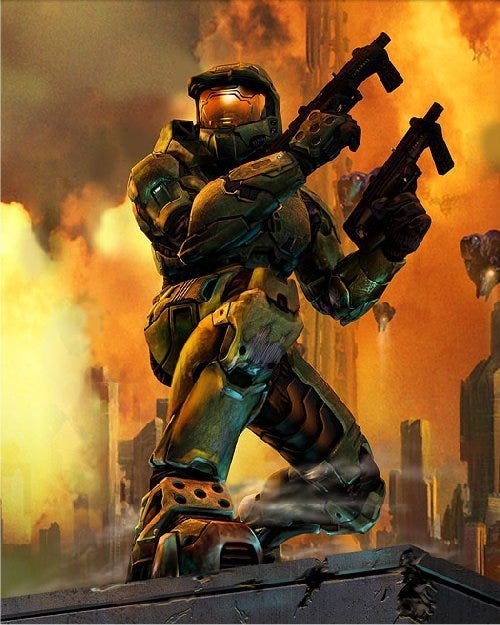
For some guys it was shipping Myth, for some guys it's getting hired, for other guys it's ODST and the story they wove into that. For Marcus [Lehto, creative art director] it's finishing his work in the Halo universe with Halo Reach and going out with a bang. There are just so many, and that's part of the reason the 20th anniversary doc exists - to look at those turning points and look at the different opinions from different people at the studio.
I came to the studio as a fan, so I really remember the things... getting hyped up for the trailers, waiting in launch lines, meeting people in lines - those are the moments that always stick out for me, the community moments. I remember meeting a guy in St Louis who had driven four and a half hours just to buy the game. When I started talking to him I found he didn't even have an internet connection. To me that was mind-blowing because the big feature for me was that I'm going to get to play this thing over Xbox Live with a tonne of people and it's going to be amazing. I'm going to be able to shoot people in the face while talking to them over an internet connection!
Whenever I talk to people about the impact of Bungie and what they remember most, it's always the people they've met, the times they've shared, the relationships and friendships they've formed. For me, thats a pretty powerful thing for a game to do – to foster a clean, well-lit place for people to bond.
Eurogamer: What's the mood on the studio floor? Are you sad to say goodbye to the series?
Eric Osborne: There's definitely a lot of excitement about the future. The transition, for us, marks the moment when 100 per cent of the studio is now laser-focussed on our future. So there's definitely a lot of anticipation. People are really ready to start talking about the next thing. Even if it's going to be a little while before we start revealing it - people are starting to get amped up.
We have out internal Bungie day happening tomorrow to coincide with the film launch. We're definitely pumped, we're definitely excited, we're definitely working. There's that feel of being in the thick of it again. It's a different world for us – we're an independent studio, so the next thing we do is going to be vital to our success. We know that although we have this legacy, we're definitely focussed on the future and making sure our next step is the right one. Pete says 'we're going to bask in our own glory or bathe in our own blood'. That's our CEO Pete Parsons, he's just standing behind me, piping in.
Eurogamer: What are your primary concerns in handing Halo's future over to someone else?
Eric Osborne: There's not a whole lot of worry to be quite honest. I think we've done a pretty good job of establishing and setting up a universe. Our guys have been working at it for 13 years now, so it's a fairly established franchise and a fairly established brand that has a lot of fans and people who love it. We just want to see that continue. I don't know that there are any real strong concerns. There's a little bit of emotion attached to the transition itself but we're definitely ready to do something new.
Eurogamer: Is there any trace of your work in Halo 4 or its narrative arc?
Eric Osborne: It's all new. We don't have any insight. I can't really spoil anything or give you any secrets. They're all outside the studio now. And if I had any information and disclosed it I think Microsoft would be very upset with me.
If you want, I can spoil Halo CE Anniversary for you though. So, Master Chief and Cortana live, the Halo ring explodes and if you play in legendary you'll see Sgt Johnson's twin brother, Sgt Shwanson, engulfed by the explosion at the Pillar of Autumn. A lot of people don't know that. They think it's Johnson, but it's actually a doppelganger. Or, maybe not...
Halo Wars.
Eurogamer: Attempts to broaden the scope of the franchise with spin-offs like Halo Wars did well enough but didn't really pan out. Would you like to have seen the universe expand more?
Eric Osborne: I don't have a take or a company stance. I think if you talk to Microsoft about Halo Wars they would probably mark it as a success - it sold millions of copies. I think if you look at the core fans – when you create a product for core fans and you want to make sure the story is solid and it resonates with them, I think it did a pretty good job in that regard. There aren't too many people who mark it as a tremendous failure.
Eurogamer: Sure, it was successful, but we didn't see a sequel or other attempts to try different things with the franchise. Is that a regret?
Eric Osborne: I think we're really comfortable with the approach we took. We had five Halo games and we love them all in different ways and creatively we were able to expand and do other things, work with people on things like the graphic novel and some of the other ancillary stuff. So we definitely had plenty to tackle with the games themselves and got enough flexibility to work on other things that excited us, work with other talented people outside the core experience.
Eurogamer: Last month Microsoft Game Studios chief Phil Spencer said "We kind of lost our way a little bit” with Halo ODST and Reach. What's your response to that?
Eric Osborne: I think there was some broader context to that conversation. There's always that choice quote you can pull out to give impact to a headline or to supercharge a statement but I don't think he was attempting to say the games were not well-received or didn't do well. I think you can look to his comments around Halo: Reach's launch where he marked it as the most successful Halo launch title, comparing it to Halo 3. He also said a really, really nice thing about the game itself beyond just the business metrics. These things get pulled out of context. They are what they are. If you go back and read the full interview I don't think you'll find too much there that's super alarming or cause for concern.
Going forward, it's their franchise, their IP, and the direction they take has got to be their own. I think for fans, the message for them is that they need to allow Microsoft the creative flexibility to let them do what they need to do. In the same way they gave it to us.
Eurogamer: How is your relationship with Activision working out? Not all fans were happy when the partnership was first announced...
Eric Osborne: It's not really my place to alleviate concerns about Activision. I think the partnerships we create are the ones that are the best for us. We're an independent developer, we're employee-owned and we're in a position to do something we hope that will be really well-received and be wonderful and tell a great story in a brand new universe. All that boring business stuff is not stuff we're really interested in talking about. We'll live and die on the quality of the games we make and that's what we're most concerned about.
Eurogamer: Has the studio culture changed at all since the break with Microsoft?
Eric Osborne: It's definitely busy here. Everybody is guns blazing and working to the next thing. We're hitting some pretty significant milestones and just really excited to dig our teeth in and make a game. In some ways it's the same process, and in many ways, like all things in games development, it changes rapidly. So there's always new problems to solve, always new creative situations to shoot through, new team members, old team members - it's fun. It's always a challenge. It doesn't stay the same from one day to the next.
Eurogamer: Have you enjoyed reading the rumours about what you might, or might not be, working on?
Eric Osborne: It's my job to pay attention to it, to make sure we respond to the right kinds of things and let other things that we don't normally touch just kind of sit there. Yeah, I see them, I know that they're out there. Speculation is usually generated when people are interested, so in that respect it's good. People want to know what we're doing and people are engaged. That's pretty cool. We're kind of going into a dark phase now. We're not going to make a whole lot of noise, we just want to allow people to build anticipation. And frankly we're really, really busy. So some of that stuff you just let fall by the wayside, and some of it you may want to address depending on the context and content.
Bungie's 20th birthday message.
Eurogamer: You recently announced your Aerospace initiative. That seems like something of a curveball.
Eric Osborne: It was just born out of… we did a press tour and people were like 'that's kind of an egalitarian viewpoint. You just want to help other developers publish their games because you like playing games?' That is in fact a really big part of what we're doing there. We're working with Hair Brained Schemes on its game Crimson that's going to ship in the summer. We don't have a date on it yet but it's an iPad game, it's a tonne of fun, everybody here at the studio is giving it some time on their breaks and having fun with it.
Really it's about forging really good partnerships with small mobile developers and seeing what comes out of that. For us it's partly about creating great games and it's partly about learning about those experiences. We've already said our next universe will be multiplatform, multiformat, so we're definitely interested in that area.