Order & Chaos Online
Mobile clone.

You can't release a proper game on a touch-screen device. We know this to be true because we've been told it 10,000 times before and, let's be honest, the early days of this particular scene weren't exactly overflowing with complex games beautifully realised on these tactile screens.
But even with the benefit of refinement and experimentation in recent years, you still wouldn't try to introduce keyboard and mouse controls to this environment. Unless of course you're Gameloft, purveyor of high-quality – ahem - homages on the mobile gaming scene. From the world's most famous RTS, to an equally beloved FPS the developer has long specialised in cutting out the middle man to satisfy mobile gamer cravings.
And so it should come as no surprise to learn that Gameloft's first foray into the burgeoning mobile MMO scene begins with the inevitable choice of race and class, human or orc, mage or warrior. While this won't surprise anyone who's glanced at an MMO over the last 10 years, it's the brazen similarity of Order & Chaos Online to the world's most profitable game that will bring an entirely unintentional “Wow” to the lips of everyone who sees it.
The similarities aren't just restricted to those famous style-over-system-spec visuals of World of Warcraft. Even the engine is eerily familiar, with skylines in the far distance morphing and stretching into hard geometric backdrops as you jog through the world. From the sharp, angular designs of the interior furniture to the occasional sight of a wolf toying with a critter before pulping it with a squeak, we're on desperately familiar ground here.

Some changes are of course critical, and the familiar action bar mechanics of the genre have been replaced with a sliding wheel that sits in the bottom right-hand corner of the screen. Despite the perceived difficulties of recreating the fiddly nature of PC MMO controls on a mobile device, with a little practice the system works well. A nifty auto-run prompt also takes away some of the thumb obscuration, while light finger-swipes turn the camera left and right.
A handful of clever touches prove that necessity truly is the mother of invention in touch-screen gaming. Screen size dictates that your currently equipped item can't automatically be compared with that exciting new pair of trousers you've just picked up – so comparisons are made via a quick tap of a magnifying glass. To the right of the screen, a tap of the finger brings out a customisable pull-bar containing your essential potions, buffs and food.
Cool-downs reign supreme over button-mashing in the genre, so overall it's a system that works better on a mobile than you might think - although trying to judge exactly when those cool-downs expire requires more than a little back-and-forth browsing through the scroll-wheel during combat.
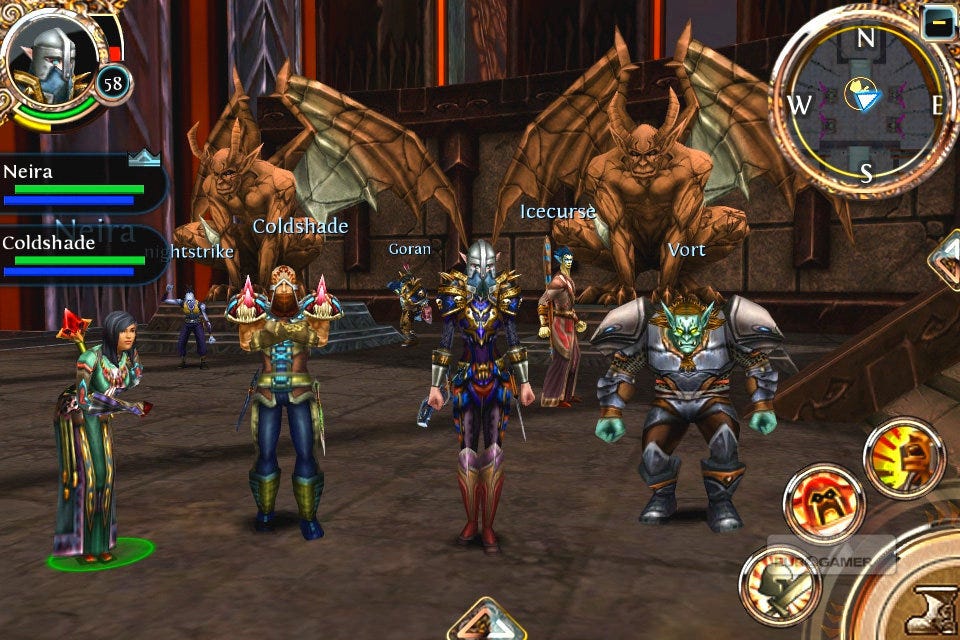
More bothersome is that the combat system is often plagued with frustration. Frequently, you'll die running away from something that no longer exists in the game world. A limited camera view means that - even fully zoomed out - it's possible to have whole armies of enemies re-spawn behind you, and just out of sight. Back-end tweaking and spawn refinement will hopefully fix the worst of these problems.
Questing is very much based on the bread-and-butter genocidal mould of a WoW from years gone by. You'll gather six wolf tongues to make a fetching jacket, which leads to an encounter with a mysterious stranger, which opens up a kill-ten-of-these quest line, during which you discover a sinister plot, one of which just happens to be overseen by a slightly tougher than normal arch-enemy.
As a result, much of your enjoyment of the game will likely come down to how much technical novelty the small-screen experience presents, combined with your particular level of WoW-fatigue. Without a truly engaging, over-arching storyline to propel the game forward, the impressively-sized world map doesn't feel like a place to call home. Areas within individual zones feel indistinct, and finding an efficient, enjoyable quest-route – one that's appropriate to your level - becomes frustrating.