L.A. Noire: Nicholson Electroplating Review

Boom town.

Version tested: Xbox 360

Nicholson Electroplating is like an extra spleen that's been cloned from the stem cells of L.A. Noire and grafted onto its armpit. Sure, it's a mighty fine spleen and all, but if you're just gonna stick it on there, don't be surprised when it fails to come alive.

L.A. Noire is an organism; it can't be broken up into modules. That's what makes L.A. Noire so special, and Nicholson Electroplating so not.

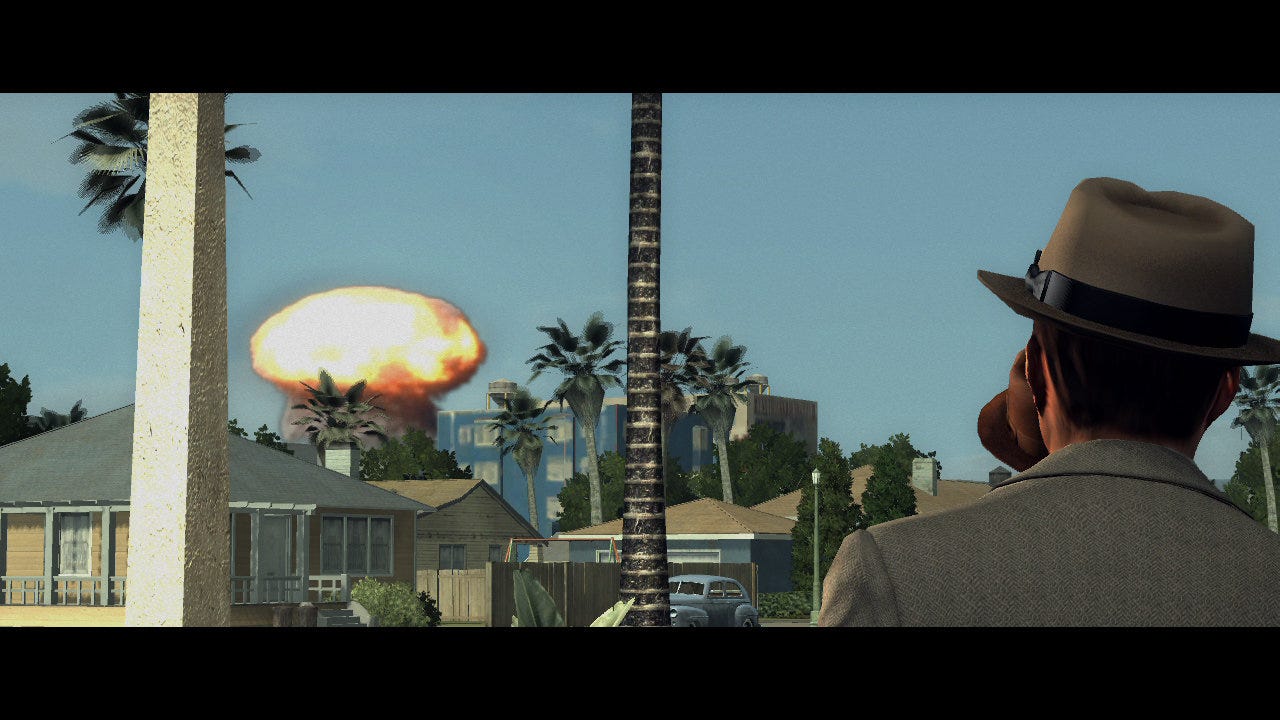
The Nicholson case, a downloadable add-on released this Tuesday, opens with a boom that spreads shrapnel and destruction across a half-dozen city blocks and lofts a mushroom cloud into the air. The epicentre of the blast is the titular metal-treatment plant, which is obliterated.

Playing as Cole Phelps, you and fellow arson detective Herschel Biggs rush to the disaster scene, where you quickly uncover evidence of an experimental aluminium-treatment technique. Because nothing is simple in Phelps' L.A., a miasma of corporate and international intrigue surrounds this lucrative process.

The case inserts itself into the L.A. Noire timeline at an awkward moment. It comes in the middle of the third act, during Phelps' stint as an arson detective. (By the way, I'm going to touch lightly on some plot details of that third act now, so if that offends your sensibilities, skip down a few paragraphs.)

Phelps' arson assignment is when L.A. Noire transforms from "only" an interesting game into an outstanding one. In the manner of all great noir thrillers, the game grabs all its dangling threads and weaves them together.

Those newspaper cut-scenes and war flashbacks; the tantalising near-adequacy of the interview system; the game's insistence on methodical, by-the-numbers police work: they all now sing in harmony.
1

I TOLD him not to move his Xbox while the disc was spinning! And now look.

The game gets bold here. A new protagonist squeezes Phelps out of the picture for a while. It's a courageous creative decision that pays off. Phelps' war "buddy" Jack Kelso finally provides a proper foil to our hero. Kelso gives Phelps some depth and, in a certain light, turns him into something of an anti-hero.

As the facts come together in the Kelso/Phelps arson investigation, it's increasingly hard to tell where the action is going to turn. It's like the approaching resolution of the mystery is closing in on L.A. Noire, and in response the game turns into a cornered cat. It's ready to lash out in any direction. Because L.A. Noire wears so many guises, there are a lot of ways it can go: a shootout, a tense interview, a careful hunt for clues?

L.A. Noire's fragile glories depend on the confluence of a huge number of threads. Nicholson Electroplating doesn't have confluence. In a game where context is everything, this case sits alone.

There is some hand-waving dialogue at the outset of the case that nods toward the main story. Phelps and partner Biggs vamp for the cameras a bit. Gee, we really should be working on that time-sensitive, life-or-death case, shouldn't we? Then there's a big explosion. It's the developers' way of saying, "And now: This."
2

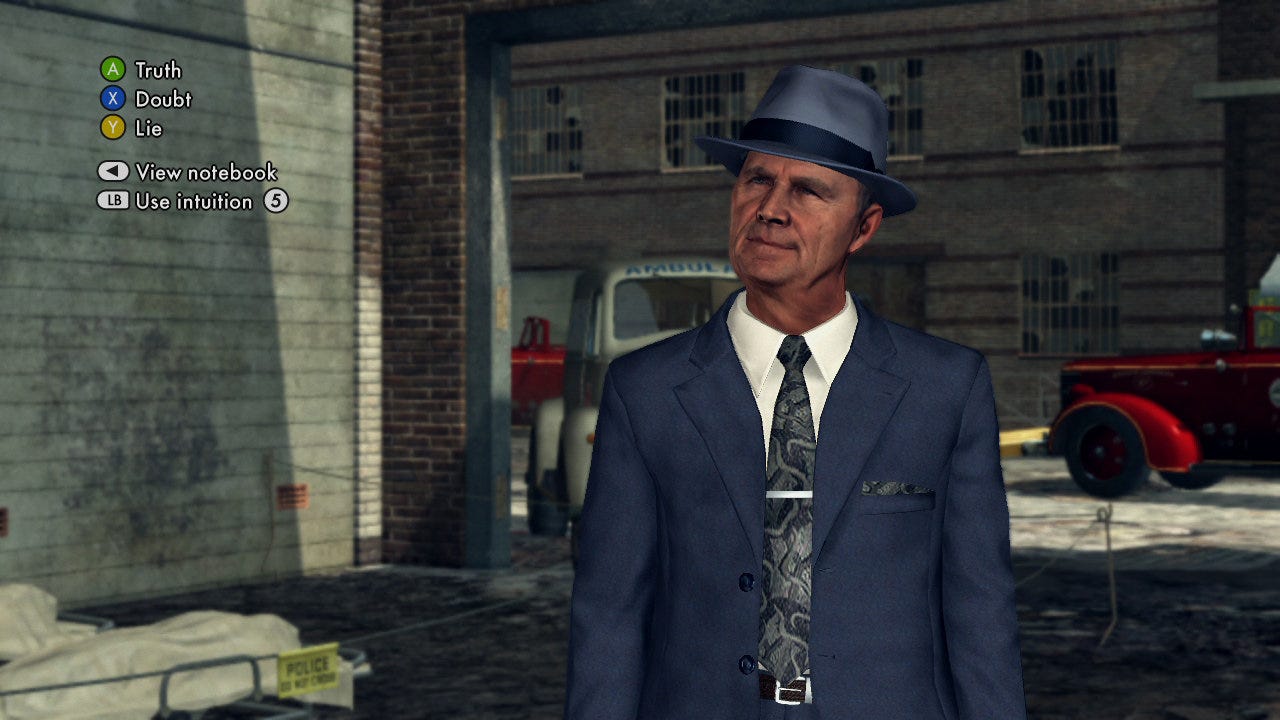
Tip: You can tell he's lying on account of he's wearing a hat.

Because it can't fit into the flow of L.A. Noire proper, this fragment, Nicholson Electroplating, has to find other ways to justify its existence. Fatally, it chooses to take each of L.A. Noire's individual "features" and amp them up a little.

No game can be evaluated merely as the sum of its parts, but L.A. Noire is especially resistant to compartmentalisation. Much like Heavy Rain before it (and maybe more so), if you break this game down into a list of features, the whole thing dissolves into farce.

Taken alone, the gunplay is generic. The driving is sort of clumsy. Searching for clues is a glorified point-and-click exercise.

Rockstar played up its facial-scanning technology in advance of the game's release. We were supposed to drool: Ooh, the faces, the faces, look at these faces! How did we ever play games without all these FACES?

The faces look nice enough, but the game's insistence on showing off that technology can be laughable. Most lying suspects "hide" their guilt with all the subtlety of a Charlie Chaplin character with black pepper up his nose.

My mom happened to be in town while I was playing Nicholson Electroplating for this review. She caught a glimpse of Cole Phelps walking in place after he hit a wall, and she giggled. She said, "This reminds me of Clutch Cargo," a 1960s cartoon with famously crude animation. So much for faces.

I would like to see Rockstar executives talk about the incredible realism of L.A. Noire's characters while behind them, a huge screen shows what Cole Phelps looks like when he is climbing a ladder.

Then there is the Truth/Doubt/Lie interrogation system. You must choose one of these options each time a suspect answers one of your questions. Choose the right one, and you hear a three-note jingle of success. Otherwise you get the sad music.

The internal logic that determines which choice is correct can be outrageously obscure. There have been times when I thought the game should be called L.A. Sad Music.

It's a recipe for one of the silliest games of this console generation - except that in practice, it's one of the best. Incorporated into the whole, all this stuff works.

Pounding pavement for clues in the Hall of Records is exciting, because you have a feeling that this is where you'll finally peel back the curtain on those shifty insider types. It doesn't seem mundane; it seems like the world is about to change.

3

Look out, motorists! I'm driving on the British side for my Eurogamer pals today. Plus, I stole this fire truck.

And while the frustration of a misfired line of questioning never feels good, a little pain is OK. Because over time, the ever-present potential for failure ratchets up the tension of every interrogation. (The capriciousness of the system has the added benefit of being honest: luck and gut instinct play a part in real-life interviews, too.)

Nicholson Electroplating doesn't benefit from this larger flow, and as such, the inanity of L.A. Noire's component parts are laid bare.

The case brings you to an airplane hangar to search for clues. The logic seems to be that if hunting for clues in a small room is fun, then hunting in an enormous building must be a rare treat! And certainly not sadistically boring!

The car-chase feature has also been isolated and turned up to 11, insofar as it is a longer-than-usual car chase. Your partner screams that you need to get closer so he can take out the guy's tyres.

He fires off shot after shot, but he never hits those tyres. Because if he did, you would never get to experience the splendour of this lengthened car case. Truly, it is of somewhat greater duration than you are accustomed.

Also, there's this one part where you shoot a bunch of guys, and there sure are a lot of guys.

4

Howard Hughes' Spruce Goose. Also pictured: Cole Phelps' Spruce Caboose.

The case isn't entirely misconceived. Recognising the need to have some larger stakes as a driving force behind the individual set pieces, the developers incorporate the great Hollywood figure of Howard Hughes - specifically, his "Spruce Goose" boondoggle - and the lesser-known O'Connor Electro-Plating Corp. explosion, which happened much as the game portrays it. (The O'Connor incident is recounted with entertaining colour in a 1947 Time magazine article.)

Yet the strength of L.A. Noire is myth-making, and this feels closer to myth-borrowing. That's not to say that L.A. Noire proper isn't also inspired by actual Los Angeles lore; it is. Yet in the broader game, over the course of many hours, those bits of legend metastasise and intertwine and grow into a thriving experience of their own.

Nicholson Electroplating doesn't have time for that slow-burn organic process. It attempts a brute-force attack on greatness and comes up short. Yet the contrast between this expansion and the main game sheds a revealing light on the thoughtful craftsmanship of experience that makes L.A. Noire such a treasure.

5 / 10

Read the Eurogamer.net scoring policy

Comments (77)

Comments for this article are now closed, but please feel free to continue chatting on the forum!

  • Loading...hold tight!