FEAR 3
Ghost trick.

If F.E.A.R. 3 has one lesson to learn, it's that horror is at its best when we care about the people involved. This is the difference between rooting for Sarah in The Descent versus cheering for Freddy as he slaughters Midwestern teenagers before making a bad pun about it in the later Nightmare on Elm Street sequels.
F.E.A.R. 3's silent protagonist, the unimaginatively named Point Man, is as bland a lead as you can find. After being busted out of prison by the ghost of his homicidal brother, Paxton Fettel (whom he murdered at the conclusion of the first game), they team up to track down their pregnant, psychic, undead mother.
Comic book scribe Steve Niles (30 Days of Night) and film director John Carpenter (The Thing, Halloween) have come aboard to spruce up the narrative, though their efforts are in vain. The story of child abuse, lost innocence and macabre family matters could be intriguing, but the game does such a poor job of telling it that it's hard to keep track of why you're doing anything or what exactly is going on.
Unveiling the story through Point Man's eyes is serviceable, but undermined during cut-scenes when he simply stares blankly while the fate of the world hangs in the balance and his spectral sibling taunts him. F.E.A.R. 3 is comically ineffective at getting us to care about this blank slate of a man, and with no appealing support characters, it winds up as just a bunch of gory stuff.
Thankfully, what F.E.A.R. 3 lacks in a compelling narrative, it more than makes up for in thrilling first-person shooter combat. The series' staple slow-mo is back alongside its hefty, punch-packing weapons, and for the first time in the F.E.A.R. games there's a "snap-to" cover system.
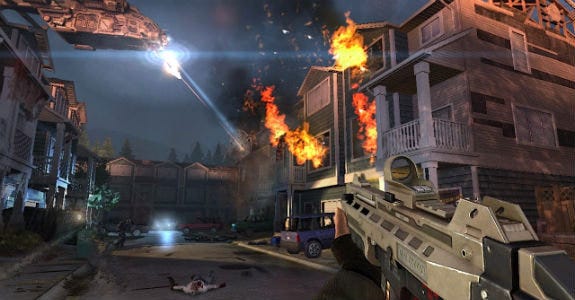
This works much as you'd expect, but unlike its employment in more traditional cover shooters, is best used sparingly. Enemy soldiers are smart and will work as a team, seek cover, flush you out and flank you. It's unnerving when the moment you duck behind a crate you hear a foe yell "He's behind the crate!" before his comrades zero in on you. Levels are expertly designed around this, with multiple routes ensuring you could get attacked from all sides, encouraging you to stay on the move.
There's a delicate balance between being the hunter and the hunted; one moment you're scrambling around looking for cover, the next you're retaliating in glorious slow motion with a shotgun that renders enemies into plumes of blood. The default difficulty level in single-player was absolutely spot-on for me; I was constantly close to death but would often survive by the skin of my teeth.
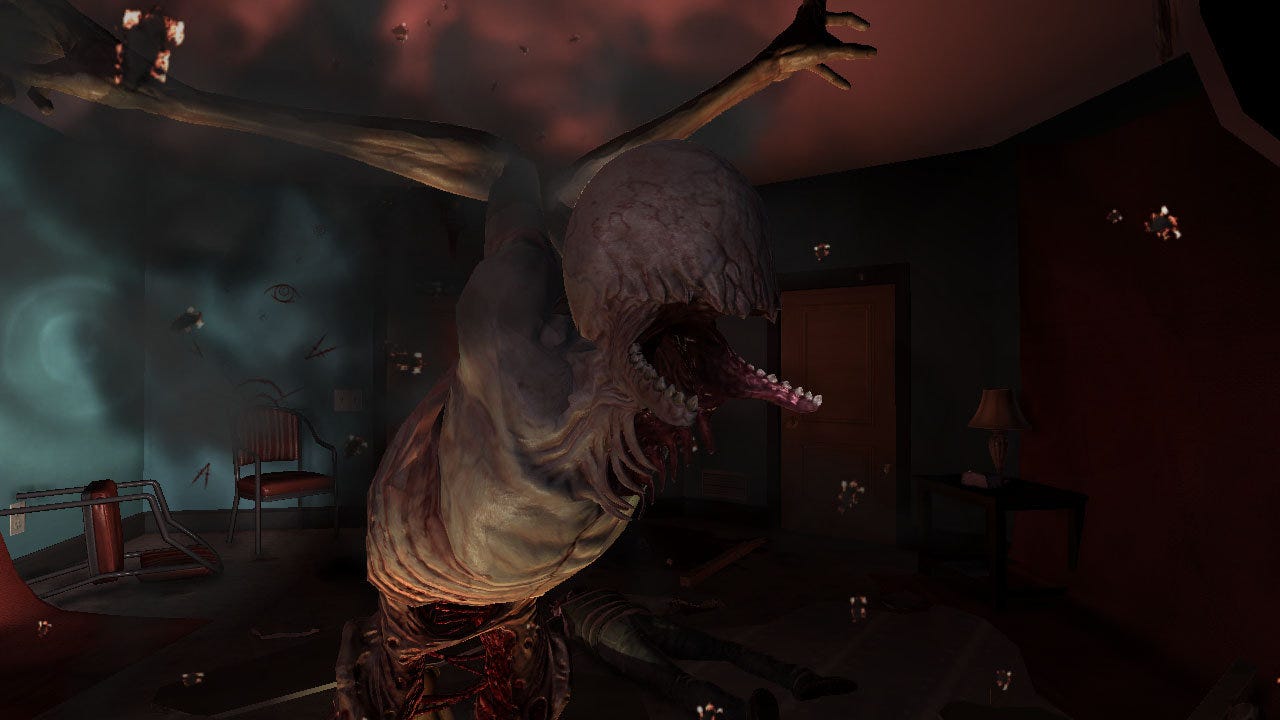
It's worth noting that unlike prior games in the series, which consisted largely of drab, colourless corridors, F.E.A.R. 3 is diverse and detailed - if still predominantly grey. A twisted version of a department store, ravaged by earthquakes and home to deranged denizens, is a particular standout, with halls of flickering TVs, a meat locker full of pigs and mutilated corpses hanging from hooks, and bizarre, bloody symbols scrawled along the walls.
Optional challenges are a neat addition to the the game. Completing such tasks as killing 50 enemies in a row, getting 25 headshots or defeating 10 foes while using cover will net you XP. This increases your rank, unlocking rewards like longer slow-mo, faster health regeneration and increased health. You can check your progress on these challenges at any time, and more often than not you'll be on the verge of completing a goal. It's deceptively addictive and encourages you to vary your approach. It also leads to a competitive angle when players compete for points in co-op.
This is based around F.E.A.R. 3's most innovative feature, Paxton Fettel. Being a ghost, he can't pick up weapons. Nor does he have slow-mo. Instead, his abilities include levitating enemies, shooting them with a projectile, forming a shield around Point Man and a melee attack that gets substantially more powerful if used while Point Man has activated slow-mo (which affects both players). Best of all, when a meter that refills over time is full, he can possess enemies.