Creative Tension

Are publishers impeding the creativity of the medium?
"It was probably all a terrible mistake..."

In 2009, Sean Murray and the rest of the Hello Games team flew to the US to pitch their first title, Joe Danger, to a publisher. It didn't go smoothly.

"Everything had been going great," Murray recalls. "We gave probably the best pitch and demo of Joe Danger we've ever done. The whole room seemed to be loving it, and afterwards we kept talking enthusiastically with the game running on this big screen behind us."

Then an unexpected visitor made an appearance. Murray didn't know, but the previous weekend one of his colleagues had put a snail character into the level. "He's purple, with green spots and crazy eyes and an actual two-storey house on his shell. He's about twice the size of Joe. What you'd normally call surreal."

"So this crazy purple snail suddenly shuffles past on the huge projector behind us, about four-foot tall, his eyes just staring out of the screen. Everyone stops, and you can feel it coming.

"Someone says, 'Is Joe really small or is that snail really big?' Then, 'Actually, how big is Joe Danger, anyway?'"

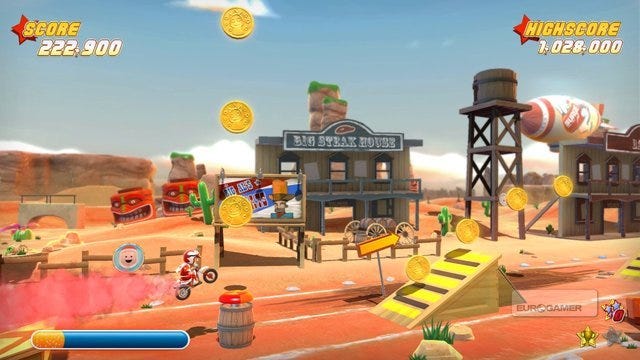
The Hello Games team hadn't given it much thought. "It's a game, you know?" says Murray. "We've got a talking mole too, and Joe goes around collecting giant floating coins, for f**k's sake." So that's what he told the publishers.

"That was a mistake," he reflects. The meeting then descended into a long debate about the snail:

"I don't think people want to play as a character that's smaller than a coin..."
1

Joe goes around collecting giant floating coins, for f**k's sake,' says Hello Games. Not exactly realistic.

"If Joe is normal size, then that would be a giant snail, so that could resonate..."

"Giant spinning coins don't seem realistic, though. The snail can stay, but the coins need to go..."

"Maybe he could fight it?"

It didn't end there. The argument dragged on and on, with calls and emails going back and forth for over a month. "I honestly believe this publisher thought we were trying to make a realistic game," says Murray, "and that we were just confused about what size real things are." Eventually, Hello Games decided to go it alone, choosing to release Joe Danger independently. "We did it for that surreal little snail and everything he stood for," says Murray.

Every developer has a story like this. Whether it's over a seemingly innocuous detail like the size of your tubby cartoon protagonist or a more fundamental issue about the direction of the game, developers can often find themselves on the receiving end of some puzzling creative input.
2

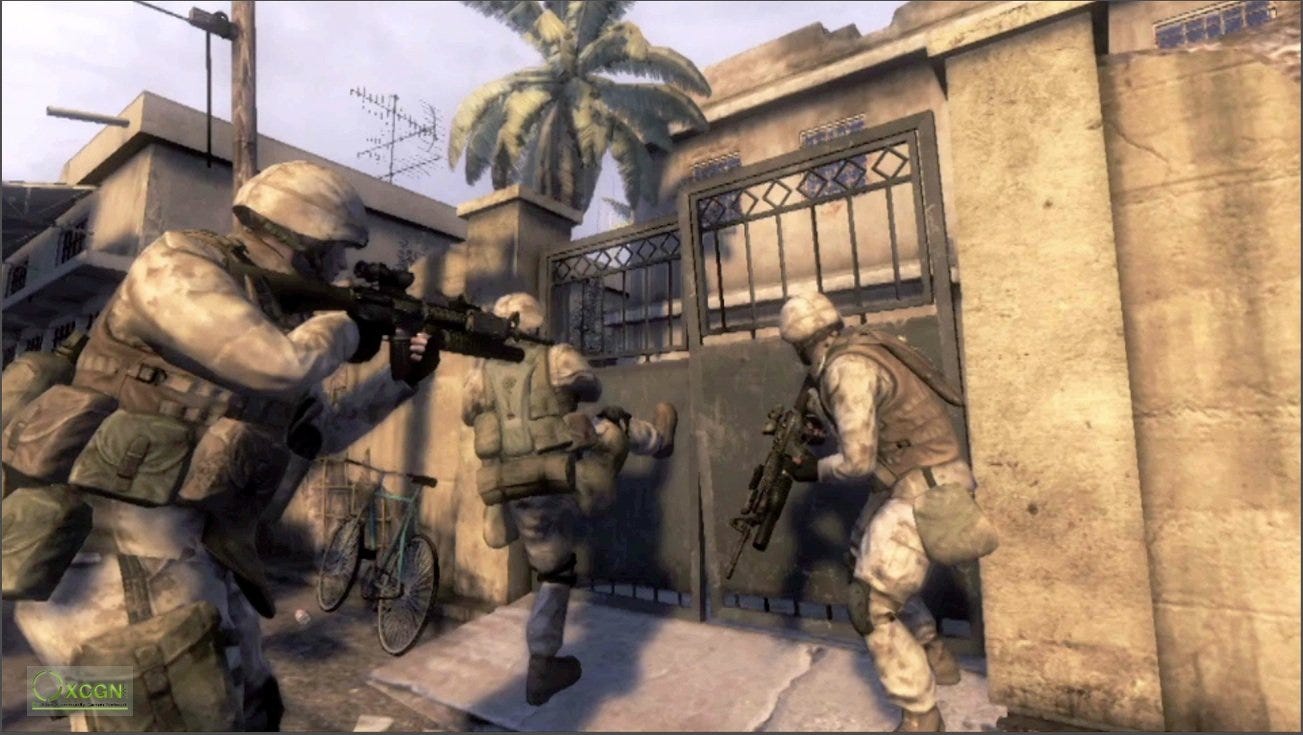
Atomic Games is still struggling to find a publisher for Six Days in Fallujah.

It all comes down to money. Publishers are terrified of alienating even a tiny chunk of their prospective user base. They're conservative businessmen who don't want innovation, experimentation or artistic merit, just cash and a safe return on their investment. And if you can't even put a giant purple snail in your cartoon racing game, what hope do developers have of pushing truly innovative ideas?

That's the argument, anyway. But does it actually stand up? It's undeniable that the industry is awash with sequels and clones, but are the publishers really to blame? Are they impeding the creativity of the medium? And are developers really struggling to find support for new ideas?

The creative relationship between developers and publishers is a subject that Atomic Games president Peter Tamte is eminently qualified to discuss. In April 2009, the FPS he was working on was ditched by Konami after the game's lofty creative ambitions stirred up controversy.

Eschewing the gung-ho nature of its brasher cousins, Six Days in Fallujah was intended as a faithful recreation of one of the Iraq war's bloodiest urban skirmishes. Yet as soon as word of the game hit the mainstream press, many reacted with outcry, damning the title for "trivialising" a battle that had cost so much human life.

Rather than support the game on its artistic merits, Konami chose to downplay Six Days in Fallujah's aspirations. "We're not trying to make a social commentary," Konami told the Wall Street Journal as the controversy erupted. "We're not pro-war. We're not trying to make people feel uncomfortable. We just want to bring a compelling entertainment experience. At the end of the day, it's just a game."

Less than a week later Konami dumped the shooter entirely, leaving Atomic without a publisher. Tamte still bristles at the game's treatment. "For us, Six Days in Fallujah has always been much, much more than just a game," he says, "I am surprised by the large number of people in senior product positions in our industry who truly believe we sell nothing more than fancy toys."

This lack of understanding, coupled with financial and creative conservatism, is to the detriment of the industry. "Generally, I think the best decisions come from smart people arguing about tough stuff," says Tamte, "so a lot of the creative tension between publishers and developers is helpful. But the culture of most publishers is built on repeating what has already been successful. By definition, this eventually fails because new franchises are always created by offering something new."

It's not a situation that Tamte sees changing soon, either. "Unfortunately, publishers are getting even more cautious as games have become ridiculously expensive to build," he says.

So exactly how hard is it to get new, innovative games made in this environment? Nina Kristensen and Alex Evans, co-founders of Ninja Theory and Media Molecule respectively, are well placed to answer, their studios having earned a reputation for creating unique titles with strong support from publishers.

3

Sony 'just got' LittleBigPlanet from the start.

Kristensen believes that the right publishers are out there, and for an enterprising developer it's just a case of finding them. Ninja Theory secured funding for Enslaved unusually late in the development process for exactly this reason. After a long search for someone willing to offer the financial support and creative freedom they felt the game deserved, the developer ended up pairing with Namco Bandai. "If you're working on an original IP, a publisher is only going to sign up your game if they believe in its vision," says Kristensen.

Evans agrees. "For us, I think the success of our LittleBigPlanet pitch came down to the amount we had to show, and our experience, but above all, [then Executive Vice President of Sony Computer Entertainment Europe] Phil Harrison's receptiveness to our vision," he says, "He really got it straight away. We had the odd disagreement, as any passionate bunch will, but we couldn't have done it without his support."

Those disagreements Evans mentions are part and parcel of a fruitful creative relationship. "As long as it's a discussion, with both sides listening, it doesn't matter who wins in each particular battle," Evans says, "The relationship, and potential for antagonism, goes both ways. It's hard making games, and we have undoubtedly caused plenty of ball-ache for each other. But in the end, it's worth it," he adds.

For Kristensen, the problems only begin if the lines of communication are not established properly. It's then that devs are pushed into creating more formulaic experiences.

"It has to fit into their portfolio," says Kristensen, "if your game isn't an exact match you can get into the realm of being pressured to tick boxes. These things aren't terribly surprising but it does mean that you need to think carefully when picking your partners."

Ultimately, Kristensen puts the onus of producing new, original games squarely at the feet of developers. "If we can't make a proper argument for why a publisher should pick up the game," she says, "we've either not explained it well enough or the idea isn't good enough."

So what do the publishers themselves have to say about the matter? Despite Kristensen and Evans' belief that new, original experiences can find backing from the right publishers, the fact remains that the videogame industry is rife with sequels and copycats. Are publishers truly committed to innovation and new IP?

Sony Worldwide Studios Europe VP Michael Denny believes so. "Gamers and consumers generally crave new things," he says, "so if we want to stay relevant in an increasingly competitive environment, we must continue to find compelling new experiences to keep our platforms exciting."

Yet despite this, new experiences must be created with an eye on how they can be turned into a franchise, says Denny. Sequels are not just inevitable – they're expected.

"The massive creative and financial investment involved in bringing a new IP to market means that planning a franchisable game from the outset is important," he says, "I think that's natural and something expected from both a consumer and commercial perspective."

For Denny, sequels don't preclude further innovation. "The important thing is to try to define some key innovations to sequels in the early stages of pre-production," he says, "to ensure the experience remains compelling and exciting for the consumers."

Lee Kirton, marketing director at Namco Bandai Partners, goes even further. Proud of his own company's dedication to new experiences, he nevertheless rejects the notion that sequels are inherently bad.

"Technology and gameplay often improve and the experience changes and grows over the years," says Kirton, "I think that consumers have confidence in big franchises and sequels, so many publishers play it safe by focusing on established audiences and brands rather than new IP. Marketing pounds go a lot further when you already have a strong brand identity. The buzz that surrounds a game like Call of Duty within the playground or in the pub is incredible. It creates an instant sale."

4

4. Despite critical praise, Enslaved failed to make much of an impact.

What Kirton addresses here is something that the other industry representatives we spoke to only hinted at. Broadly speaking, consumers are wary of unique experiences.

He should know. Enslaved, Ninja Theory's Namco Bandai-published action game, failed to capture the public imagination. Despite being a new IP garnering positive reviews for pushing boundaries in story telling and motion capture, it has sold just 730,000 copies - well below the million they were aiming for.

It's not the only one, either. The list of well-received, yet poorly performing new IPs makes for dispiriting reading: Mirror's Edge, Mad World, Vanquish and Blur. And that's just in the last few years.

Ultimately, it's a publisher's job to second-guess consumers in order to provide them with what they want. So if sequels and military shooters continue to sell in huge numbers, for example, then publishers will continue to fund them and developers will continue to make them.

Yet, as we've seen, there is room for innovation. Publishers in the search of the next big thing will support the right project. Even if the intention is to iterate on it with sequels further down the road. They get it wrong sometimes of course, as Hello Games, Atomic Games and many other developers will attest. But original, unique, innovative mainstream games will still be made. It's just up to us to buy them.

Comments (67)

Comments for this article are now closed, but please feel free to continue chatting on the forum!

  • Loading...hold tight!