Fate of the World
Ends of the Earth.

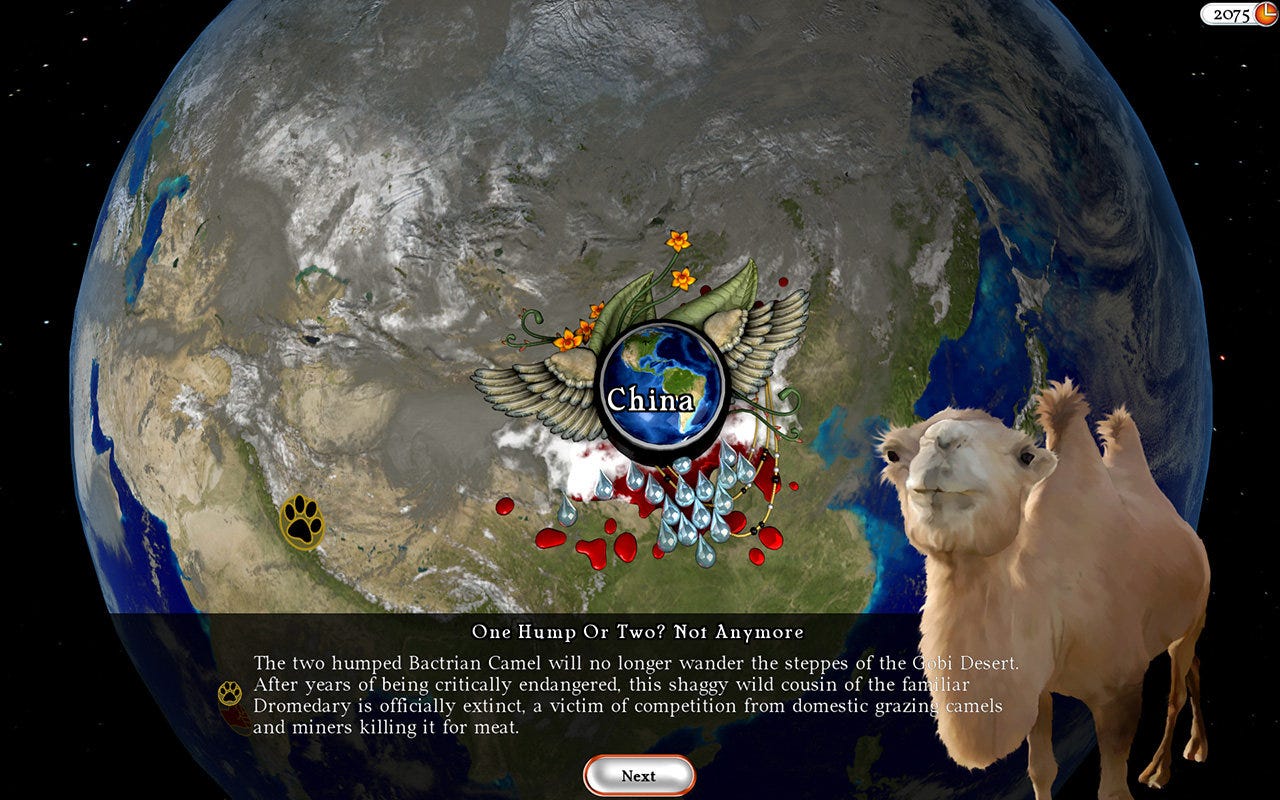
Never, ever put me in charge of anything even remotely important, let alone of the fate of the bally world. I have plunged Africa into violent civil war. I have caused mass famine in Europe. The US is wracked by fire and drought. The Middle East can add catastrophic disease to its many other crises. The quality of life in China is worse than anything Mao ever wrought. I've turned India into a brutal police state. The Bactrian camel is extinct. Oh God, even the camels are suffering because of me.
I was only trying to help.
Helping, it transpires, isn't easy. Helping can cause harm on massive, apocalyptic scale. If Fate of the World, a turn-based, card-based strategy game about steering the planet away from the environmental and geo-political disasters which may await it in the decades to come, is hard, it's for a very good reason.
You don't solve humanity's problems with good intentions alone. If you did, there wouldn't be a fuel crisis, the Middle East wouldn't be defined by terrible conflict, most of the developed world wouldn't be suffering brutal austerity measures and the polar ice caps wouldn't be shrinking at an alarming rate. This is a game of cause and effect, of the awful complexity inherent in making a political decision with far-reaching consequences.
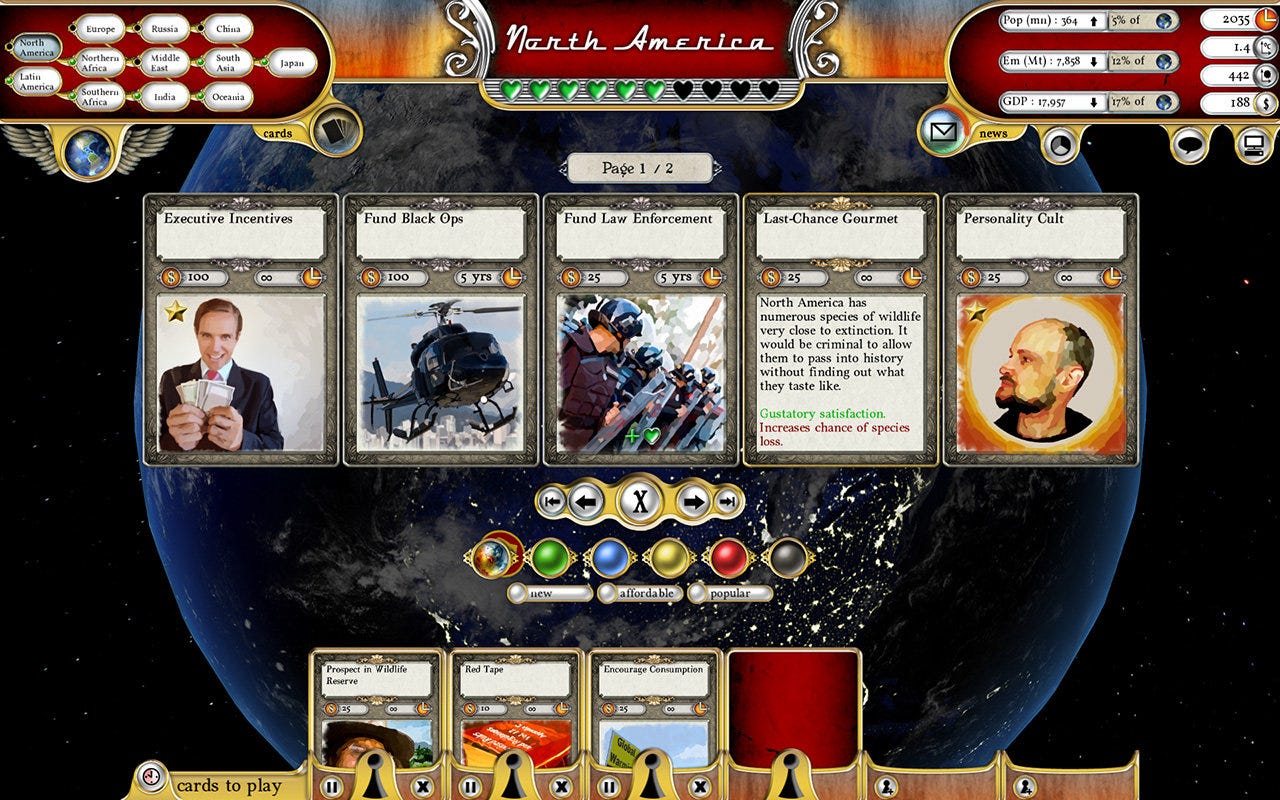
In the name of making your goal even faintly achievable, Fate of the World removes most of the politics from your role. You're not the leader of a country, chasing your party's own ends – you're the head of a fictitious omni-national, independent body able to make enormous, sweeping decisions about any continent's economy and wide-scale development. You could order that the entire world stops using coal fuel; you could force Russia to adopt vegetarianism for the sake of cutting down agricultural emissions and land-usage; you could turn China to biofuels.
Your conscience will guide you, at least at first, but for every action there is an unequal and not entirely opposite reaction. For instance, take away a key part of a more industrially-inclined zone's economy – such as natural gas or heavy industry – and it's going to a) create a financial hole, b) potentially see the area adopt even more unhealthy alternatives and c) risk your unpopularity, which leads to a reduction in funding and ultimately being banned from the territory. You might be looking at the bigger picture, but from that territory's point of view, you've just wandered over with a knife and started randomly hacking at stuff they desperately need.
For a game that, in a practical sense, involves only the very simple act of choosing a few cards from a virtual deck then hitting next turn to advance the timeline by five years, it is an intense, exhausting balancing act, and one that successfully challenges your morals. As war erupted in the Middle East, I found myself funding black ops research and then an enforced regime change in an attempt to calm things down enough to enact green motions. And it's best not to talk about how I chose to stem population growth.
I did terrible things. I became a jackboot, stamping on the face of humanity... but I only did it to save the world. There are right answers, and there are answers that only feel right. While there are unquestionably effective patterns to follow, increasingly desperate fire-fighting will be the experience of so many players, with early choices resulting in later tragedy you might never have expected.
Fate of the World is split into a small handful of escalating campaigns, commencing with the relatively simple task of raising the quality of life in Africa across a couple of decades, before rapidly moving onto holding the reigns for the entire damned planet over a century in the name of slowing down catastrophic global warming. This escalation was just one way in which Fate of the World was notoriously and punishingly difficult upon its initial release last month, but a much-needed patch redresses the balance in important ways.