Version tested: 3DS
Ubisoft has been so busy porting Rayman 2, it's a wonder the publisher has any time left to spend on new Rayman games. Since 1999, this game has appeared everywhere – the N64 and Dreamcast, the PlayStation and PlayStation 2, the iPhone and iPad, PSN... And, most relevantly, the original DS.
Rayman 3D is the same game again, but in 3D. It seems a bit rich that this is not pointed out anywhere on the box or in the game itself. It does look a lot better than the 2005 DS iteration. It is purportedly sourced from Dreamcast version as opposed to the N64 game, and the circle pad makes controlling our hero a less torturous experience.
Other than that it's the same game again, relying on the endurance of 12 year-old mechanics and environment layouts.
The language of 3D game design has evolved much in the intervening time. In good modern platformers, clever camera framing guides the eye towards important object and areas. Use of colour or effects lead us subtly towards where we need to go.
(In bad ones, of course, we're led by the nose through boring levels along signposted routes that could hardly be more obvious, and must spend five minutes learning how to push forward on the stick.)
With its strange or absent signposting, unhelpful camera angles and odd, surreal palette, Rayman 3D speaks a dialect that's difficult to understand if you didn't learn it back in the day. It shows its age in ways that are actually quite interesting, and give you an insight into the direction design trends have taken over the past decade or so.
Things I Never Noticed About Rayman 2 First Time Around, No.1: He shouts 'Rayman!' in a French accent.
It's the surreal nature of the game which makes people remember Rayman 2 fondly. Captured by menacing robotic pirates, Rayman escapes a slave ship and must hunt through 19 levels for winged balls of light called Lums.
Mostly they're scattered around in plain sight, but some are fiendishly hidden. Others are imprisoned within cages, and their plaintive creaking and cries of 'Help!' will follow you around long after you switch the game off. Rayman 2 is as much about this obsessive quest for secreted Lums as about overcoming the platforming challenges of its large, strange levels.
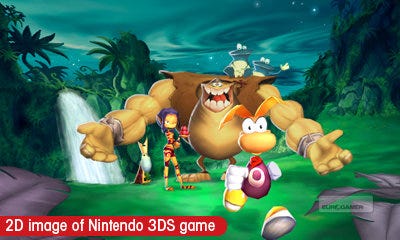
Rayman is a satisfying character to control, falling somewhere between the acrobatic elegance of Mario and the versatility of Banjo and Kazooie. His world is unique. It features weird, slightly nightmarish characters and a bold, distorted colour scheme which relies heavily on purple and green. There are plenty of odd setpieces like riding around on a two-legged bomb, Dr Strangelove-style, or water-skiing on a swamp whilst hanging on for dear life to a runaway snake's scarf.
The jumping and climbing is broken up with puzzles where Rayman has to carry explosive barrels or orbs around tricky labyrinths to unlock doors. There are simple but satisfying fights against one-eyed robot pirates who shoot energy orbs from chunky guns.
The game is up to its eyeballs in character and delightfully French, but it also has a camera that was awkward even in the old days. You have to use Rayman's first-person view an awful lot to grasp the layout of the levels or see where the next platform might be.
It's largely because of this camera that the 3D effect doesn't really work. Having the inside of a polygon jump out at your face because the camera got stuck on a wall is even more jarring in 3D, and things are constantly getting in your way at the forefront of the screen.
I lasted about ten minutes before wanting to turn the thing off. It's further evidence that games need to be designed for 3D – retroactively imposing the effect doesn't ever work very well.
There's something weird going on with the sound, too. Changes in music are triggered when an robot pirate appears or something else exciting happens, but it doesn't change back when you die.
Sometimes it cuts out abruptly at odd moments. In the absence of music or ambient sound there's a horrible buzzing noise. It's one thing that the original game's problems still endure, but these technical inadequacies are inexcusable.
Rayman 3D undoubtedly presents a tough challenge. It's difficult in ways that games just aren't any more, especially when you get into the second half. Some of that is down to the camera and other mechanical obstacles, but mostly it's about the level design; this game is not afraid to make you swear and try again.
No.2: if you leave him alone for long enough, he starts bouncing his floating body around like a basketball.
Our hero has infinite lives and the checkpointing is fair, if not forgiving. It assumes you won't give up the second it shows its teeth, as so many publishers sadly believe today.
Playing Rayman 3D reminds you that working around a game's quirks used to be fun. There's a bit in the most infuriating level, the Sanctuary of Stone and Fire, where you have to ride a bouncing plum down a lava flow by shooting in the opposite direction from the one you want to go in. But the camera is positioned behind Rayman, so it's literally impossible to see where the hell you're headed.
It's infuriating to the point where you feel like snapping the 3DS in half, but there's still a real sense of masochistic achievement in beating the stupid broken thing. I even had a slight nostalgic thrill when I found a bug and Rayman dropped through the floor and into nothingness – you NEVER see that anymore.
That's not to say it has any place in a game released in 2011, or to make excuses for this one's faults. However, if you were around for 3D platforming's nascent years, you'll probably enjoy Rayman 3D more than you strictly should.
Rayman 3D is an artefact. It's completely anachronistic in today's world. If you speak its dying language, there is still fun to be had in this surreal, angular, polygonal universe. But this is a 12 year-old game being marketed as a new experience, and that sort of thing really ought to be discouraged.
5 / 10
