Superbrothers: Sword & Sworcery EP Review

Tell me a stwory.

Version tested: iPad

There's a difference between admiring a piece of art and loving it. Admiration is cerebral. You can evaluate a thing on its merits and talk yourself into admiring it. But love happens. It can be explained, sometimes, but not premeditated. Love creates movement in the soul; admiration stands there and smiles.

Superbrothers: Sword & Sworcery EP is built to be loved, and I admire the hell out of it.

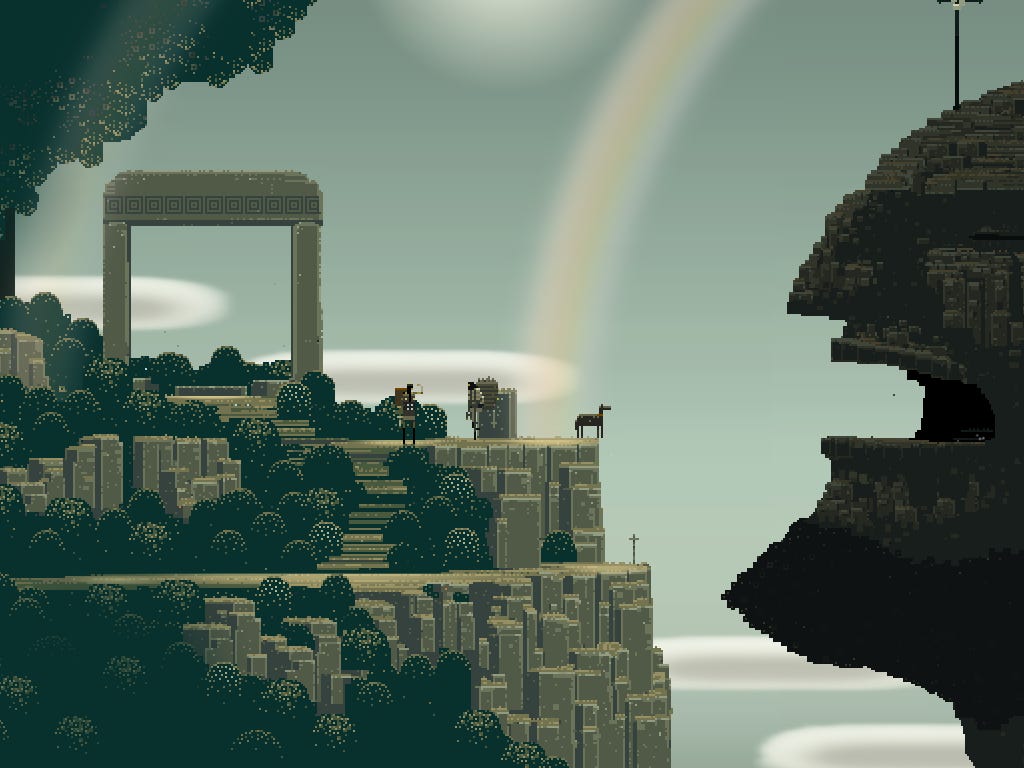
I admire its visual style, a lush, proto-Bohemian echo of King's Quest tableaux from the Apple II era. With brick-like pixels and a palette dominated by muted greens and blues, artist Craig Adams (he's "Superbrothers") hand-crafts the moody forest enclave where the large part of your quest plays out. As a result, the game is filled with scenes that ought to be framed and hung on the wall.

A round of applause is in order, as well, for musician Jim Guthrie, whose soundtrack starts from the game's strongest inspiration – Zelda – and gives the old adventure-anthem genre a more weathered and adult sound. Like Adams and his pixels, Guthrie layers miniature building blocks – short audio loops and esoteric effects – into impressive aural moments.

These perfectly commendable production elements come together in a perfectly commendable work that doesn't quite inspire lasting passion.
1

I'm a cave whose burps are made of rainbows, what's your deal?

The thin fabric uniting Sword & Sworcery's artistic collaboration is a vague quest. You play as The Scythian, a warrior-adventurer who tramps back and forth through the woods, joined on occasion by a few friends, seeking to wield the Megatome of ancient knowledge and awaken spiritual sprites by singing songs of Sworcery.

I could go into more detail, but it's hard to say too much without giving away the whole store, and it wouldn't make much more sense anyway. The premise is purposely ethereal. The specifics of the quest are not of primary concern to Sword & Sworcery; all that really matters is its quest-ness. Literary theorists will love it. Your guide (and possible overlord?) is a cigar-chomping corporate sort named The Archetype, for Pete's sake. The senior thesis practically writes itself.

In any case, don't get too wrapped up in the story. It's a framework, a justification for a world in which the player can explore or even just exist – Sword & Sworcery would be totally fine with that.
2

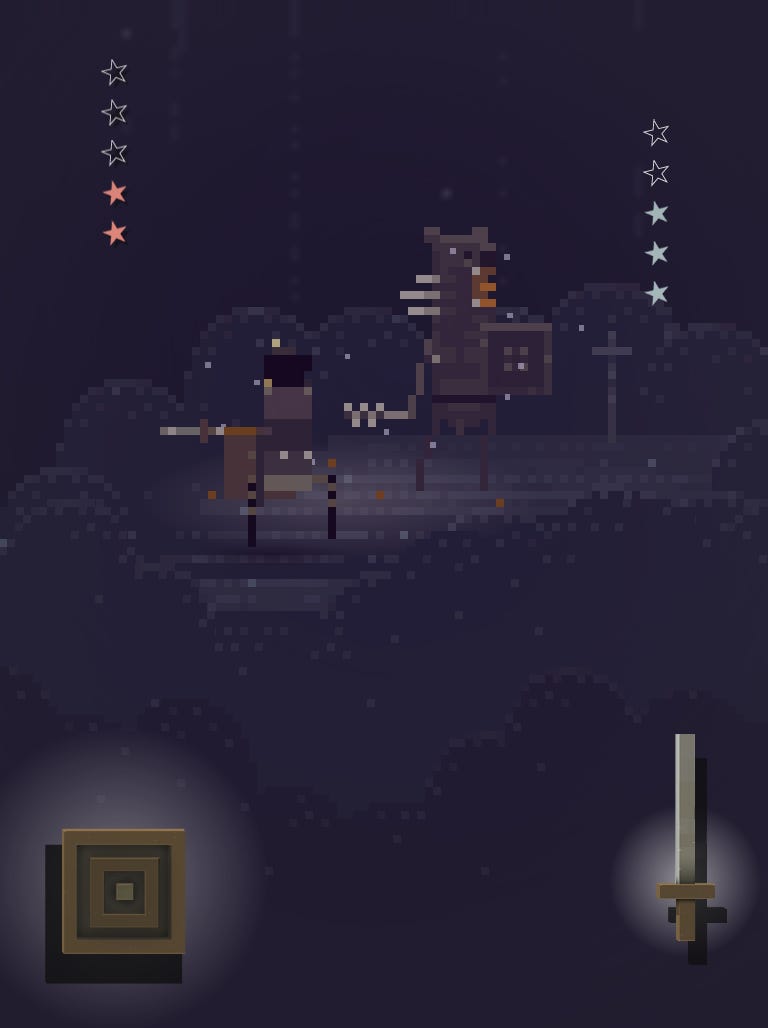
Is it rude to fight a bear-boar hybrid thing on someone's grave? Nah, that's probably OK. Right? Yeah.

There are elements you will recognise as traditional game-y stuff: some low-key puzzles, and a few very simple battles. For the most part, though, you browse at your own pace, preferably a languorous one. It never urges you to push ahead, and in fact encourages you to look around and take a break once in a while. As The Archetype puts it early on, "S:S&S EP does not produce the transcendent experience, it is merely intended to free the nervous system of ordinary patterns."

That's stilted nonsense, of course – it roughly translates as "This is not a transcendent experience, merely a transcendent experience" – but so is everything The Archetype says. I take it to mean that the game wants to be approached calmly, as a plaything rather than as a challenge to be vanquished.

It sounds like easygoing flower-child stuff. However, Sword & Sworcery isn't quite as chill as it lets on. It has an obsessive side, exerting a subtle yet encroaching pressure on you to freaking relax and enjoy yourself. The saccharine prose, the frequent swells in the music, the infinite cheerful orbs of glowing light – all of it gets poured on thick, as if every tiny detail of this game absolutely must fill your belly with sparkles of childlike wonder, or else something bad will happen, like some baby animals will die, probably.

There used to be a nice restaurant near my house. At every meal, a couple of minutes after the food had been served, the owner's wife would emerge from the kitchen to hover over us. She'd say, "It's delicious?" She was half asking, half insisting. I get the same vibe from Sword & Sworcery.

"TWEET THIS?" the game asks/insists, dozens of times. A message appears after solving a puzzle: "The dark moon reigns and we just woke a Sylvan sprite surrounded by four little round trees in the darkest woods." And a menu slides out: "TWEET THIS?" This feature shall henceforth be known as the Unfollow-matic.

See, it's not enough to have solved the puzzle and awakened the sprite. Simply experiencing a happy turn of events does not, in itself, sate this game's appetite for innocent joy. No, the moment must also be commemorated and celebrated.

I'm not just talking about the misguided Twitter-spam. Tweetability aside, the countless cutesy dialog boxes – "Are you feeling that peculiar vibe? It is a time of miracles!" – are overbearing enough themselves. After every minor success, yet another pithy scrawl descends on the scene to recap, and thereby diminish, what just happened.

3

This game is probably better if you play it stoned, but then again, so is every game.

This tic strikes me as especially odd given that last year, Superbrothers published an inspiring manifesto titled Less Talk, More Rock. It made a convincing argument for the beauty of nonverbal communication in games. And indeed, Sword & Sworcery is packed with gorgeous nonverbal flourishes. The trouble is that it won't shut up about them.

Still, I'd be inclined to look past the game's excessive earnestness if it were so wondrous as its trappings imply. Don't get me wrong, I was ready to be swept up in Sword & Sworcery's magic. Each of those delightful touches – a deer scampering away into the woods, a boss grappling with you in perfect rhythm to the music – seems to hold the promise of something greater.

In this case, however, the details are just that. It's not that they're incoherent. (That wouldn't even be a problem, as indie developers like Cactus and Mark Essen regularly create moving games of great incoherence.) No, all the little pieces in Sword & Sworcery speak to each other. They simply never add up to a larger whole. The spirit of the game doesn't aspire to much beyond a broad sense that adventuring is neat, and hey, joy is super, too.

4

The next time you read a Top 10 Games With a Cool-Looking Hut by a Reflecting Pond list, if it does not include Sword & Sworcery, you should probably get angry about that.

Maybe that's what The Archetype is getting at when he says, "S:S&S EP does not produce the transcendent experience." It could be that the world's sweet curios are meant to stand on their own, content in their simple pleasures. That's fair. But I also believe it's fair to ask that art at least transcend itself.

Sword & Sworcery does accomplish that feat in one respect, by broadening the idea of what a game can be. I'm not talking about touch controls (somewhat clumsy) or the fact that it's on the iPad (not the first or the last). Rather, this work stands out in its willingness to subdue the goal-oriented aspects of gaming while still embracing the idea of a quest. These are purely formal concerns, though, which leave me a bit cold.

I realise that's an odd thing to say about a game of such exceeding warmth. There's no doubt of the passion and heart that went into the creation of Sword & Sworcery. The artistry is extraordinary. The resulting art is not, not quite. Artistry is important, and I admire it to the fullest extent. In considerations of art, though, I want something more profound. Love, perhaps.

7 / 10

Superbrothers: Sword & Sworcery EP is out now on iPad. A version for iPhone and iPod Touch will be released in April.

Read the Eurogamer.net scoring policy

Comments (71)

Comments for this article are now closed, but please feel free to continue chatting on the forum!

  • Loading...hold tight!