Hyperdimension Neptunia Review

Game will eat itself.

Version tested: PlayStation 3

Hyperdimension Neptunia is the latest member of a small family of releases to choose the videogame industry for a theme. Unlike iPhone app-du-jour Game Dev Story or SEGA's eccentric Segagaga, however, you are not charged with steering the fortunes of a virtual games company. Instead Idea Factory's idiosyncratic role-playing game offers, ostensibly at least, an abstract, metaphorical take on the videogame business, featuring game consoles personified as warring goddesses that vie for dominance over the land of Gameindustri.

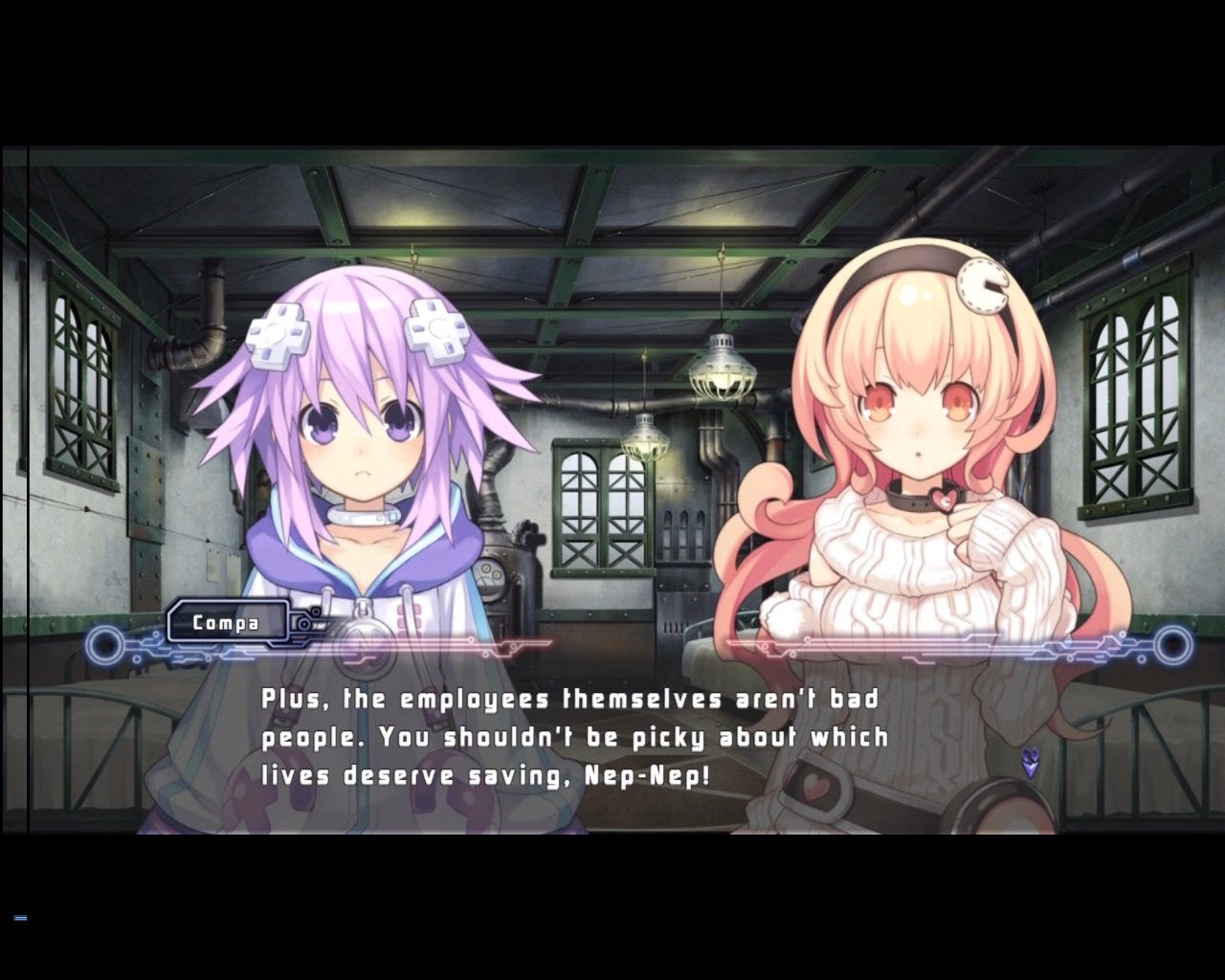
It's a ripe premise, but almost immediately whatever metaphor the developer was aiming for falls apart. Despite lines of dialogue that poke fun at JRPG conventions ("I'm apparently an amnesiac, so I need you to explain stuff to me in a manner convenient for the players to understand," says your character, Neptune) it's never quite clear who or what is the primary subject of the satire.

Rather, ideas and conventions from videogames are invoked with no rhyme or reason (from Princess Pear, a character who is running from castle to castle in order to evade her rescuer, to a Nintendo DS-style piracy device). The writers grin idiotically as they rely upon our familiarity with their reference points to make the game funny and interesting, inviting us to join in gags that lack bite and, more often than not, a punch line.
1

The American voice acting grates.

It's hardly Nippon Ichi's fault - the publisher's English translation is generally robust - but joke after joke falls flat, the dialogue inane and childish, the Japanese writers missing every available opportunity to say something witty or insightful about the industry whose terminology they plunder with such gleeful abandon.

Moreover, the game adheres to a strict and orthodox JRPG template, both in terms of the narrative and game structure, a decision born not of irony but of a plain lack of imagination, one entirely at odds with the developer's boastful name.
2

Neptune takes her name from the unreleased SEGA Neptune, a system which planned to combine the SEGA Genesis/Mega Drive and SEGA 32X into one unit, originally scheduled for release in 1994.

The wearying effect of the witless writing is exacerbated by the plain sexism on show in almost every one of the garrulous cut-scenes. The camera lingers longingly over stills of each girl's crotch (and, as the cast of Hyperdimension Neptunia is exclusively female, that's a lot of crotch), while characters make lewd comments with all the awkwardness of a children's TV presenter telling a dirty joke.

In one of the earliest acts of the game, your character arrives at a busty barely-legal nurse's home only to have her scratched, suddenly-naked body bandaged to a soundtrack of squeals of delight.

Some will claim the game is playing on established anime conventions. True. It's playing on conventions of plain old ugly Japanese sexism, and while the Carry On tone ensures the game stops short of titillation, the innuendo leaves a bad taste in the mouth. Not because its innuendo - we love a bit of innuendo, especially in your mum's pretty mouth - but because it's dull and stupid and essentially based around girls made to look and sound like schoolchildren.

Almost as unforgiveable are the game mechanics beneath the story. Peel back the mess of a narrative and the RPG underneath is feeble and undernourished, far less robust than the studio's previous effort, Trinity Universe.

The action is limited to dungeons: there are no towns or over-world to explore here, with each new dungeon selected from a drop-down menu. The dungeons themselves are relentlessly simple and uninteresting; dull, repetitive corridors furnished by invisible monsters that interrupt your progress with archaic random battles.

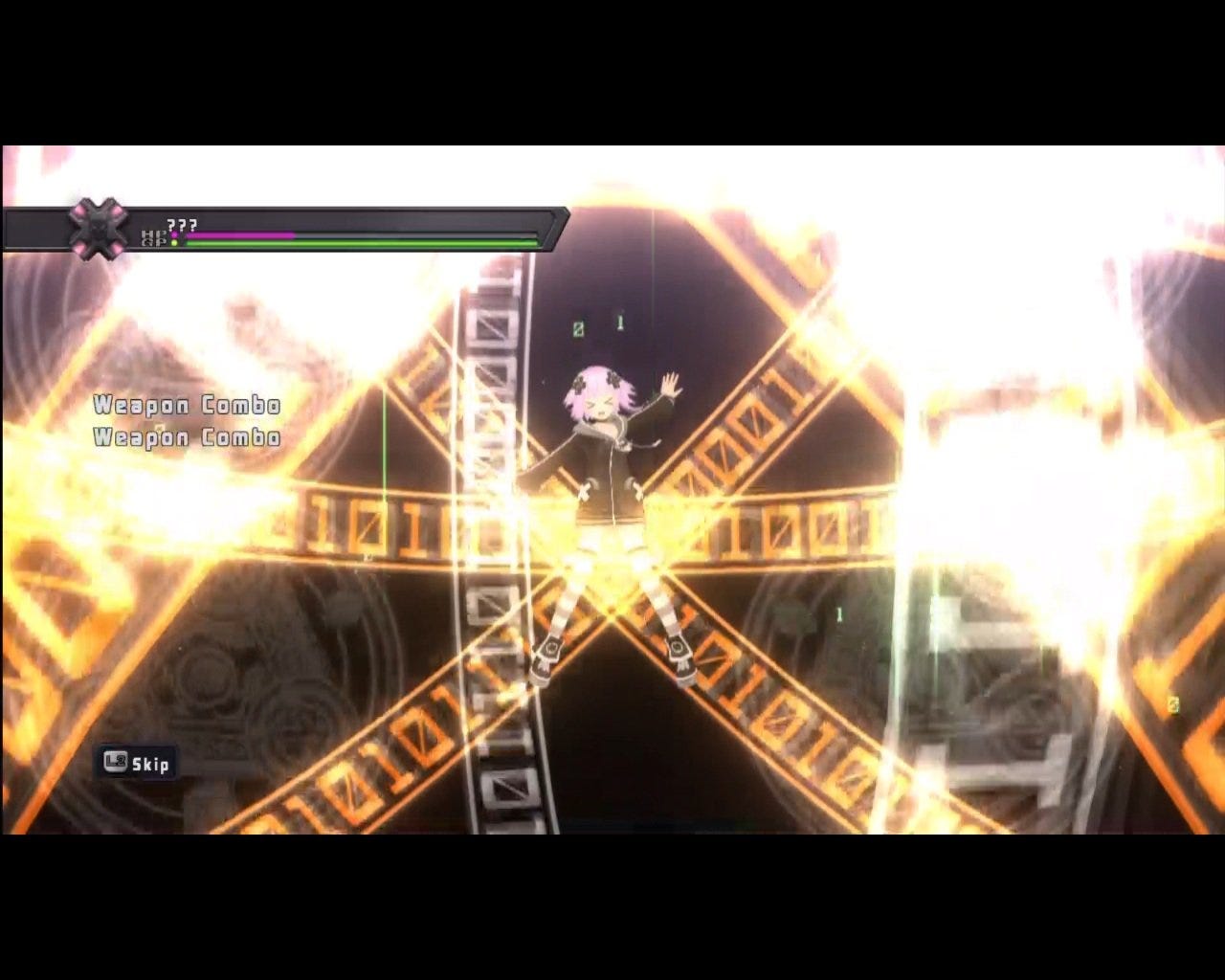
The battle system too is a shadow of what it could have been. Borrowing from Square-Enix's classic PSone RPG Xenogears, each of your characters is given a stock amount of Action Points during their turn. You are then free to create four-part attack combos from that character's three stock attacks, the order of attacks resulting in different effects.

Some combo strings have a special finishing move attached that will see your character transform into a more powerful version of themselves for the rest of the battle, but as the attacks that are available to you remain the same, it's little more than a graphical and statistical upgrade.

While the system appears to be interesting at first, the lack of any meaningful character progression in terms of raw attack abilities ensures that after five minutes you will have explored and mastered most of its idiosyncrasies. The long, ponderous attack animations draw battles out unnecessarily, and so more often than not you'll hit the skip button to fast forward to the next attack.

In time, you find yourself entering a string of attacks and then tapping away at the skip button, merely glancing at the monster's health bar as it depletes. It's spreadsheet gaming, and the lack of any real need for strategy ensures it's lifeless and uninteresting.

3

Anime tropes abound. One member of your party is a nurse wielding a giant syringe as her weapon.

One of the most puzzling design choices in a game filled with wrong-headed decisions is the way in which healing items cannot be manually administered to wounded allies. Rather, restorative actions are randomly triggered during the course of battle.

The only power you have is in allocating points to each character's item skills, a figure that increases the likelihood that they will be randomly triggered during a battle. As such the only definite actions you can make during the course of a fight are offensive ones, and the lack of control over healing your party (you're even restricted from using the heal command outside of battle) is irritating and idiotic.

It's frustrating that, of all the great many Japanese games that should be picked up for Western release, Nippon Ichi has chosen Hyperdimension Neptunia. On paper, the premise is a solid one, but the execution disappoints on every level.

Even the most ardent JRPG fan will baulk at the roughshod simplicity of the game's systems, restricting the game's audience to Japanophile anime fans who can overlook the experiences shortcomings as a videogame and approach it as a cultural curio. That is, a sexist, senseless and ultimately stupid cultural curio.

2 / 10

Read the Eurogamer.net scoring policy

Comments (79)

Comments for this article are now closed, but please feel free to continue chatting on the forum!

  • Loading...hold tight!