Gratuitous Space Battles
Torpedophile.

Remember how, when introducing Fable II in interviews, Peter Molyneux teased out the concept of "no control over the dog" like a seedy magician producing a never-ending handkerchief? The world watched, partially in awe and partially because we had nothing better to do, as Molyneux spiralled this idea out into all of its repercussions.
Well, Gratuitous Space Battles is built on a similar bit of minimalist design. It's a space RTS, where mighty fleets meet in space like tidal waves crashing against one another; scores of tiny fighter craft dogfighting their way around enormous frigates and cruisers that fling torpedo barrages at one another between heavy burps of laser beam fire.
There's just one twist: You have no control over the ships. When a battle starts, you can't issue so much as an attack command. You can only sit back and watch all of these pretty vessels crumple and burst like overripe fruit until, eventually, one side is declared the victor.
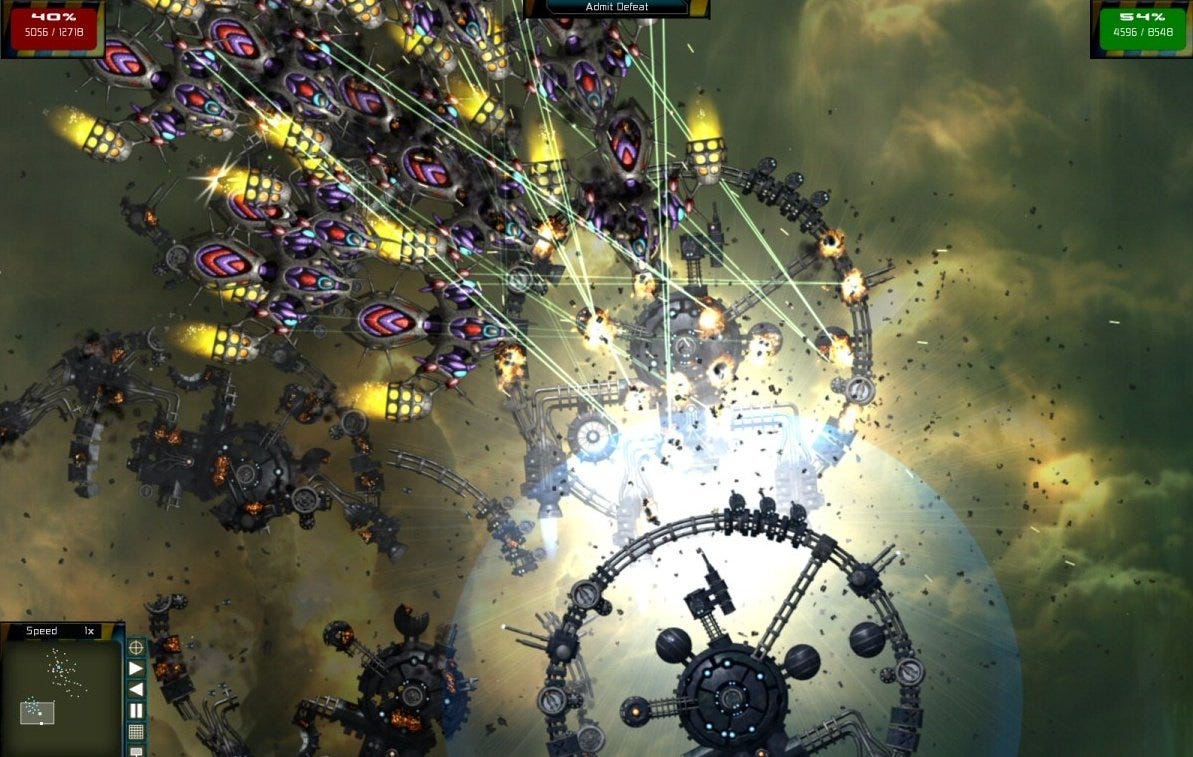
As such, Gratuitous Space Battles is a game about planning. Each class of ship you choose to deploy is hand-designed by you. Whether a type of fighter is carrying blasters, pulse lasers or rockets – that's your call, as is how fast it is, and how heavily armoured, and whether to field any cruisers with hanger bays attached so that your damaged fighters can go limping back for repairs during a battle. Each empty hull at your disposal has a number of equipment slots and weapon hardpoints, and the choice of what to put in each of them is, at first, bewildering.
The second part of Gratuitous Space Battles happens on the deployment screen. Before each (strictly two-dimensional) space battle begins, you're presented with a tidy grid on which to place ships, your options limited only by that battle's budget and the number of available pilots.
Your final role is to issue orders. Using three sliders you can tell ships whether to prioritise enemy fighters, frigates or cruisers, what distance to engage at, and then if you like you can add additional special orders. "Co-operative" causes ships to gang up on the same enemy. "Vulture" has ships prioritising damaged craft. "Formation" causes ships to fly in formation, "Cautious" means ships fly away after receiving a set amount of damage, and so on.
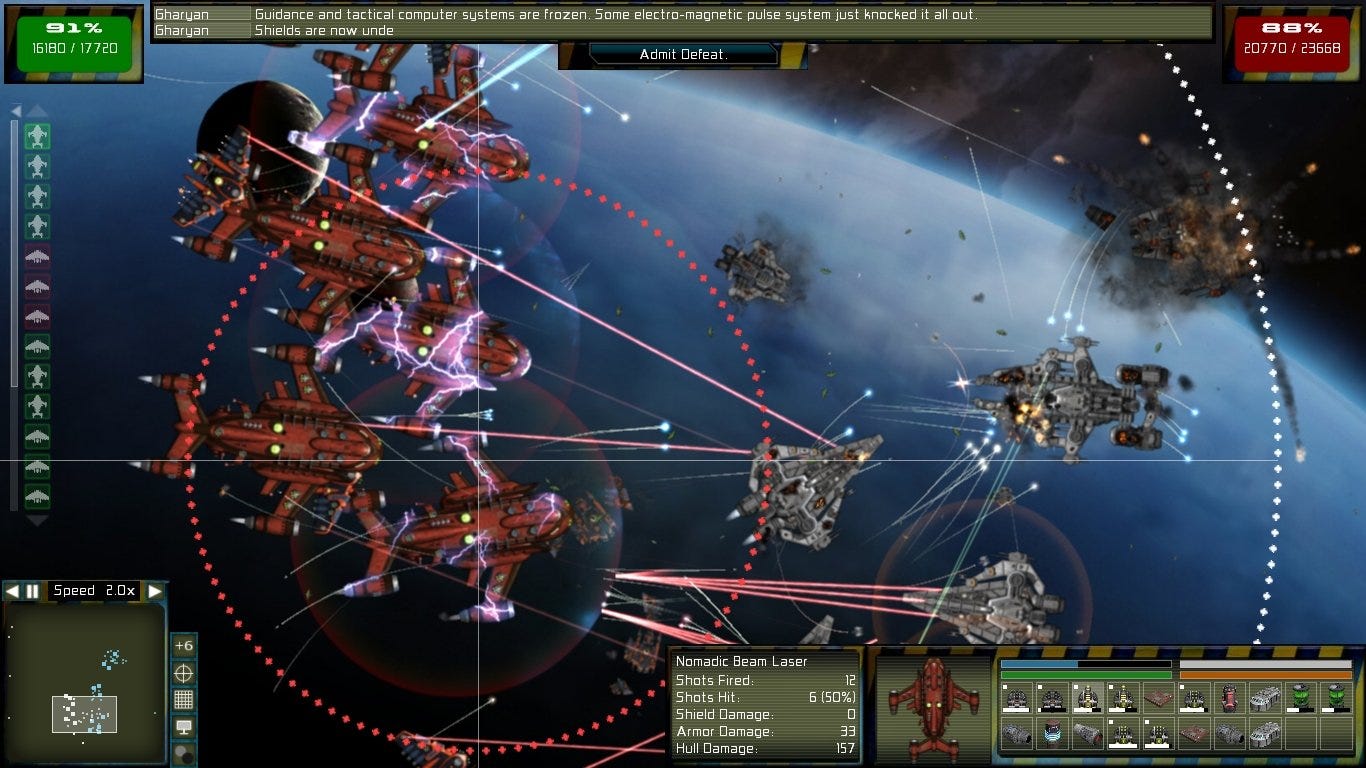
After you've settled on your orders, you've done all your can. There's nothing left but to bite back that trembling lower lip of yours and click on the big button that starts the battle.
Despite a number of quick, friendly tutorials, Gratuitous Space Battles is far from intuitive, which is kind of the point. For your first 15 or so battles, this game is like performing surgery on a wombat. You have no idea what you're even looking for. You think, "Well, maybe this will help", and then you sew that sucker up and watch it flounder about, uselessly – or, in Gratuitous Space Battles terms, you watch that meticulously crafted fleet of yours get steamrollered for reasons you can't quite comprehend.
But your interest is piqued, because in all that chaos you do notice one thing you did wrong. So you drop straight back into that design lab and swap out a couple of components, then duck back into deployment and change a couple of ships, a couple of orders and try again.
This trial and error is the core of the game. Inventing tactics and layouts, refining them, abandoning them, testing them. Ooh, it's a nerdy game. It's also an addictive one. Winning battles earns you honour points, and honour points can be spent back at Fleet HQ unlocking new races, hulls and ship components, broadening the scope of your tactics even further.