It's 1983. Thatcher has marched the Conservatives to a landslide victory, the Austin Metro is Britain's best-selling car, and a new BBC Micro game called Time Lords has just launched.
Time Lords was the first computer game designed by Julian Gollop who, along with his brother Nick, went on to make the first X-Com game in 1994, UFO: Enemy Unknown, and in the form we loved it best: turn-based tactical combat with a strategic metagame.
The X-Com licence was also the victim, like so many great licences, of sequel pressures, publisher takeovers, and an embryonic industry focused on short-term gain. We recently spoke with Julian about those days, to chart the genealogy of X-Com, and find out what really happened behind the scenes.
Eurogamer: So Time Lords was your first computer game?
Julian Gollop: Yes. It was originally designed as a pencil-and-paper game, but it wasn't very practical to play. So when a friend of mine at school got a BBC model B, I asked him if he could program it – which he did.
From a very young age I played a lot of board and card games. My Dad was very keen on games of all kinds. Every Christmas, we didn't watch TV, we'd play games endlessly. My Dad was inspirational in this respect, as I was exposed to a lot of games, and this was before computers, of course. Time Lords, and later Chaos, were both board games before they were computer games. I made a lot of such games back then.
Eurogamer: And you released Time Lords commercially?
Julian Gollop: It was published by Red Shift, which was a company formed of a group of friends who were all gamers. I remember going to various computer fairs and selling it, in a bag with a cassette a cardboard insert. Very professional!
The first game I made on the Spectrum was a strategy game called Nebula, which was actually a sort of 4X game. You were expanding and colonising the galaxy. It had a basic combat system and AI, resource management and exploration.
Eurogamer: You were really the architects of turn-based tactical combat games, weren't you?
Julian Gollop: The first tactical squad-level game I did was Rebelstar Raiders. I was working on that in late 1983. I'd left school, I bought a Sinclair Spectrum, and I started to program. It was inspired by a couple of board games: Sniper, and Snap Shot by Games Workshop. They had some interesting combat mechanic ideas which I used in Rebelstar Raiders.
Eurogamer: From Rebelstar Raiders, there seems to be quite a clear evolution of ideas to X-Com...
Julian Gollop: Yes, there was definitely a progression there. It's not too difficult to spot! After leaving school, I took a year out. During that year I did Nebula, Rebelstar Raiders, I did a little bit on a game called Battle Cars, then started work on Chaos which I finished at college. While I was at college, I also started and finished Rebelstar, and Rebelstar 2 came soon after.
Eurogamer: So after college, you devoted all your time to computer games?
Julian Gollop: When I left college, I set up Target Games with a friend. When he left, my brother Nick joined as a programmer. We made Laser Squad; I programmed the Spectrum and Amstrad versions, and Nick did the Commodore 64 version. Laser Squad was the first game where I was devoted to development full-time. It was a development of the Rebelstar ideas, which involved unit facings, hidden movement based on true line-of-sight, destructible terrain... all ideas which were then expanded by X-Com.
Eurogamer: And as a multi-platform game, was Laser Squad a success for you?
Julian Gollop: It didn't do too badly. The only problem was, I was self-publishing. We then got a publishing deal with another company called Blade Software. We did Lords of Chaos with them, the follow-up to Chaos.
This wasn't as successful commercially, so we went back to working on what, at the time, we called Laser Squad II. We built the demo on the Atari ST, and I remember saying to Nick that we needed to get a better publishing deal. The deal we had with Blade wasn't that good; we didn't get a good royalty fee, they ended up owing us some money... it was time to get serious and find a decent publisher.
So we made the demo, and it had a basic working tactical combat system, but with 3D isometric graphics so it looked more impressive. We had a shortlist of three publishers, one of which was Microprose. We were particularly keen on them, because they published Civilization, of course. We thought they were the best company for strategy games because of Sid Meier, and we wanted to do games for PC, because we saw it as the future of gaming.
We took the demo to Microprose in the UK, and they liked what they saw, but they said that they wanted something bigger. It wasn't a Microprose game; it needed to be something deep. There was a guy there called Pete Moreland, who suggested the theme of UFOs, and I thought this was a very good idea. So I went away and we came up with the whole strategic aspect of the game, with randomly-generated tactical missions, the Geoscape, the economics. In a couple of weeks I went back to them and said, "How about this?" and they thought it was great! So we started on X-Com, which was what Laser Squad II had become.
Eurogamer: With its management metagame, X-Com was an order of magnitude bigger than Laser Squad...
Julian Gollop: Yes, well, we were trying to make a big game, a game that was comparable in size and scope to Civilization, for example, and I think we succeeded. But it took nearly three years to make. Mythos Games, which is what Target Games had become, was still just me and my brother, although the art was done by a couple of guys from Microprose; one guy did the aliens and characters, and another guy worked on the terrain.
Later we also had a musician at Microprose, John Broomhall. John did a great job with the music and the sound. It was great working with him. A thing a lot of people say about X-Com is that the suspense and fear of the unknown are accentuated by the fact you can hear something but you can't see it. It's a simple device, but it does work quite well!
Eurogamer: How many platforms did X-Com reach?
Julian Gollop: The PC, Amiga, the CD32 and PlayStation. It didn't do too badly on the PlayStation, which surprised me – I was sceptical. I thought it wasn't the kind of game that was good for a console. The total physical sales were around the half a million mark. But of course many more people have played the game than that. A lot of people I meet played X-Com, but they didn't necessarily buy it!
Eurogamer: And the sequel, Terror from the Deep, came next?
Julian Gollop: Microprose wanted us to do a sequel in six months. We told them the only way we could do a sequel in that timeframe would be to change the graphics and tweak a few bits. Eventually we came to a compromise: they'd license our code to make a direct sequel, and we'd do the third one in the series in two years. TFTD was made entirely by Microprose; we had no input apart from giving them our code. They managed to do it in a year, but they had a much bigger team. A shockingly large team, I thought at the time, 12-15 people.
We earned lots of cash from X-Com, so we hired more staff at Mythos. But the deal that Microprose wanted was that they did the Apocalypse graphics. It was a disastrous relationship from the start. They had some very fancy, rather expensive ideas: they hired some relatively famous artist who made physical models of the aliens, which were then scanned into their software. It didn't work very well. The Microprose artists couldn't quite understand how isometric graphics worked. It was enormously difficult, and I think overall the artwork was done pretty poorly on that game.
It was a disaster area. Apocalypse was quite a sophisticated and ambitious game, but it was a big mistake from our point of view. In retrospect, we should have originally agreed to do a sequel in six months, and spent a year doing it, like they did! It would've been a lot better.
Eurogamer: And is that when you split from Microprose?
Julian Gollop: Microprose was taken over by Spectrum Holobyte, and they in turn were being taken over by Hasbro Interactive. At the time, Virgin was the premiere European publisher, and because of Westwood and Command & Conquer, they were doing pretty well. In the end we went with Virgin.
Eurogamer: But Microsprose retained the X-Com licence?
Julian Gollop: There was some dispute about who owned the licence. In those days, companies weren't terribly good about intellectual property protection. Our lawyers said that if it went to a court battle, we'd probably lose, and have to hand over the X-Com name. But strangely, their lawyers were telling them the same thing! We eventually struck a deal that we would get increased royalty rates for X-Com Apocalypse, and they would take the licence. And then, of course, Microprose took it in a slightly different direction.
Eurogamer: X-Com Interceptor?
Julian Gollop: Yes, the space-combat one. And they started work on X-Com Alliance, an Unreal Engine game. I remember seeing it at E3 in 1999. They had a really big display, with dwarves dressed as aliens wandering around and glass tubes full of alien foetuses.
It was basically a tactical shooter. You had a squad of four guys, you directly controlled one of them, and I was shocked. It was an FPS. It didn't bode well basically... It was very buggy, and poorly done. It had the other elements of X-Com – research and base-building – but it looked like an FPS to me. They spent quite a lot of money on it, but it was canned.
They also started work on something called X-Com Genesis, over in the original Microprose offices in Chapell Hill, North Carolina, but that was canned as well. It was supposed to be a remake of the original, but they closed down the studio.
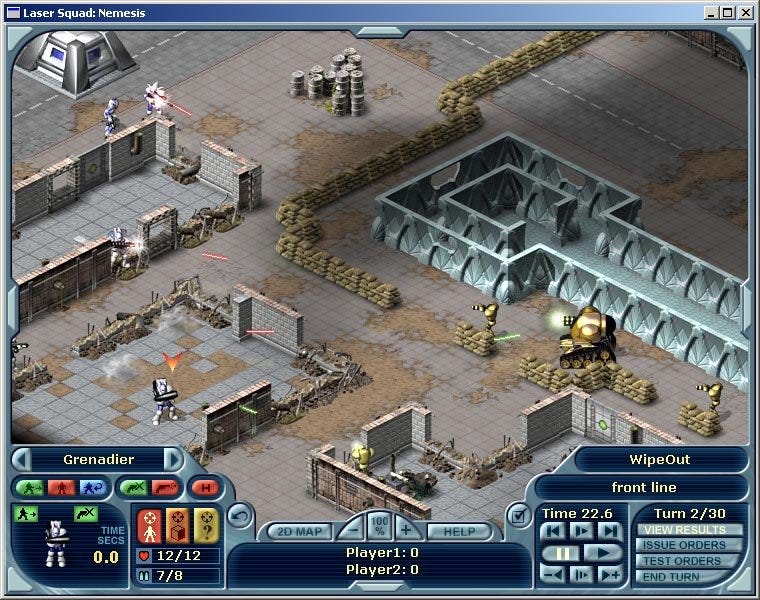
Eurogamer: And, of course, you and Nick went on to make Laser Squad Nemesis....
Julian Gollop: Yes. First we made Magic and Mayhem for Virgin interactive, but things went bad. We'd just proposed Dreamland Chronicles, which was a faithful reworking of the original X-Com. It was a turn-based game, with a focus on research, though the setting was different as the aliens had already invaded the earth. It had proper 3D graphics and we were using a very early version of Havok.
We were doing it for PS2 as well as PC, and it was an interesting game because it had a third-person view but went into first-person for the shooting mode. It was still turn-based, action-point based. Last year when I played Valkyria Chronicles on the PS3, I was stunned – it was almost exactly the same as Dreamland Chronicles! It even had a little bar for your action points.
However, Virgin were sold to Interplay, who were then sold to Titus Interactive. Titus were only interested in plunder, particularly Interplay's assets and IP. They weren't interested in our game at all and simply stopped funding us. And because we had an exclusive four-game deal with Virgin, we had to liquidate Mythos. It was a tragedy.
We were left without our development team, which was shame because by that point we'd managed to recruit some really good guys. One of whom went on to be the lead programmer for Heavenly Sword; one is now Audio Manager at their Cambridge studios. One went on to be a producer at Climax. We went back to a very small team again – me, Nick, and one other guy – and back to experimental games like Laser Squad Nemesis.
Julian now develops for Ubisoft. His current project is Ghost Recon: Shadow Wars, a squad-level turn-based tactical game, and launch-title for the Nintendo 3DS.
The X-Com licence was acquired by Firaxis in 2005, and now lies with take Two Interactive. 2K Marin, owned by Take Two, is currently working on the 50's-themed franchise reboot, XCOM.
