Vanquish Review

Overcome.

Version tested: Xbox 360

It's entirely in keeping with Platinum Games' devil-may-care attitude. For years, we've written off Japanese studios when it comes to first- and third-person shooters: always playing catch-up to their American counterparts, never quite delivering. But Shinji Mikami was never going to meekly push his team's debut shooter centre stage with a deferential bow and an apologetic glance, pleading: "Might this be good enough, Yankee-Doodle-sensei?" It's just not the Platinum way.

What is, you ask? Well. You kidnap Master Chief, that icon of contemporary Western shooters, that representative of all that is strong and successful about the white man's videogame and its gun-toting alpha-male hero. You strip him naked and throw him into the alleyway behind your Osaka studio, keeping only his clothes. Why just his clothes? Because you don't need the man. Master Chief himself is just a cipher. It's his armour that holds the iconographic value.

And once you have the armour, this suit that embodies the great American videogame? Well, then, you do what the Japanese do best. You mod the f*** out of it.

When Sam Gideon emerges in the Augmented Reaction Suit (ARS) 18 months later, it's clear combat has, once again, evolved. The round edges from the time it belonged to Halo's hero are still recognisable, but the exoskeleton now bears fifty booster flaps, whirring transistors and other bells and electric whistles.
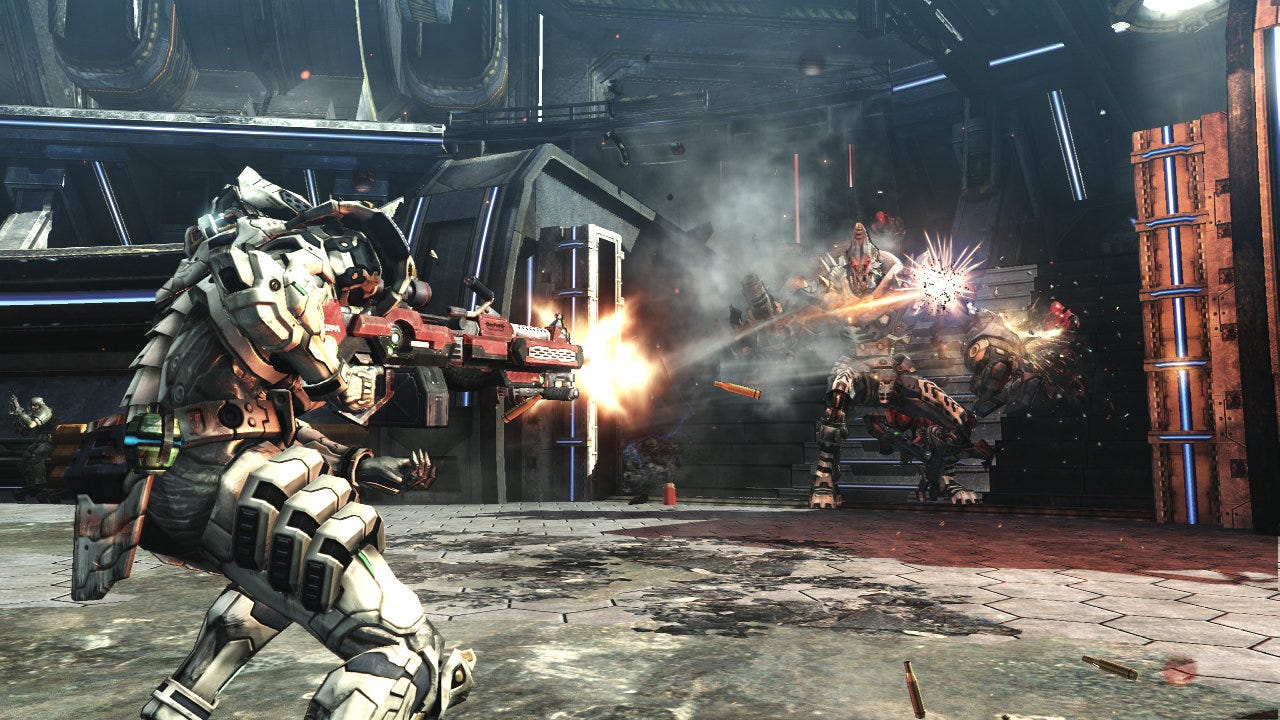
Sure, Halo: Reach gives you a jet pack. But Vanquish gives you the ability to slide 40 yards on your knees along concrete, ducking through the legs of a giant bipedal robot while firing rockets at point-blank range into its groin. Vanquish lets you shoot individual enemy missiles out of the air like you're knocking apples from a low-hanging branch. Vanquish lets you speed up and slow down time at the touch of a button, lurching forwards and backward as you set the pace of war like a mop-haired conductor directing an orchestra of bullets. Vanquish changes everything.

Not that it does anything particularly new, mind you. Rather, Platinum has extracted the best elements of Western gaming's totem shooters: the cover mechanic from Gears of War, the squad-based progression of Modern Warfare, the environmental degradation from Bad Company and the psychics–bending weapons of Half-Life.

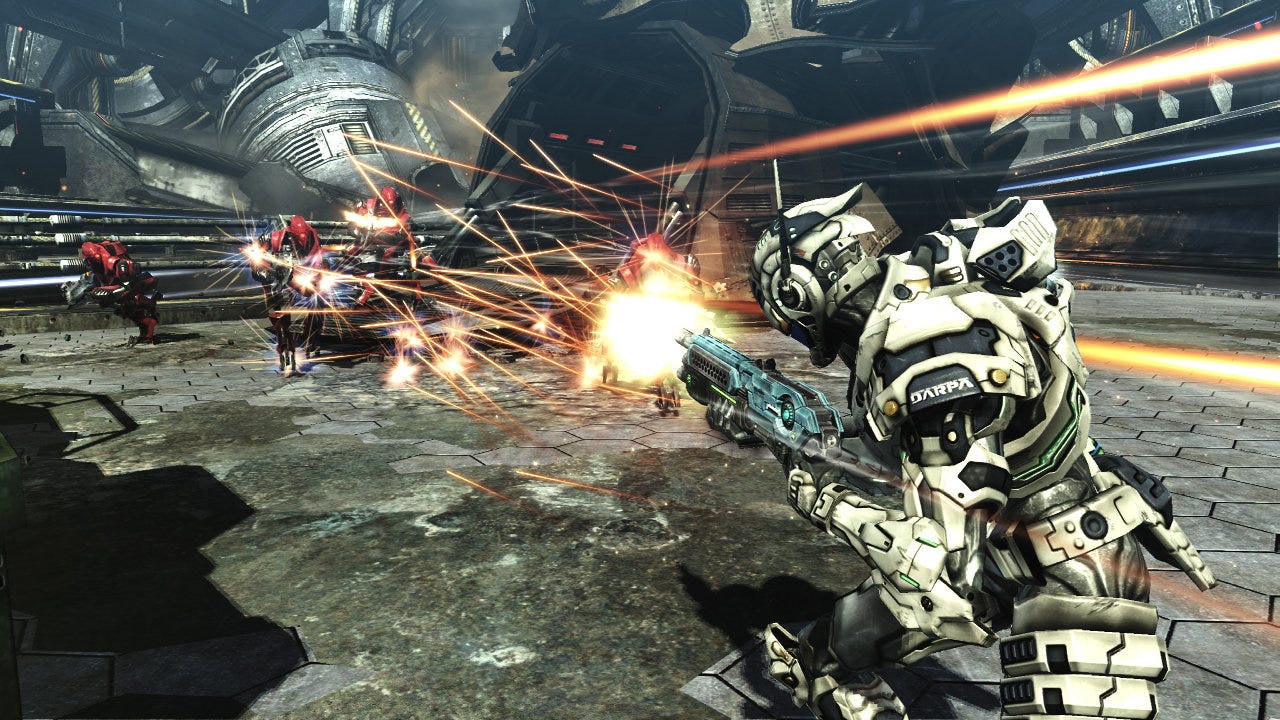
Then it whisks them up with a host of less obvious ingredients. The recurring hail of tracer gunfire is taken from Cave's "bullet hell" shoot-'em-ups; the gigantic boss battles are borrowed from a Metal Gear Solid cut-scene; the constant score-attack incentives are lifted from Geometry Wars. Then it tops the recipe off with set-piece after set-piece stolen from the idea safe hidden deep within Christopher Nolan's creative consciousness.
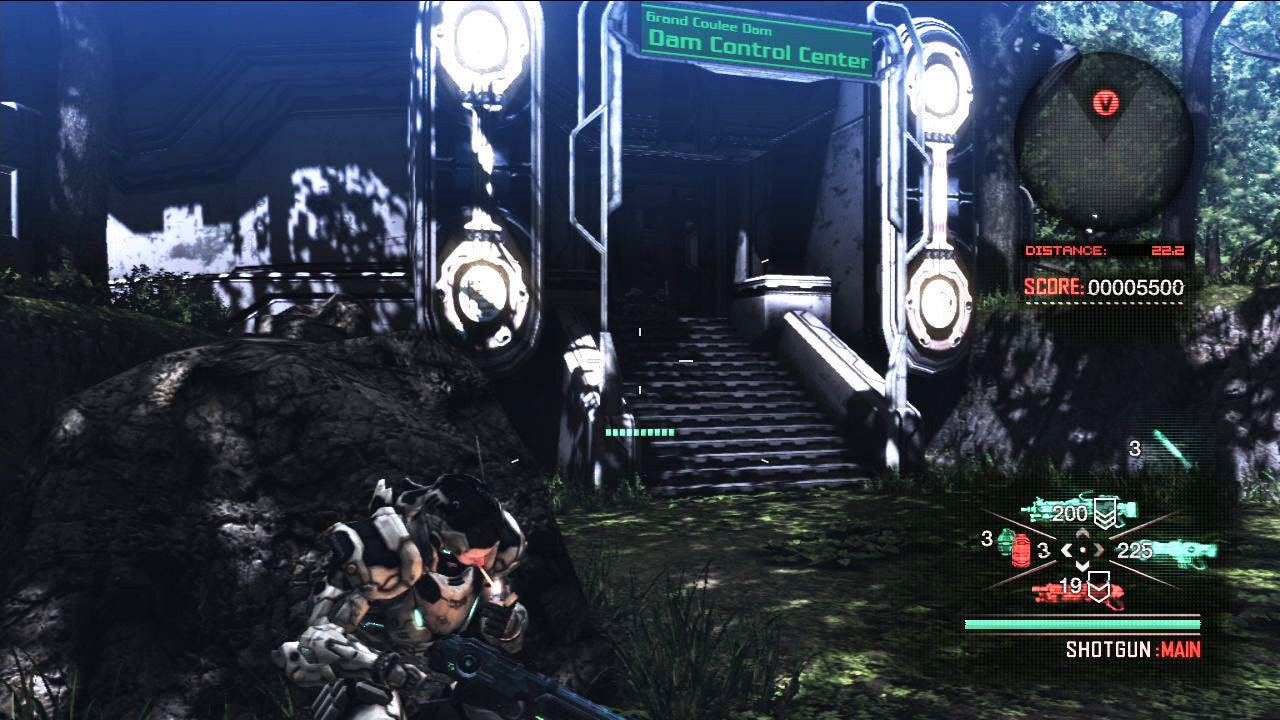
Some, you've seen before. Many of the stages in the game's five Acts take place in the inside curvature of a giant ring world, hundreds of miles of city stretching up into the sky in a gravity-defying scene plucked straight from Inception. But that's not to say Mikami and his team don't play with the idea. Midway through Act 2, for example, you streak along a train track that runs inside the circle, bending upwards into the sky like a giant's rollercoaster, while an enemy train circles above and below you like it just flew in from F-Zero.

Other set-pieces are entirely new and, pleasingly, often generated on the fly. Sliding past a mecha in bullet time and picking off the pilot before somersaulting up to the controls, punching in an override key and turning its turrets against its own side is one of the year's most memorable moments.

It's not that the idea of commandeering an enemy vehicle is innovative. But the style with which it's handled in Vanquish is unrivalled. If games are adolescent power fantasies that give us the chance to be cooler, faster, more athletic, more precise and less like the lumbering morons we really are, then in Vanquish they reach the full extent of this ambition.

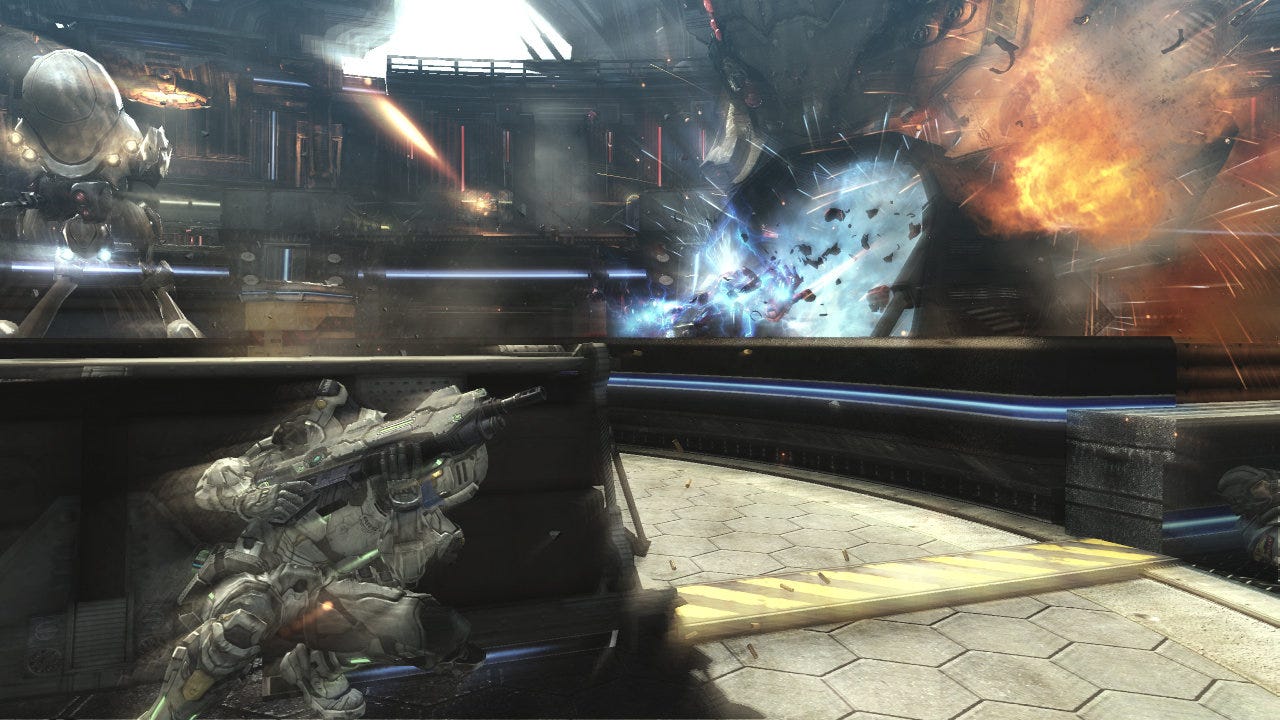
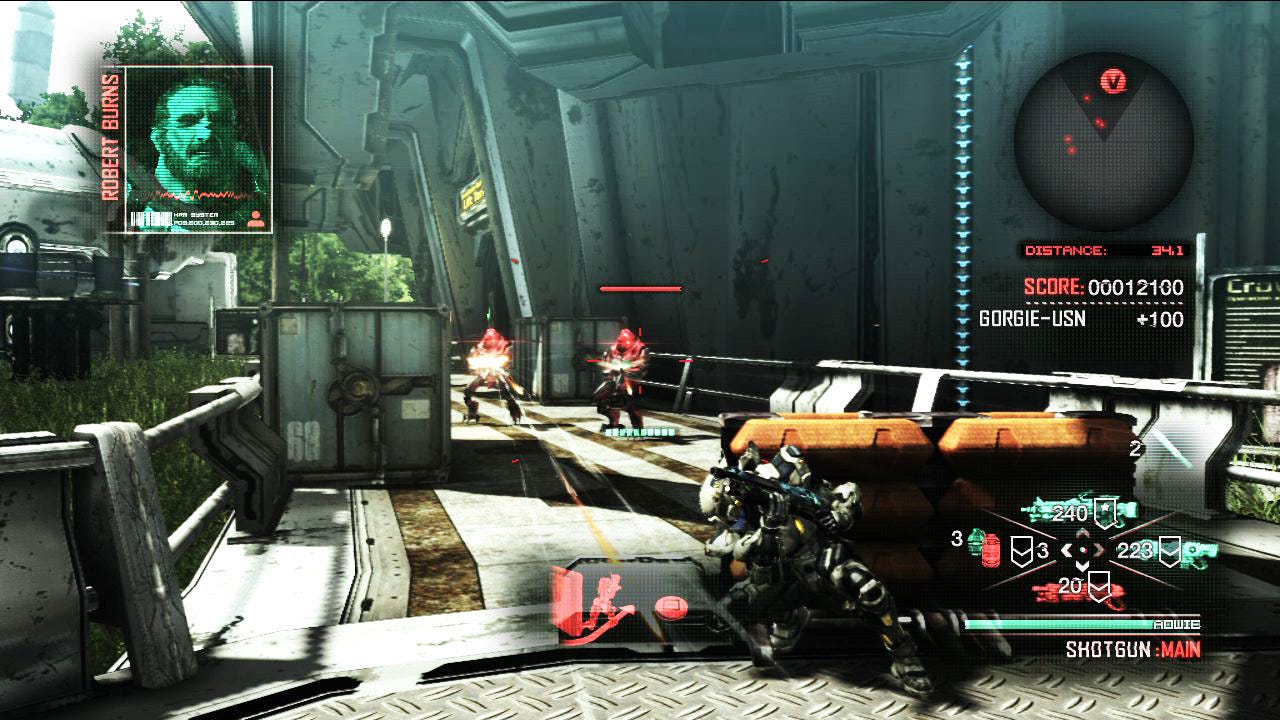
It's a cover shooter, at heart. You move from pillar to post lining up shots on enemy robots, d-pad switching between your three equipped weapons. But play the game like a straight Gears of War clone and you'll catch less than half of the appeal.

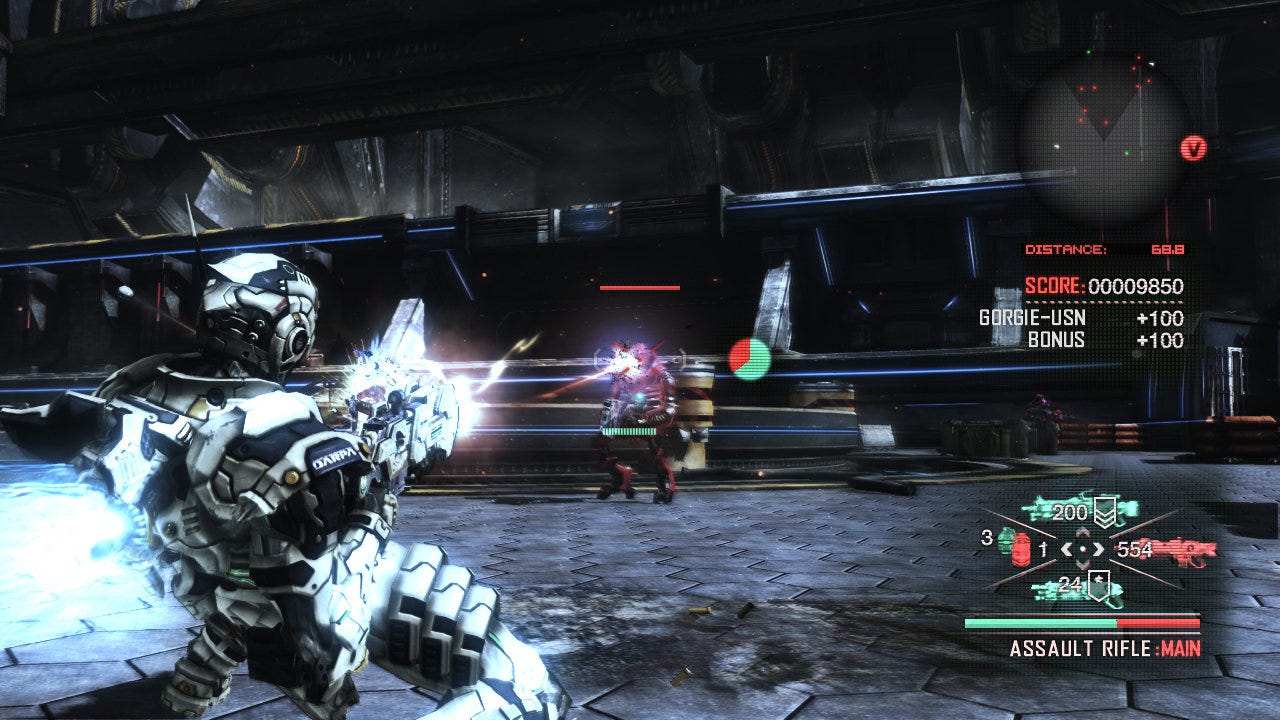
Tap and hold the left trigger and Sam will lurch forward on his knees at high speed, skidding across the environment like an OutRun Ferrari mid-drift. Let go of the button and he'll spin his legs upwards like a break-dancer, landing in a combat-ready crouch in a single motion. This ability shrinks the game world, allowing you to cover vast distances in seconds, offering the chance to flank groups of enemies simply by sliding past their noses.

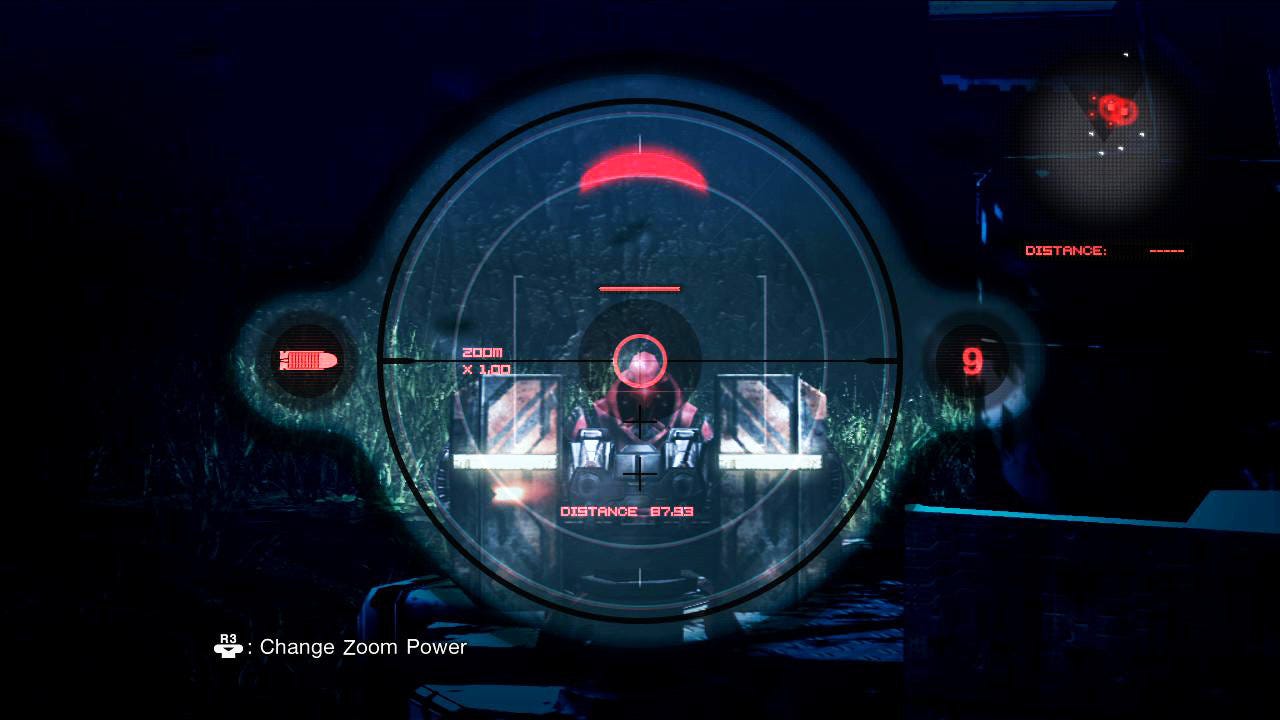
While in this high-speed slide it's possible to trigger the suit's bullet time mode, allowing you to pick out individual bullets and dodge between them. Bullet time is something we've seen before, but never with such grace as in Vanquish.

Both the high-speed dash and slow motion modes use up the suit's power gauge, which must be refilled after a few seconds. But the effect lasts long enough to offer near-constant use. Time rarely moves at a constant rate, instead slowing to a crawl before accelerating to fever pitch and back again, combat taking on a dreamlike quality as you dash from cover to cover before slowing the world around you to line up the crucial headshot.

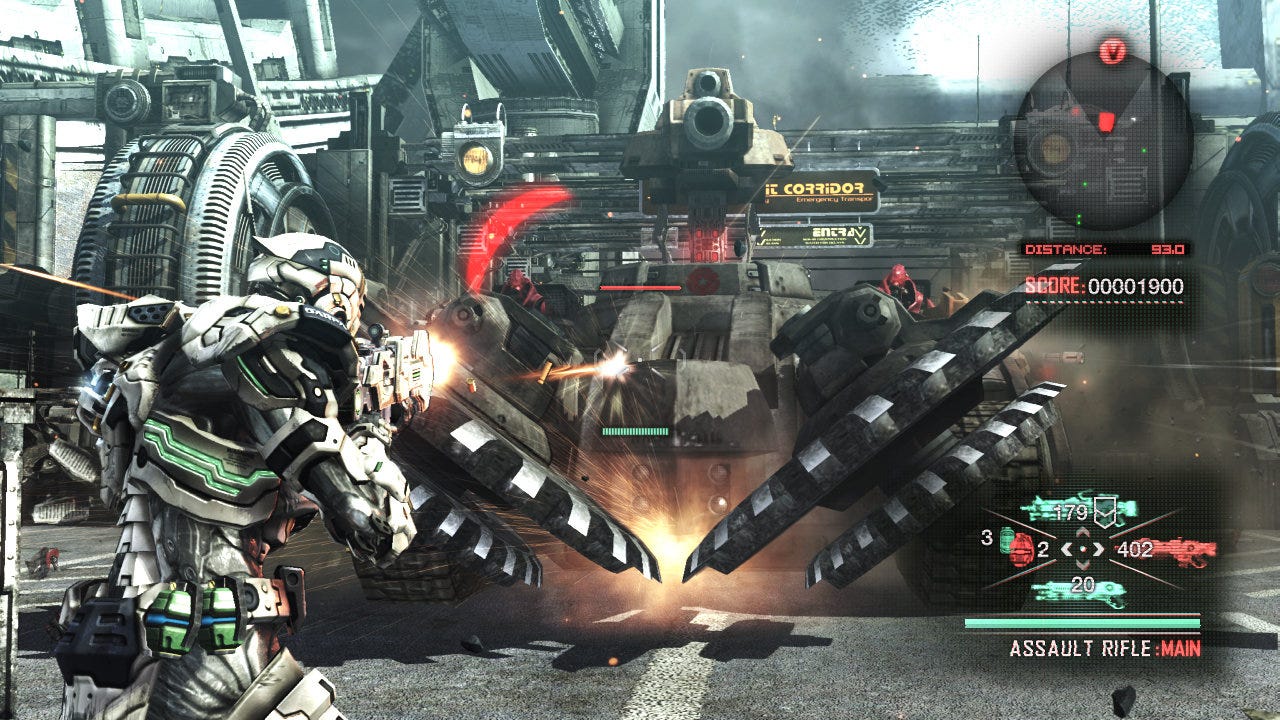
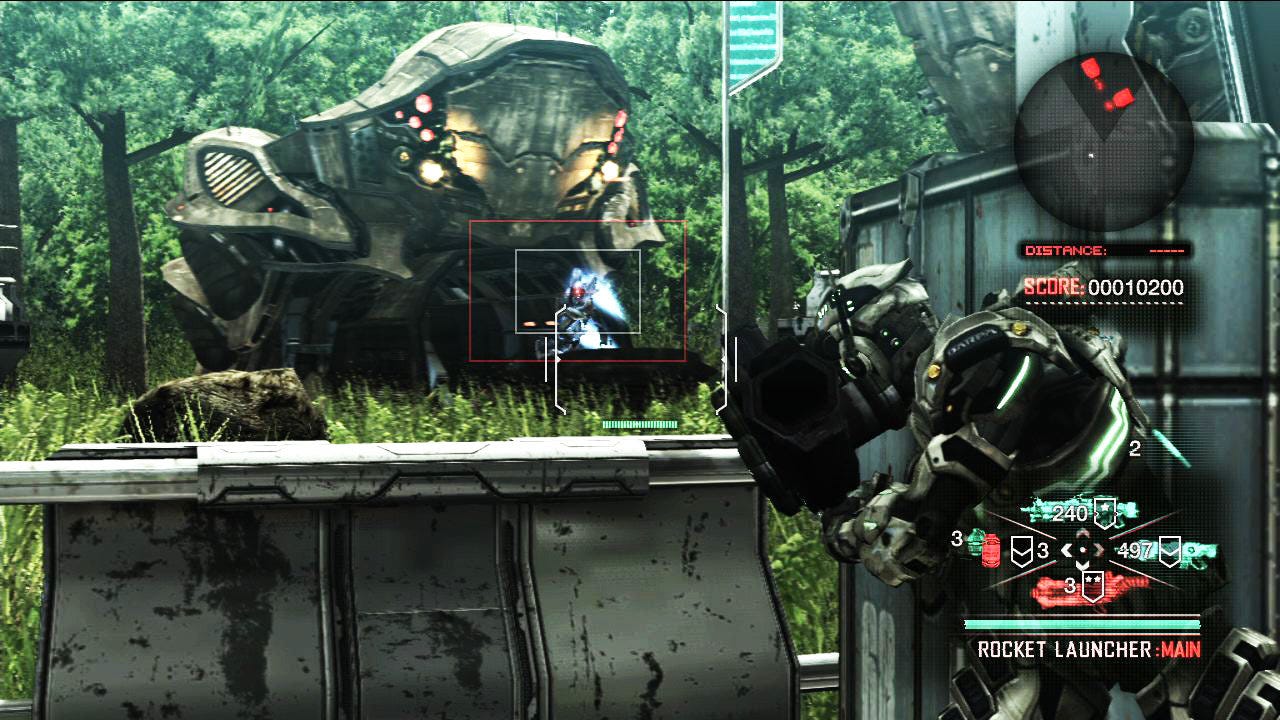
These interactions are interesting in themselves, but in the context of Vanquish's wider world, they become thrilling. Enemy designs have all of the creativity of Treasure's best output: tortoise-like tanks that can click-clack into humanoid infantry; portable cover that sprouts legs and scuttles, crablike, across the battlefield before setting itself down in front of rows of soldiers; a tiny orb-headed sprite that can attract any metal debris around it to take on the form of a robotic tiger.

These are game-changing inventions; that they come from a Japanese developer that has never worked in the genre before is startling. Enemy behaviour, too, astounds in its fantastical believability. Shoot the legs from one robot and it will crawl at you. Not in a laboured, Hollywood death scene way, but with desperate lunging thrusts, its drill bit claws extended as it tries to skewer you with frantic, shocking jabs.

Combine this with Platinum's creativity in environmental, showboating thrills and the effect is spellbinding. In one level you attempt to scale a hill while gigantic pieces of masonry and concrete tumble towards you, kicking dust clouds up in the air. In another, you fight robots in a zero-gravity space station, debris and furniture floating all around within a 100-foot-high chamber, framed by stars seen through the giant windows beyond.

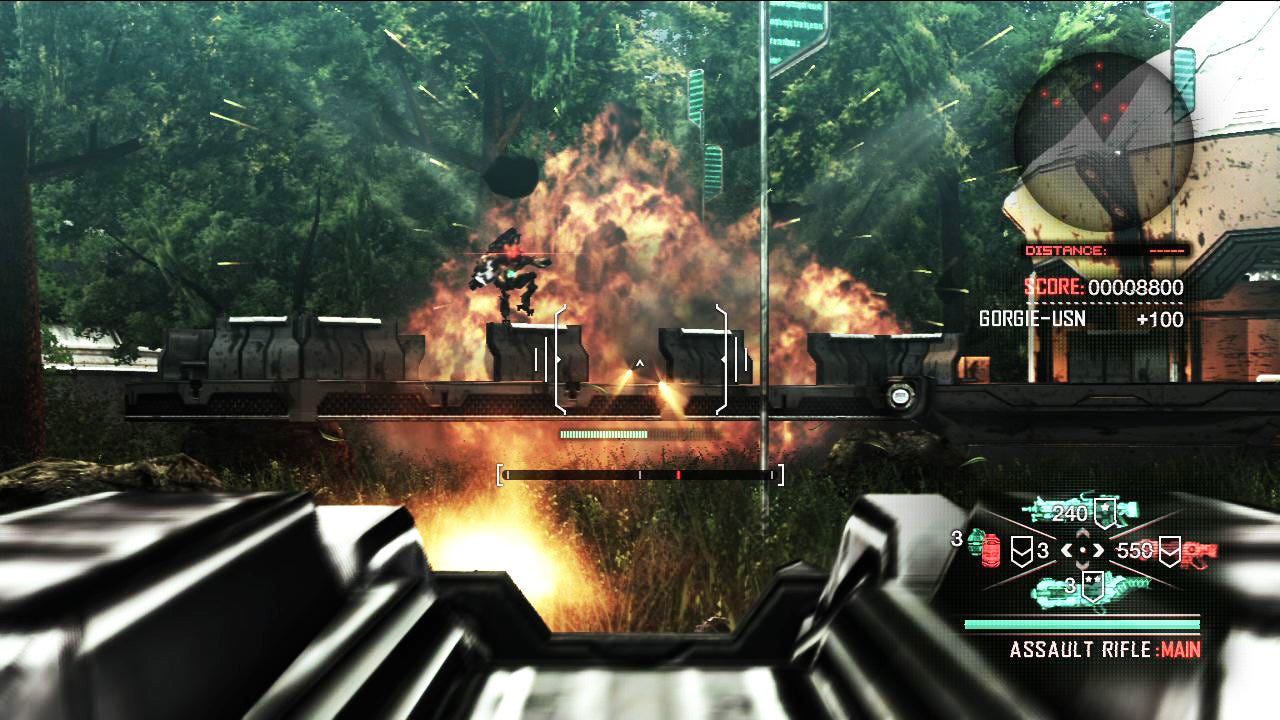
The engine is nothing short of breathtaking. Watching ten thousand missiles streak from the back of a bipedal robot, tracing light-lines upwards towards the ceiling before arcing over into a death fall towards your position, is a spectacle that doesn't grow old.

Vanquish is, however, a game primarily fuelled by spectacle. The story is sub-Kojima nonsense. Reduce the boss fights to their most basic components and the designs are decades old: you find the weak spot, exploit to temporarily reveal the tender core, and repeat the process.

But the riotous presentation makes each encounter feel as fresh as if it were conceived here for the very first time. As Sam launches into the air, the camera wheeling and diving about, you forgive even the intermittent QTE button-prompts that flash up on screen. The pay-offs are so magnificent that they justify these incongruous design crutches.

Devoid of any multiplayer content, Vanquish relies on its scoring mechanic to introduce longevity. Every action in the game is scored, while restarts from checkpoints incur point penalties to encourage careful progression.

While a 'God Hard' difficulty unlocks on completion, there's little incentive to keep returning to the game beyond climbing leaderboards and, at a push, trying to find the single hidden statue in each stage. This is perhaps the only area of the game which lags behind its Western counterparts, requiring the player to fully subscribe to score rivalry for any replay value.

But in almost every other regard, Vanquish is a trailblazer. It is a game of astounding creativity and polish, exhilarating on the ground in the moment-to-moment thrills of high-speed-to-slow-motion combat, as well as in its wider, twisting trajectory. Doubtless the best third-person shooter ever to come out of Japan, Vanquish builds on Western developers' triumphs to push the genre in new, interesting directions, shifting the balance of power, and cementing Shinji Mikami's position as one of the best directors working in videogames today.

9 / 10

Read the Eurogamer.net scoring policy

Comments (150)

Comments for this article are now closed, but please feel free to continue chatting on the forum!

  • Loading...hold tight!