Nobody could accuse NetDevil of being unambitious. Three-and-a-half years in development, LEGO Universe is an attempt to graft the framework of a full MMORPG onto a plastic chassis designed to appeal to kids.
While it's no secret that young 'uns love the social aspects of MMO games, and the breadcrumb trail of character creation and development, most successful online games pitched at this audience focus their attention on minigames and unlockable widgets. The likes of Club Penguin, Clone Wars Adventures and Moshi Monsters all favour 2D graphics and browser interfaces.
Disney's Toontown Online, by contrast, launched its polygon animation fantasia to much fanfare in 2002. It's quietly dropped off the radar in recent years, consolidating its undisclosed userbase onto US servers earlier this year. Pitched at an audience that clearly responds to simplicity, LEGO Universe's sprawling 3D World of Brickcraft is a risky undertaking.
Will it pay off? The closed beta stage of LEGO Universe recently came to an end, finally giving us our first hands-on impressions of what will await eager brick-builders who sign up for the full experience.
After creating your minifigure avatar from a small selection of available pieces, you're dropped into a space station emergency where you're introduced to two of the key gameplay elements – imagination and construction.
Imagination is the LEGO Universe equivalent of MP, the currency you expend every time you tackle one of the numerous Quick Builds littering the landscape. These are signified by piles of jiggling blocks, just as they are in the console LEGO titles. A little bubble informs you how much Imagination you'll need to put the bits together. If you have enough, holding down the Shift key constructs the object in a flurry of movement.
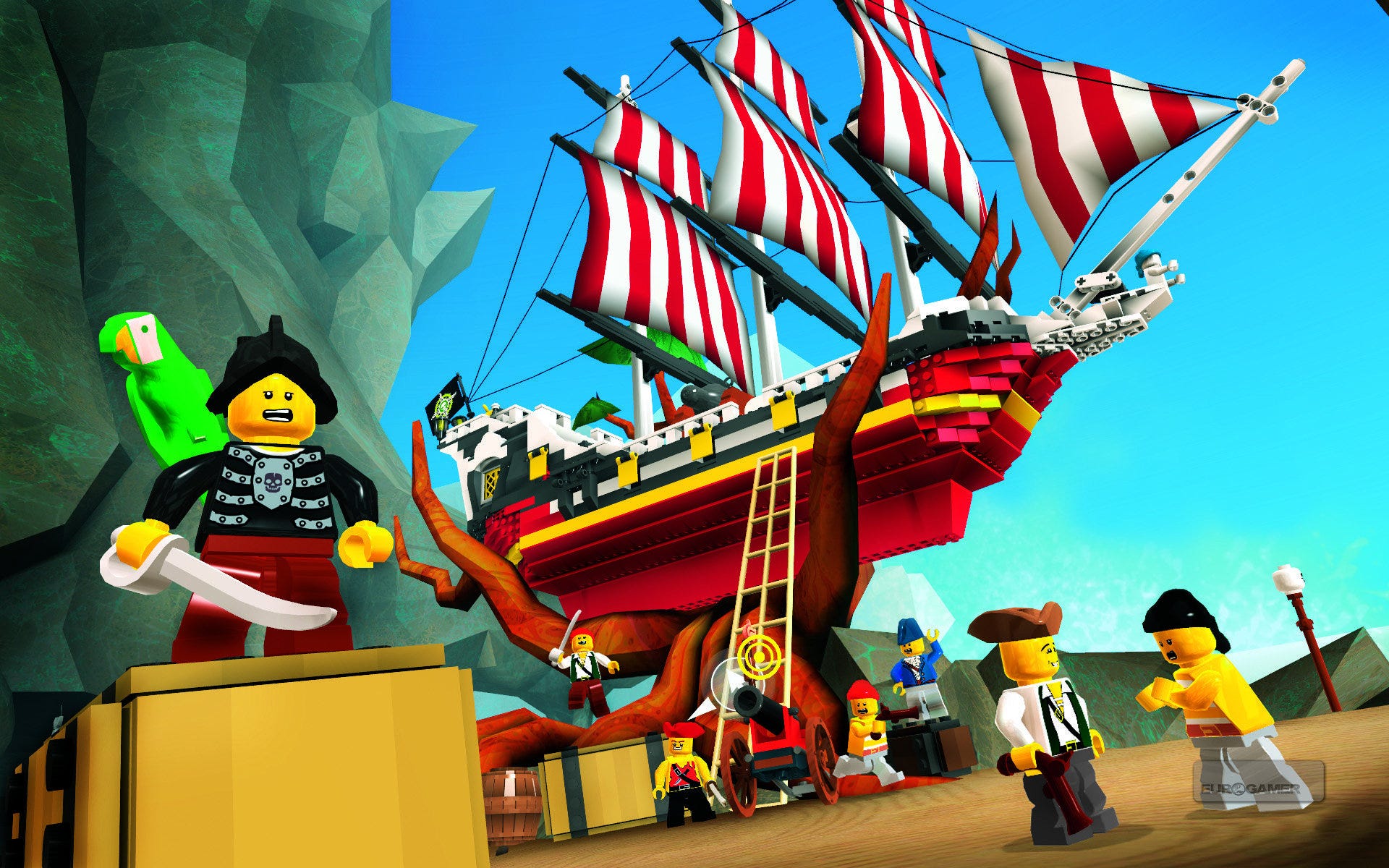
Pirates may be overexposed, but at least they're not zombies.
You can top up Imagination by smashing other items, or by consuming potions and food items available from in-game vendors. Since there's no character levelling in the game, your maximum Imagination is dictated by the items and clothing you equip.
Construction, meanwhile, comes in three flavours. Quick Build is the most basic, used to insert specific objects into the game, such as bridges or springboards to reach new mission-specific areas. The next step up involves putting together predefined blocks, as illustrated by the rocket you put together to escape from this first tutorial area.
You get a selection of rocket pieces – nose cones, cockpits, engines – and whatever combination you choose can then be saved as a completed model. Dragged and dropped from your inventory backpack onto a launchpad, it becomes your default mode of transport between the various worlds of LEGO Universe.
Having learned the basics and escaped from the space station, you enter the gameworld proper. It's here you start getting missions from NPCs, and meet your enemies – the Stromlings, corrupted minions of something called The Maelstrom, which threatens LEGO Universe with its black and purple tendrils of vague evil.
Combat is simple enough. Equip a weapon – a basic sword is your starter, but you can quickly purchase spears, guns and more impressive items – and then mash the Alt key to attack.
Firearms can be aimed with the mouse, while longer button presses charge up more powerful attacks. Defeated enemies and any smashed scenery items cough up more Imagination along with health and armour top-ups, and new LEGO bricks for your collection.
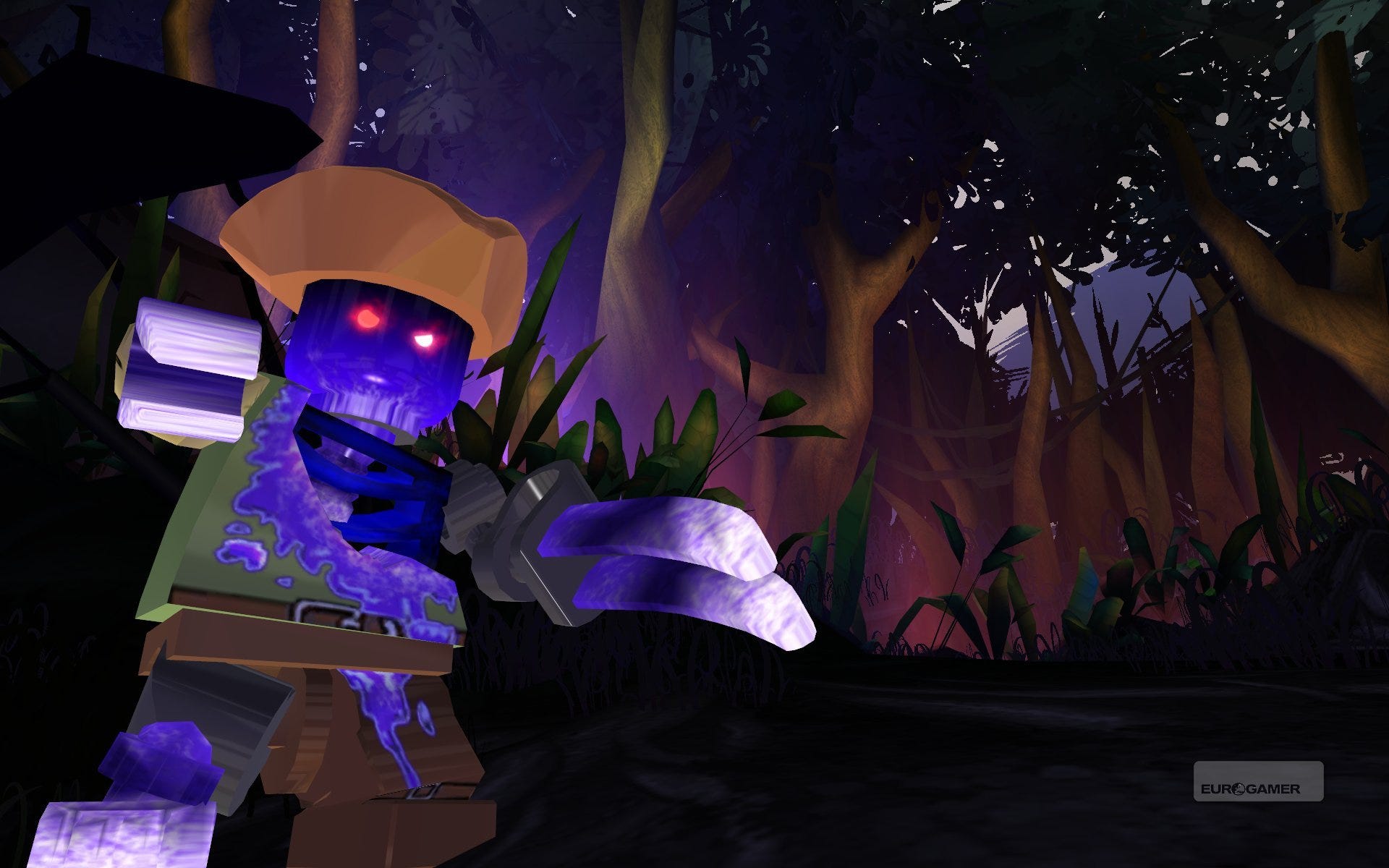
Zombies may be overexposed, but at least they're not pirates. Oh.
Missions are also simple, generally revolving around standard fetch quests for items or destroying a set number of enemies. The early stages available in the beta continue the tutorial theme, setting players the task of building their first house, taming a pet or designing a racing car.
That these tasks also showcase some of the extra-curricular activities available away from the war against the Stromlings is no accident. There's a lot to do, and even within a few hours of play you'll have put your stamp on the game.
Perhaps most intriguing is the ability to put objects together using individual LEGO bricks. These have to be sent off for moderation, just to minimise the number of giant plastic nobs, but are then imported back as a self-contained in-game object.
You can dictate whether other players will be able to smash your creation and even attach "behaviours" to your it, such as basic mobility and AI. So if you want your giant plastic nob to act as a guard dog for your LEGO house, that's a possibility.
It's also around this time that you'll get to choose what faction to align yourself with. The Nexus forces are split into four, and you'll have to do a short mission for each before making your final – and irreversible – choice.
Sentinels are the game's warrior class, while Assembly is for those who want to specialise in construction. The Venture faction maps broadly onto the traditional RPG scout class, with Paradox supplying the requisite "dark side" route. This doesn't mean you get to play as a villain – there's no PVP here – but you do get to walk the line, and use Maelstrom powers.
Each faction then offers sub-class specialisations. I opted for Venture, and could then choose between becoming a Daredevil or Buccaneer. Each provides access to unique items and skillsets, but none of this is made clear before you take the plunge. Considering it's a choice that can't be undone, a little more information about what you're signing up for would be welcome.
Now you're firmly inserted into LEGO Universe, the final areas of the beta open up and you can go and explore Gnarled Forest and Forbidden Valley, depending on what choices you've made, and play with items you've been given by way of a welcome to Nexus Force.
Both are much as they sound – a creepy jungle setting where possessed pirates are on the rampage and a parched volcanic mountain region where you can train as a ninja. It's here that the missions start to develop away from the rudimentary housekeeping and into something more familiar as an MMORPG. The combat missions never quite take on the scale of a proper dungeon raid, at least not in this early glimpse, but anyone worried that the game would be too kiddy should be satisfied with some reasonably tough challenges that stretch the rather basic melee and ranged combat abilities to the limit.
There's no PvP action, but you can take on other players in competitive games.
What's strange is that there doesn't seem to be any emphasis on the MMO side of things. There are lots of other players, and you can obviously form ad hoc alliances with anyone playing nearby, but the Team feature, which brings guild-style community options, hasn't been highlighted for beta players. Hopefully it will make it easy to hook up with friends, or it'll just be a case of making sure you're online at the same time, and tracking each other down.
That may be harder than it sounds, since if there's one area that would benefit from attention it's navigation. The game is broken up into discrete areas, none of which are terribly large, but the in-game map is virtually useless, offering no explanations, mission markers or even a key as to which exit icon leads where.
You'll be mapping most of the terrain in your head, and considering most kids are likely to just leg it into the gameworld rather than proceeding carefully and logically, I suspect there'll be some confusion. You can, at least, dismantle your minifigure and respawn at the nearest habitable spot should you get really stuck.
Travel between zones is also rather clumsy, with rocket pads only leading to specific destinations, rather than letting you take off and choose where to go next. In other words, to get from the Gnarled Forest back to Forbidden Valley, you'll have to trek all the way back to the rocket pad that leads to the intervening areas, jogging across each map to the next pad in a weird leapfrog style.
That seems impractical.
If there's a fast travel option it's as well hidden as the team functions at the moment. Throw in some fairly grievous loading times (sometimes up to several minutes at the moment) and whenever a mission sends you to a distant zone, you might as well go and put the kettle on.
Put these early hiccups aside, however, and you find that heart is where LEGO Universe shines, offering a bright inviting playground that still manages to offer a fun approximation of more adult MMO games.
Even without the ongoing war against the Stromlings, the chance to build your own LEGO house, train a LEGO elephant or just dress up as a pirate and do some breakdancing all tap into the enduring appeal of those omnipresent plastic bricks. There's a pervasive sense of glee and creativity that is already very appealing.
Hopefully that will be enough to coax the younger audience into a fairly complex game, and convince their parents that the monthly subscription (currently £7.49 or €9.99) is a worthy investment. Right now, LEGO Universe is a fun place to visit, but will we want to live there?
LEGO Universe will be available from LEGO stores, the LEGO Online Shop and LEGOLand from 12th October. A full release will follow on 26th October.
