Blue Dragon: Awakened Shadow
Should have stayed in bed.

Three games in, and Blue Dragon is starting to feel like a franchise that hasn't quite found its niche yet, perhaps because it spends most of its time trying to squeeze into someone else's. The original Xbox 360 game was an amalgam of every JRPG ever made, DS follow-up Blue Dragon Plus might as well have been called Heroes of Revenant Wings, and this one doesn't so much copy Dragon Quest IX as smack it around the head with an oar, steal its girlfriend and assume its identity. Unfortunately, it's not nearly as good a mimic as Tom Ripley.
You start the game as a self-created character, constructing your avatar from an array of enormous eyes and a modest selection of haircuts, all of which would require a substantial supply of VO5 to maintain in real life. You can't have short or blonde hair, but are more than welcome to choose a green Mohican - not that the 'do matters too much, as it's often obscured by whichever helmet you're currently wearing.
You wake in a mysterious and terribly garish environment having – surprise, surprise – lost your memory. Simultaneously, a mysterious light appears, stealing all the shadows in the world, thus removing the source of everyone's power, and leaving them helpless against the various monsters that roam the fields of this otherwise peaceful planet. Thankfully, your own is unaffected, and so it's up to you to recover all the other shadows while finding out who you are, why you're the only one still with a shadow, and why no-one ever stops to think the two events just might be connected.
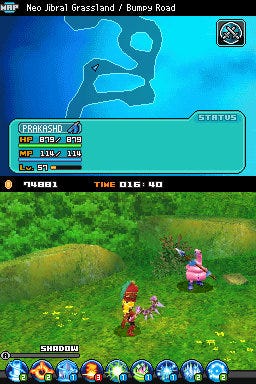
Unusually, you start the game in the company of the series' ugly purple baddie Nene - still apparently grumpy at the fact that he's named after a Hawaiian goose - though it soon transpires that this is merely a tutorial for the controls, which use either the d-pad or the stylus for movement. A is used to attack, and holding it down for a couple of seconds activates your Shadow, allowing you to choose various skills from healing spells to elemental attacks. B is your all-purpose don't-get-killed button - holding it blocks enemy attacks, reducing damage inflicted by half and cancelling any status effects, while tapping it in conjunction with a direction rolls you out of harm's way.
At least, that's the theory. In fact, your character's reactions are so sluggish that you need to move around half a second earlier than feels natural, even though most enemies are kind enough to telegraph their attacks. When the screen gets busy, stylus controls become all but useless, particularly as you sometimes need to manoeuvre the camera to get a better view of the action.
The first few hours are conducted at a funereal pace, with regular cut-scene interruptions. They're almost laughably ponderous at times, as the camera very slowly pans around the environment and eventually across to the protagonists, while the dialogue has all the snap and zing of... well, a very poorly scripted JRPG.
The localisation is especially feeble, with typos and grammatical errors galore. It can't even be bothered to differentiate between a male and female character; you're frequently referred to as "them" or "they" when people are talking about you. Mercifully, all the cut-scenes are skippable, though if you give into temptation you'll often be left slightly confused as to what's going on. Either way, it's hard to care when even the characters can't bring themselves to give a toss about their plight, as they send you out on minor errands, evidently more than happy to go without their shadows a while longer.