It's been said many times, but that doesn't make it any less true: the internet has set game designers free. Before the online gates were opened, you could beaver away for months on your pet project but the chances were that nobody would see it outside of the limited confines of the public domain demo scene, and that's if you were lucky. Nowadays a game born of private passion can be uploaded, bounce from inbox to inbox and build a real-world audience with dizzying speed.
That's what's happening with The Dream Machine, the sort of charming and thoughtful indie game that has gone from obscurity to viral buzz thanks to careful design and an eye-catching visual hook that all but demands you tell your friends about it.
Not to be confused with the 1990 Corey Haim caper, The Dream Machine is an offbeat point-and-click adventure about a young married couple expecting their first child and moving into an apartment together. Of course, things aren't what they seem. The neighbours are odd, the removal man is obtuse, the man who owns the building is downright weird and everyone keeps having peculiar dreams.
It's the work of "two Swedish nerds", Erik Zaring and Anders Gustafsson, and is being released episodically as an online Flash game. The strange atmosphere is built through simple dialogue but heightened by the bold decision to create the entire game using physical clay models and hand-crafted sets. Think Inception by way of Jan Svankmajer and you're halfway there.
Intrigued and smitten by the game's charm, we tracked Gustafsson down for a chat.
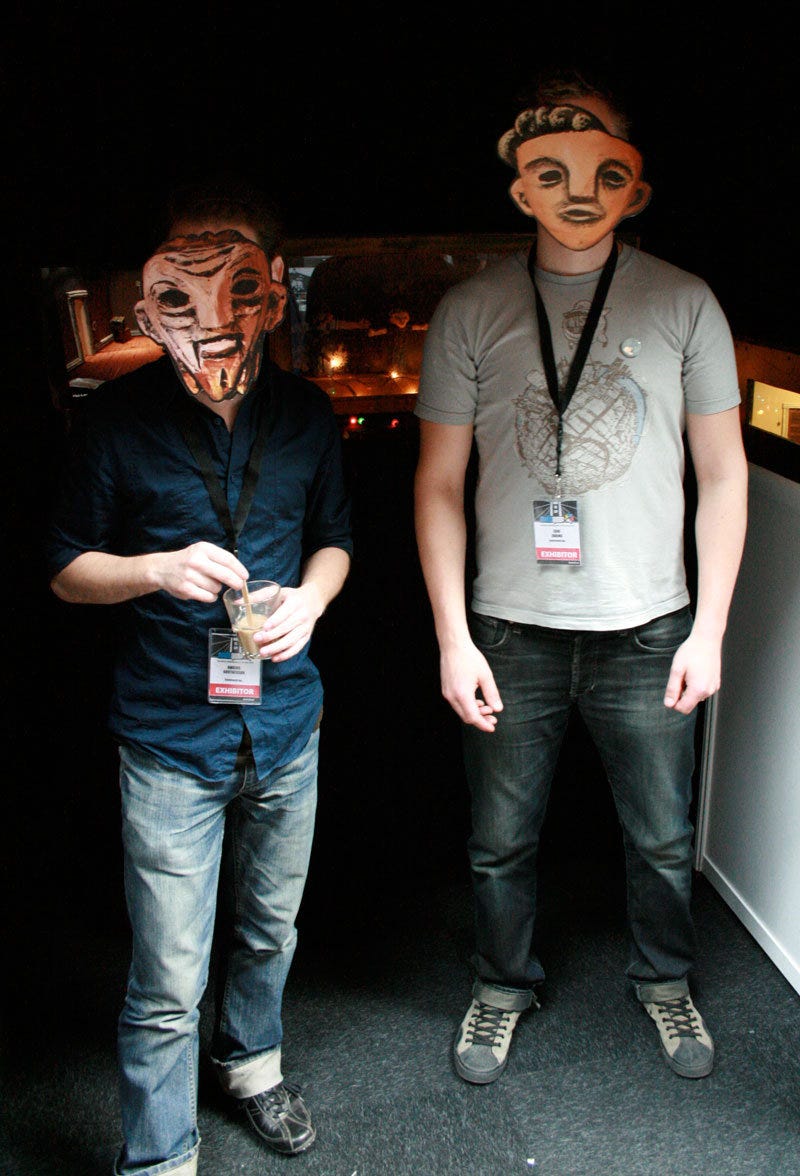
Creators Erik Zaring and Anders Gustafsson, proving that you can put too much of yourself into a game.
Eurogamer: There are only two of you working on the game full time. What sort of prior experience do you bring to the project?
Anders Gustafsson: The core team consists of me and my partner in crime, Erik. Since we're only two people we have to take on a lot of different roles. I've been trying to focus on the narrative aspects of the game, writing and directing, and Erik has mainly focused on building and producing. On some occasions we've employed the services of people who have expertise in areas we're lacking, like 3D modeling and music composition.
Prior to The Dream Machine I had done a handful of small browser-based games, among them Gateway 1 and 2, but our main background was within the field of traditional animation. Erik has worked on stop-motion commercials and feature-length films, and I've worked on animated TV series and done commercial work for companies like Nike and Adidas.
Eurogamer: So how did you go from working in animation to making a game using the same techniques?
Anders Gustafsson: Prior to working on The Dream Machine, Erik used to manage a stop-motion animation studio in Trollhättan, Sweden, so he already had the knowledge required to build strange and skewed miniature worlds. When we started talking about making a game together, Erik brought up the idea of a stop-motion animated adventure game.
I was reluctant at first, since building a game world physically just sounded too time-consuming. But Erik knocked out four or five miniature sets literally overnight just to prove to me it could be done. When he showed me what he had done, it was love at first sight, and there was no turning back after that.
Once we received some grant money, he called some of his old stop-motion buddies and knocked out the main locations for the game within a three-month period, while I was feverishly labouring with the design document for the game.
Eurogamer: Normally the game world can evolve alongside the code, but your game world is literally set in stone (or clay) from the start. Can you talk us through how this has affected the development?
Anders Gustafsson: Building something physically requires a lot more pre-planning than building something digitally. If we need do a major change on one of the sets, it basically means we have to build, paint, light, shoot and Photoshop the whole thing again. With that much overhead, you can't make creative decisions on a whim, which keeps you focused and on your toes.
Since this was a new way for us to work, it took a while to establish the production pipeline, if you can call it that. In the beginning, for instance, I was very reluctant to supply the builders with detailed blueprints of the rooms I needed, thinking that it would limit them creatively. But once I tried building a room myself without a blueprint, I realised that you're basically lost in the woods if you have to come up with what to build as you're building it. It's a recipe for disaster.
A huge plus is that the entire game is an amalgamation of my design filtered through Erik's artistic sensibilities. It gives it a strange, uneasy quality that really serves the story.
Victor and Alicia's bedroom is where you'll encounter the first truly tricky puzzle.
Eurogamer: Can you explain the technical process of taking the models and putting them in game?
Anders Gustafsson: The stop-motion studio, Dockhus Animation, is the same one that Erik used to run. They're brilliant guys and still let us borrow equipment and workspace. They helped us out in the beginning of the project when we needed to whip up a proof-of-concept demo to show the Nordic Game grant people that a game built out of clay and cardboard was actually feasible.
As for the characters, they are built out of clay and painted by hand. We then take photographs of the figurine and apply as a texture to a 3D mesh. The animation and lighting is then done in Maya. In the early days, we discussed doing the animation by hand as well, but since the characters have to travel through very varied lighting conditions, stop-motion animation just proved too static and wasn't practical.
Eurogamer: A lot of coverage is obviously going to focus on the unique look, but what steps have you taken to ensure the game itself is different to its peers?
Anders Gustafsson: Mainly by trying not to draw inspiration from other games. Games in general are too homogenous. They all borrow from each other in a way that's a bit incestuous. Once a game mechanic proves successful in one game, you see it crop up everywhere. This industry really enjoys beating things to a pulp. I guess it's a side effect of the cost associated with a triple-A title.
Victor's desert island dream makes for a clever and concise tutorial, as well as establishing key narrative themes.
I think my main beef with other games is that I just get bored with the stories they tell. Even games that are held in high regard story wise are just formulaic and insulting when compared to any other medium. "Alright marines, alien xenomorphs have taken over Tiara! We need to establish a beach head on that ridge - otherwise humanity is done for!" The second I hear dialogue like that, I just tune out.
I love the mechanics of some games, and I love the immediacy of the medium, but the stories are often just used as a flimsy pretext to string the Egyptian level, the offshore oilrig level and the lava level together. I wanted to do something that's a bit more ambitious than that.
When we tried to establish the mood for the game, we looked a lot at Polanski's Apartment trilogy, Polish film poster art and Cronenberg movies. I love the skewed universe in Polanski's The Tenant, in particular. It starts out in a very real, very mundane place, but soon veers over into a darker realm of neighborhood conspiracies, hieroglyphs and self-mutilation.
Strictly speaking, our closest peers would be the three games in the exotic sub-sub genre of hand-built adventure games. Correct me if I'm wrong, but off the top of my head I can only recall The Neverhood, Blackout and The Dark Eye. And they all came out more than twelve years ago. You can't exactly call the market saturated.
Eurogamer: What can you tell us about the characters, particularly Victor and Alicia? Their interactions are really simple, but there's a wealth of subtle detail in their dialogue that really brings them to life as a couple. Is this one of the areas where you can tweak and change things rather than going back and starting over with the models?
Anders Gustafsson: Yes, very much so. Since we're releasing the game online and are producing it on an extremely limited budget, making elaborate cut-scenes would be time consuming, expensive and cause the files to become very bloated. To me, a dialogue exchange - if done right - can be far more engaging than a cut-scene. The challenge is of course to give the players interesting choices and reactions along the way so they don't feel they're just being spoon-fed long expository rants.
Eurogamer: It's also interesting that you're running a beta test for a point-and-click adventure on the web. That means you can track how people play and which bits they get stuck on, whereas adventure games in the past had to rely on the judgment of the developer. Has this "live QA" procedure been helpful?
Anders Gustafsson: It's been said before, but I think a large contributing factor to why adventure games went out of style was because the puzzles just got too obscure and self-serving. Once unintelligible puzzles were established as the genre norm, it was only a matter of time before people would just give up and stop playing.
Mr Morton, perhaps the creepiest game character of 2010.
Balancing difficulty is possibly the hardest thing about designing adventure games. You want the game to be challenging, but you don't want people resorting to walkthroughs. As a developer, the best way of guarding yourself against overly difficult puzzles is through testing, and since we're releasing online it's very easy to build in a system that sends completion and interaction information discretely in the background.
If a puzzle causes 30 per cent of our players to drop out - as was the case with the first iteration of the circuit board puzzle - we go in and tweak the design. Also, if enough people try an inventory combination that we never considered, we go in and add a proper response to that. I always thought the default, "That doesn't seem to work," response made the player character seem strangely robotic and broke my suspension of disbelief. It's the adventure game equivalent of walking into an invisible wall.
This is the first game where we've actively used player metrics to improve the design. I look forward to seeing where we can take this player/designer collaboration in future games.
Eurogamer: The first chapter will be free with a small charge for access to the four chapters after that, but what are your future plans for the game? Given the success that the revived Monkey Island has had, would you consider releasing it through digital channels like Steam, PSN, Xbox Live Arcade or even Xbox Indie Games?
Anders Gustafsson: Right now we're only considering releasing the game online, episodically, but if there's enough interest, we'll certainly consider an offline version or even releasing on other platforms.
Although it turns out that Mr Morton started out fairly 'armless.
Eurogamer: Finally, do you have any favourite characters - or non-spoilery in-game moments - that you can share?
Anders Gustafsson: I'm very fond of the caretaker, Mr Morton. He's an older, shifty fellow, who basically hasn't left the building since the 1970s. He enjoys smoking and listening to old records on his Victrola. He also has something to hide.
As for game moments, I like that one of the early puzzles involves eating breakfast with your wife. It's a very simple scene, but still reveals quite a lot about who these two people are. I really admire what David Cage is trying to do inserting moments of the mundane in his games, to establish a mood and character. Making those moments rewarding from both a gameplay perspective and a narrative perspective is very hard indeed. It's always heartwarming to see something subtle being attempted in games.
A demo of The Dream Machine is available now at the official site, where you can also sign up to beta trial the very lovely first chapter.
