Version tested: PlayStation 3
Sony's Move controller is undeniably an impressive piece of technology, but the software so far hasn't quite shown how impressive. Sports Champions is half of a brilliant game, Start the Party is a trumped-up EyeToy title whose main distinguishing feature is that it works properly - and the less said about the mess that is Kung Fu Rider the better. In the absence of a genuine killer app, it's been left to this PSN title to show the big boys how it's done. As a demonstration of Move's capabilities, Tumble is pretty hard to beat.
Let's get the obvious question out of the way: yes, it looks a lot like Boom Blox, but it's not really much like it at all, apart from the occasional destruction challenges which are basically Boom Blox if it went to finishing school. There's nothing as uncouth as throwing stuff here; instead, you're asked to demolish a pristine structure using well-placed limpet mines. (It's a finishing school with access to military-grade explosives, obviously.)
Tumble is actually quite unsuitably named, since it's more about building things up than knocking them down (though it's probably for the best that Sony didn't call it Erect). At first, you're asked to build a structure using blocks of various shapes, sizes and textures. The idea is to stack them to a given height - or rather, three given heights, representing bronze, silver and gold medals.
There's a fine balance between ensuring your construction is structurally safe and making sure it's tall enough with the limited number of blocks you're given. Should you hit the bronze medal height, you'll get a three-second countdown during which your structure must remain intact. It can still be wobbling when the timer hits zero, but as long as no blocks hit the ground, you'll pass, and move onto the next challenge - like WiiWare game Art of Balance, for the seven people that played it.
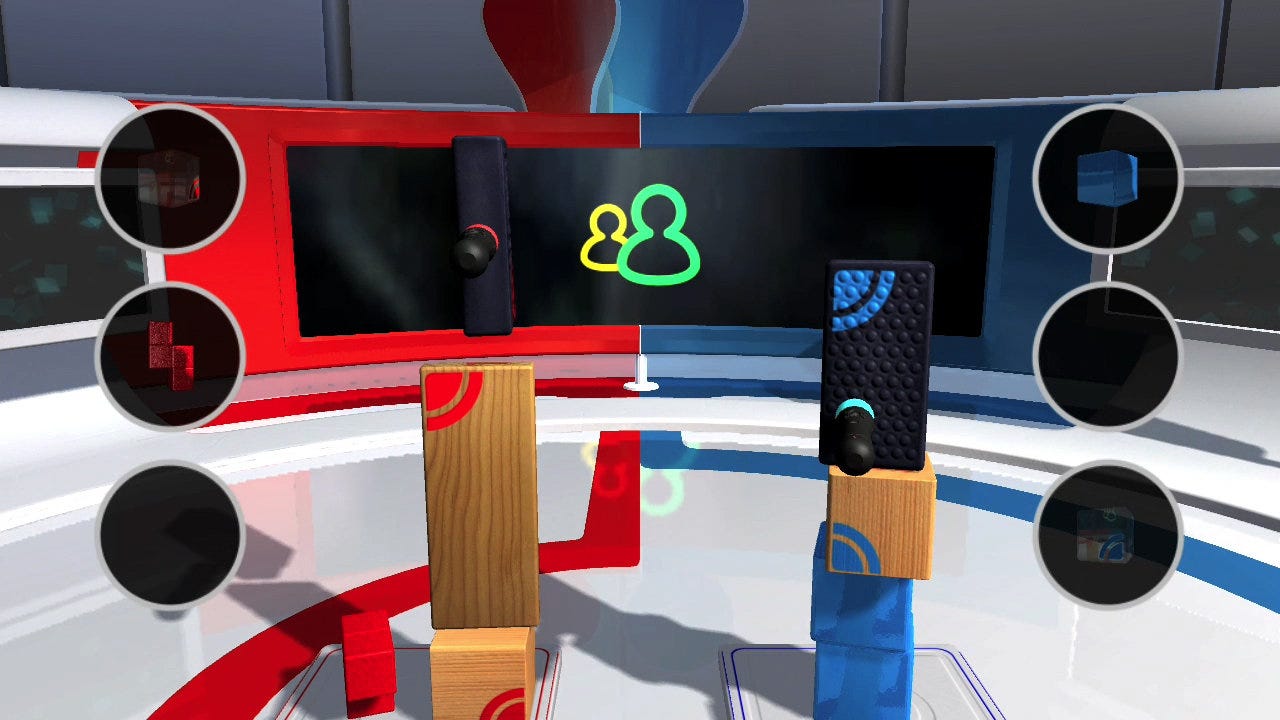
The setting is a kind of futuristic TV studio where every surface has been given a thorough going-over with Cillit Bang.
Most levels offer additional objectives once you've earned a gold medal, such as having one of your blocks pass through a hard-to-reach target, or completing a stage within a strict time limit. Get enough medals on one zone and you'll unlock the next. It's fairly simple in the first couple of zones, with most gold medals within the reach of the average player. Then it all goes a bit Krypton Factor.
That's because Tumble is as restless as a wonky tower of polystyrene and balsa wood, introducing new features or level types every few stages. One minute, you're stacking blocks or squashing them all together on a small platform, the next you're refracting beams of light through coloured orbs by positioning mirrors and colour filters. The starting platform gets gradually smaller, then it spins, and then it slopes, and bonus stages have you solving simple maths problems or completing a jigsaw. Others ask you to reach a certain height using just a handful of awkwardly shaped pieces. And that's when the game's not actively trying to knock your tower down with moving metal blocks or gravity wells or earthquakes.
In some of the challenges it seems to revel in being as difficult as it possibly can, throwing out a perfectly square block just when you'd left a space for a triangular piece, or giving you huge, heavy rubber rectangles when you've got nothing to balance them on. It's like waiting for one of the straight pieces in Tetris. And as if to invite further comparison, a few levels introduce Tetrominoes, with one level - the evocatively titled Russian Limbo - asking you to slot them together as tidily as possible to fit under a metal bar positioned at a dangerously low height.
If all that sounds a little frustrating, you'd be half-right, because for the most part it's frustrating in the best kind of way: tough enough to have you sighing or swearing, but constantly encouraging you to have another go. The soporific tones of an unrecognisable Natascha McElhone - who, like Samus Aran's voice actress, seems to have been sedated before entering the recording booth - inform you how many medals you got, and more importantly, how many you didn't get. "You were only two centimetres away from a gold medal," you're told, and it's impossible to not want to try again. The constant wheedling gets a little tiresome by the time you're on your 17th attempt at a stage, mind.
Sticking points are few and far between, as you don't need to get gold medals on every stage to unlock the next area, but occasionally you'll be required to complete one level before, say, another four open up. If it's one you're struggling with, then you'll just have to keep trying. And while most of the additional challenges can be beaten with a little patience, a few of the timing-based medals seem unreasonably difficult - especially on a stage where the blocks appear in random order.
Objects are flipped with a quick flick of the Move wand, the one area where the controls can seem capricious.
One or two baffling design choices seem destined to infuriate. There's the way you're rudely shunted out of a level when you've unlocked a new zone, even if you wanted to try again (not helped by the slightly excessive loading times). Restarting a stage is a good few seconds slower than it needs to be, particularly on the destruction challenges where the game slowly counts up your tally.
Camera rotation is a little too slow, and surprisingly there's no option to adjust its sensitivity; though rarely a serious issue, on the timed challenges moving around to a better view of your tower can eat away valuable seconds. Craziest of all, the option to retry is assigned to the triangle button, with the Move button you tap to skip through stage intros and tutorials returning you to the level select menu via another loading screen. It's a good job I had the wrist strap attached, put it that way.
That these issues - and the slightly sterile, aloof presentation - aren't too off-putting is a testament to the quality of the central experience, the appeal of which is almost exclusively down to the controls. The simple act of manipulating these objects with the Move controller in 3D space with pinpoint precision is thrillingly new and different: reaching forwards to grab a block, pulling it back towards you and rotating your wrist to set it down at the right angle is as accurate and intuitive as you could possibly wish for. Like most Move titles, Tumble seems to work better the more space you can put between you and your TV; it can get a little wobbly if you're sitting a little too close, but recalibration is just a single button-press away.
The object of destruction challenges is to try and spread the blocks as wide as you can.
With just under 70 levels, the single-player game is pretty substantial, and there are two competitive multiplayer modes, too. The first game sees two players take turns to stack three blocks, gaining points for successful placement and losing them for any objects dropped, as power-ups earn bonus points or cause tremors on your opponent's turn. The second requires two controllers and is a simple race to build the tallest tower; the camera follows the highest stack, with the object being to push your rival's structure off the bottom of the screen. They're both fairly limited, but matches between two similarly-skilled players are thoroughly entertaining.
Tumble's never quite as outright fun as something like Boom Blox, but along with Sports Champions' table tennis mode it's a terrific showcase for Move, and another reason to get excited about the possibilities of motion control. It mightn't be quite the classic Sony's remarkable device deserves, but right now, this is comfortably the best reason to invest in a Move at launch.
8 / 10
Tumble is out this month exclusively for PlayStation 3.