Version tested: Xbox 360
I can't help wondering what the atmosphere in the IO Interactive office was like when EA announced details of Army of Two: The 40th Day. Both sequels were revealed within a few months of each other last year, and the similarities are startling.
Obviously, they're both follow-ups to third person co-op shooters with a heavy focus on cover and flanking, so the gameplay echoes are to be expected. They're also both set in Shanghai, in the aftermath of one last job that goes disastrously wrong. Both concern themselves with helping our foul-mouthed amoral anti-heroes battle across the city to freedom. Even the dual animation for opening doors feels familiar.
It's the depth of gameplay, or lack thereof, that proves the distinguishing factor. Army of Two wasn't the most innovative game around, but it at least included a robust co-op system and weapon customisation. Kane & Lynch 2 offers... shooting. Lots and lots of shooting. And pretty much nothing else.
The story picks up with world-weary Kane arriving in Shanghai to help paranoid psychopath Lynch, his erstwhile partner, finish off some vaguely sketched black-market arms deal. The two haven't spoken since it all went a bit Bad Boys II at the end of the first game, and there's a nice undercurrent of tension in the opening moments that suits the edgy atmosphere. There's unfinished business between the two, but before it can be resolved, Lynch wants to put the frighteners on a snitch. Bing bang boom, the shooting starts, and doesn't stop until around five hours later when you plop out the other end of the disappointingly slender story.
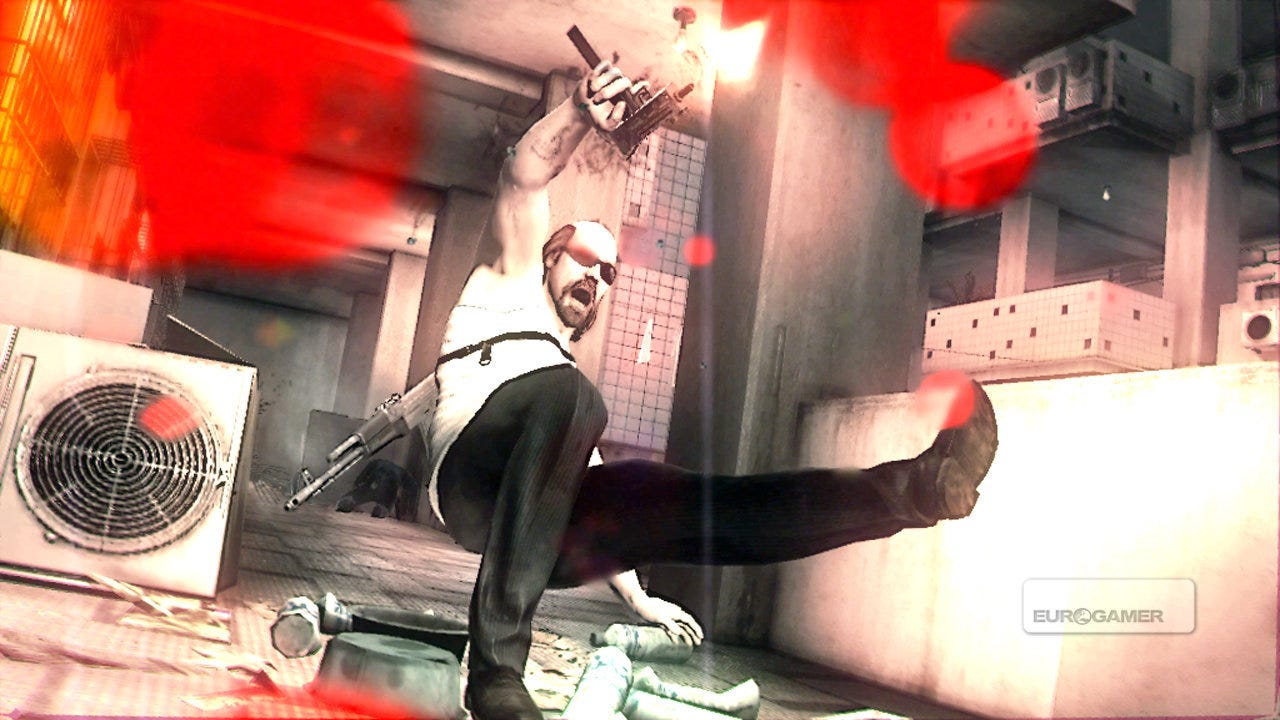
John Woo's new Streetdance movie proved surprisingly controversial.
There are a number of first impressions of Dog Days that grab hold early on and never really dissipate. First is how it looks. IO has opted for a grainy, lo-fi, "YouTube" visual approach, and while you can appreciate the flickering urgency it brings to the cut-scenes, its impact on the gameplay is distracting rather than immersive.
That shaky handheld style is divisive enough when used for action scenes in movies like The Bourne Supremacy, but for a game where there's nothing but action for hours on end, it's often downright nauseating. Sprinting is especially problematic, as the camera lurches and judders behind you, the scenery swaying in and out of focus. This, at least, can be switched off in the pause menu, but you're still left with a game that looks cheap and ugly.
Light sources fragment and flare all over the place. Gory moments are buried under censorious pixel smears. Fast movement results in deliberate screen artefacts, mimicking the effect of a low resolution movie blown up to HD size. The gameworld blurs and flickers and flares constantly, to the extent that I found myself taking a break after each level to allow my rapidly encroaching headache to subside a little.
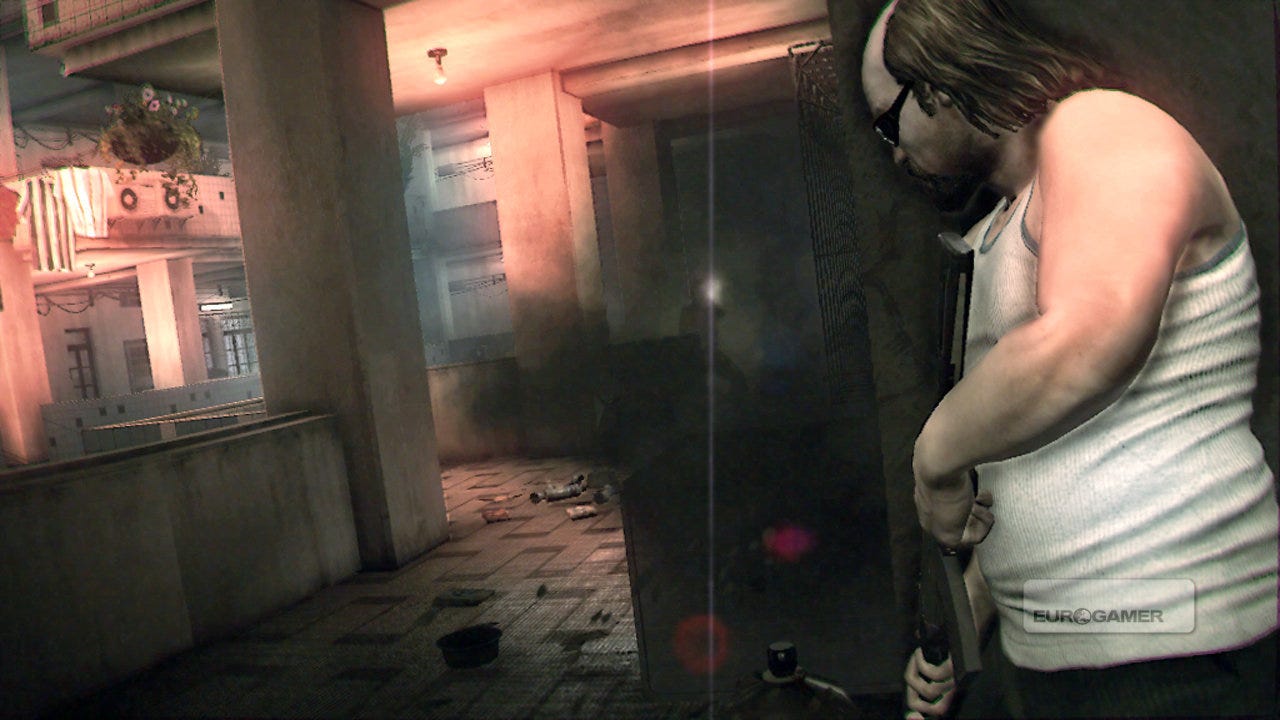
Lynch: now looking more like Little Britain's Andy than ever.
This has a knock-on effect on the characters themselves, with models that are sparsely detailed and poorly animated. At one point in the second stage, while protecting a limo from attack, I was taken aback to notice that some of the enemies didn't even seem to have proper faces, just vague, lumpy people-shapes smudged under the digi-smear effect. There's a British crime boss who looks like someone tried to digitise Michael Caine but got an inflatable Harry Hill sex doll instead.
The main characters fare slightly better, but even then the low-tech approach sells them short. Kane's stubbly beard jitters about on his face as if he's covered in flies, while close-ups have a bizarre, waxy sheen. A section in which the pair fight their way through a shopping mall, stark naked and bleeding from multiple razor cuts, looks more like something out of Silent Hill. And not in a good way.
So the game takes a visual gamble that fails to pay off. The other first impression that proves hard to shake is in the control. There's just something not quite right to the way things move and aim and interact. Everything feels loose and flappy when it needs to be tight and focussed. Cover is flaky, sometimes refusing to let you take shelter because you're at slightly the wrong angle or just because the game engine doesn't want you to take cover next to something of that shape.
As in the first Kane & Lynch, precision aiming is blighted by weird hitboxes that feel far too broad for a game of this type. You're occasionally able to snap off a decent mid-range headshot, but most of the time it's best to spray a quick burst and hope a lucky bullet hits the spot. Combat feels chaotic and manic, an appropriate choice given the subject matter and tone of the game, but one that ultimately frustrates whenever you try and bring any finesse to the mayhem. This nervous energy could have worked for maybe for one or two set-piece battles. Stretched out over the whole game, it's wearying.
This is all in service of a plot that races along at breakneck speed, propelled by incoherent, angry cut-scenes and loading screen voiceovers that convey only the bare bones of the story, rarely getting any more insightful than, "Argh! F**k! F**k you...I'll f**king...F**K!"
It's especially disappointing given that the previous game - for all its faults - managed to spin a decent, pulpy crime yarn, with personal stakes for Kane and a neat wild-card element in Lynch's psychosis. All of that is absent here, with Kane trudging reluctantly along behind his savage companion for no apparent reason, while Lynch growls and barks about his Chinese girlfriend, a virtually unseen and mute young lady whose existence seems fairly arbitrary.
Do not mess with the Shanghai Dwarf Police.
Worst of all, Lynch's lunatic tendencies have been all but removed. You're playing as him for almost all the single-player story, yet there's never anything as clever or interesting as the bank job from the first game where he hallucinates that civilians are cops. He's become just another scowling, swearing, shooting abstraction.
There's virtually nothing in the gameplay to distract from this uninspired construction. Weapons are simply picked up off the ground with no mechanism to improve or add to your arsenal. For solo players, the conceit of having two characters in play is left untouched. There are no co-op moves or tactics to employ, just an extra gun following you around and occasionally finishing off some enemies for you.
This is alleviated somewhat by the choice between split-screen and (at long last) online co-op, where the game's rather mundane shooting galleries at least offer enough alternate routes to encourage more ambitious flanking manoeuvres, even if the bog-standard AI doesn't really require such flourishes.
Fragile Alliance. It's like a stag night in Newcastle with slightly less violence.
But wherever ideas could be injected, IO has opted to leave things as basic as possible. Kane & Lynch 2 doesn't even offer any reason to rummage around in the dark corners of the levels. While the developer is to be congratulated for not falling back on tired "Find 50 pointless trinkets" padding, it's unthinkable that the studio that innovated so effortlessly with Hitman has come up with a game so empty; an unvarnished shooting gallery so bland and repetitive that the late arrival of a stage where you shoot from a moving helicopter somehow feels deliciously fresh.
Online, at least, is an area where IO continues to explore different avenues to varying effect. Co-op heist mode Fragile Alliance follows the same template as it did in 2007. A gang of players hit a location, kill whatever guards or cops stand in their way, swipe the valuables and then try to make it to the getaway van before time runs out.
Any gang members killed along the way respawn as cops, and you can also turn traitor on your criminal cohorts, gunning them down and taking their cash, at the risk of turning everyone else against you. If you wound someone by accident, you get a yellow card, giving the injured party the right to execute or forgive you. Reach the van first and you can also opt to split your personal haul with the getaway driver, leaving the others stranded, rather than sharing it equally between everyone. Solo players get to enjoy this scenario as well in the offline Arcade Mode.
Undercover Cop is much the same, except one member of the team is randomly selected to be an infiltrator. It's up to them to sabotage the heist and kill the other players without everyone turning on them. It's another clever wrinkle, but one that lives or dies by the effectiveness of the players. It's very easy for the game to devolve into mayhem, which might be a realistic depiction of honour among thieves, but isn't the most consistently entertaining way to spend your time. Cops and Robbers, meanwhile, follows the same heist template but offers a more recognisable team-based framework with AI removed from the equation, pitting human thieves against human cops.
All the modes are certainly preferable to yet another half-baked deathmatch variant, but the construction of the thing still holds it back from greatness.
There's no real motivation to turn traitor, for example, since the cash you swipe is only good for buying new weapons between rounds. Nothing is carried over from one game to the next, and since the default weapons work just fine and you can walk away with at least a million dollars by playing fair, the whole mechanism goes limp. Betraying the squad means a lot of risk for no lasting reward so, unless you're an unrepentant griefer, why would you bother?
More on Kane & Lynch 2: Dog Days
-
Face-off: Face-Off: Kane & Lynch 2: Dog Days
Xbox 360, PS3 & PC versions under the microscope.
-
Hands On: Kane & Lynch 2: Dog Days
Shanghai surprise.
-
Blog: Kane & Lynch 2 targets 60FPS
Full analysis of limited release 360 demo.
-
Video: Kane & Lynch 2: Dog Days: Cops & Robbers
Multiplayer mayhem with a financial twist.
-
Screenshots: Kane & Lynch 2: Dog Days
Also holding things back are the incredibly strict time limits - five minutes is the longest available - which leave little room for any serious strategic play beyond "I'm going this way, you go that way". It also means that the game becomes pretty much impossible with low numbers. With its woolly targeting, the odds of one or two survivors battling through a gauntlet of whack-a-mole cops in the time it takes to boil an egg are minimal, so expect to see lots of dropouts when things go pear-shaped. Adding insult to injury, you earn absolutely no XP for a failed mission, regardless of how many lawmen you killed or dollars you snatched before death.
And, finally, the maps are scripted to a fault. The same cops spawn in the same places, running in the same direction, every single time. It's easy to imagine that players who put in the hours will be able to breeze through them blindfolded within a few weeks.
All the ideas behind the multiplayer remain sound, and are certainly good for a few rounds, but the co-op heist concept simply needs more variation, more room to improvise, to keep you coming back. It could have been a giddy Tarantino-esque spin on Left 4 Dead's beautifully pitched panic, but instead it's a curious distraction that runs out of steam far too quickly.
The kindest thing you can say about Dog Days is that it exists. It's a shooter, and there's a lot of shooting. In that respect it meets the genre basics, without ever being successful in any single area. The single-player mode is short and hollow, its wanton excess weighed down by twitchy targeting and distracting video effects. The multiplayer is fun, and improved from the previous game, but still fails to offer any compelling reason to commit for the long term.
Taken as a whole, Kane & Lynch 2: Dog Days will probably amuse unfussy fans of nihilistic violence for a few evenings. But in a genre stuffed with far more interesting efforts, that still leaves it woefully below average.
4 / 10
