Version tested: Xbox 360
Tower Defense is gaming's youngest genre and it shows: endless waves of clones clog up iTunes, many as irresistible as their inspiration but few displaying much innovation. That's natural. Evolution requires a large gene pool before baby-step iterations begin to generate true diversification.
For that reason, Monday Night Combat's giant leap forward for the genre is exciting. It's like nothing seen before and yet, in its borrowing of game elements from a variety of other well-known titles, it's immediately familiar.
Monday Night Combat is built upon an orthodox Tower Defence foundation. This much is made obvious in the first of the game's two core modes: Blitz. All of the elements of the fixed path Tower Defence form are present here. Your base is known as the 'Moneyball', which you must protect from waves of enemy bots that approach it along fixed paths.
To fend off the attacks, you erect turrets in predefined build locations using what limited funds you have. They automatically fire upon attackers when anything enters their range, and can be upgraded using money you earn from the enemies they take down. Survive a set number of increasingly challenging waves without losing all of your Moneyball base points and the game is won. So far, so StarCraft mod.
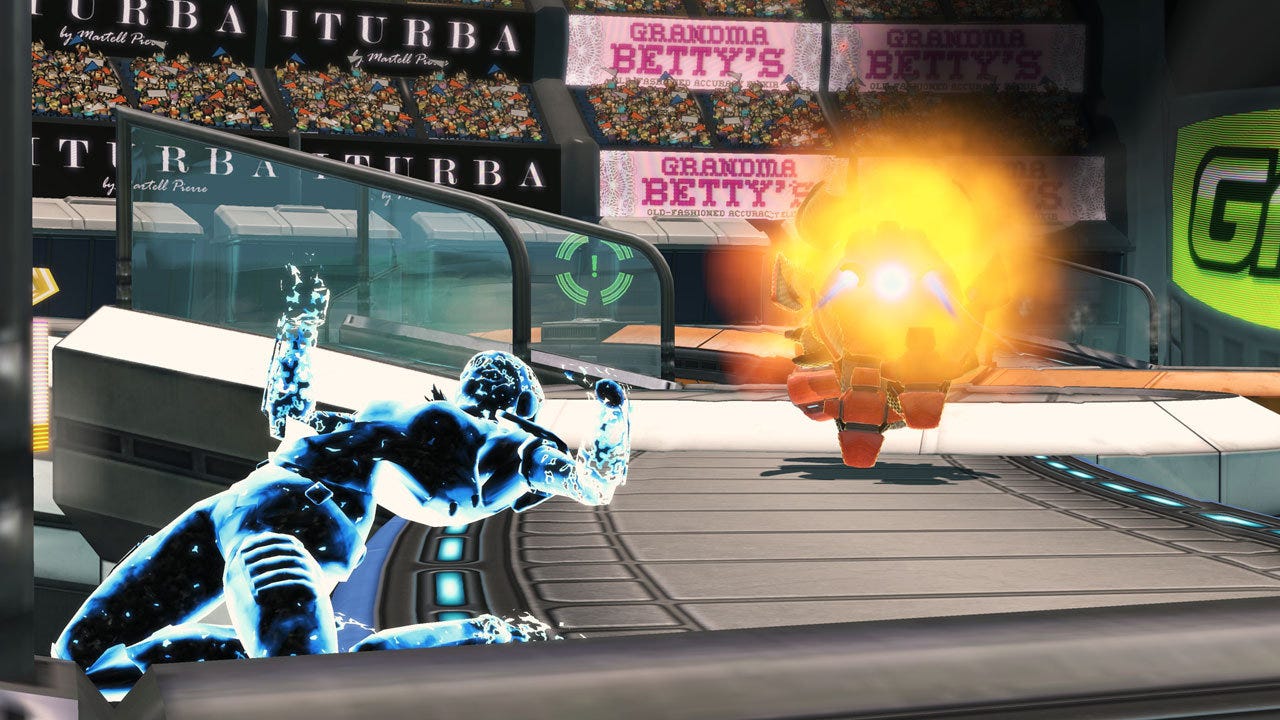
The game uses Title Managed Storage to allow developer Uber Entertainment to make tweaks to class balancing without the need for a title update.
The game's first innovation is in casting the player not as some disembodied mouse cursor, clicking on build points like an abstract strategy god, but rather as a soldier, on the ground, running in between and around the turrets and attackers. You essentially act as a turret with legs, able to line up shots on bots as in any third-person shooter, yet also tasked with running up to build points and erecting static turrets to provide back-up.
Your character, as well as packing two projectile weapons, has three unique abilities to use on the playfield. Each of these can be upgraded with money from felled bots. This introduces a new layer of tactical consideration: should you spend your resources on building new static turrets, upgrading existing ones, or turn yourself into a more powerful weapon? Who do you trust more: the AI, or yourself?
All of this is made yet more interesting by the fact the game supports up to four players working together. With six character classes to choose between, each with their own strength and weaknesses, the raw number of different factors in play dwarves that of most Tower Defence games, even as the core objective remains constant.
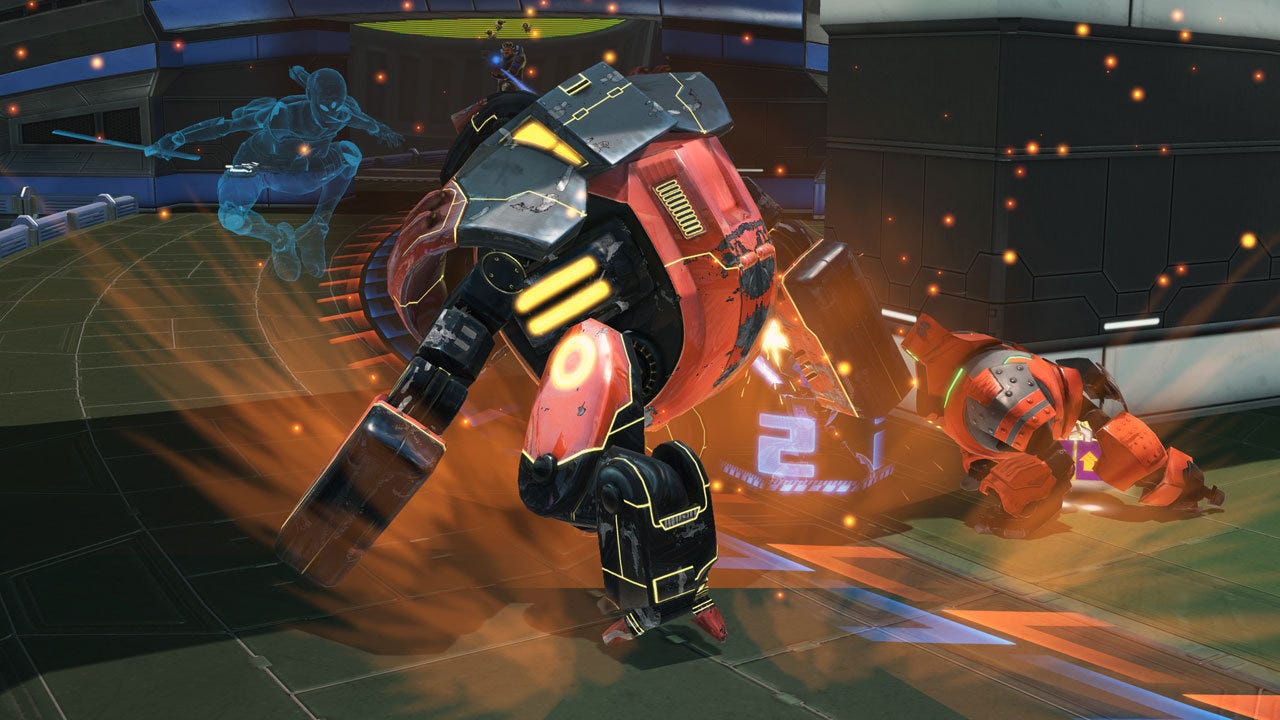
The combination of AI units and player competitors in battle is unusual yet wonderfully effective, discouraging camping and providing a continual focus.
The game demands its players to organise themselves effectively, deciding who is going to cover which bot path, and on what element each member is to spend their money on. If a multiplayer version of Plants vs. Zombies combined with Gears of War's Horde mode sounds appealing then rest easy: you're home.
Blitz Mode, with its five challenges scaling from ten waves of attackers to infinity, is interesting and well balanced enough to stand alone. However, the package is elevated from fascinating to essential by the inclusion of Crossfire mode.
Here the fundamentals laid out by Blitz remain the same, except two teams of four players are pitted against each other. Now the task is a dual one: defend your base from the waves of enemy bots, and chaperone your own bots as they progress toward the enemy base.
Character classes that previously seemed like a neat, but perhaps unnecessary addition become a core component of the experience, the cat's cradle of factors in play most heavily influenced by the character class composition of each team and each player's efficiency with their character.
There are six classes to play as, each of whom has three special moves in keeping with their build and approach. The 'Assault' is the all-rounder, with moderate offense and defence. His remote-detonated bomb skill is useful for laying traps, while his assault charge can be used to slam opponents from the play area, or just as a plain evasive manoeuvre.
The 'Tank', as his name suggests, is a heavy built entity with a 'Product Grenade' that, when upgraded, plasters advertising over the enemies' screens, temporarily obscuring their view.
The 'Assassin', the most popular character class on the game's servers right now, is lithe and fast. She has a useful cloaking ability to hide her from being seen, which can be used in conjunction with her dash move to sprint into enemy territory undetected.
The 'Support' can upgrade turrets to increase their range and fire rate, while his Air Strike can prove invaluable in laying down a blanket of fire when enemy bots have invaded your base.
Turrets are limited to four types, each with a different build cost and effect.
The 'Gunner' is one of the most useful classes, somewhere in-between a 'Tank' and 'Assault', with a fast, powerful minigun that can be upgraded to a dual version of itself. Using the Gunner Deploy ability, you can set up in a prime spot and (at the cost of being able to move) increase the amount of damage you can take and deal.
Finally, the 'Sniper' makes up for his weak defence with the ability to lay traps around a sniping position and, of course, a long range rifle that can take down most targets in two clean shots.
While the classes appear like carbon copies of those perfected in Valve's Team Fortress 2, a game from which Monday Night Combat also borrows a number of its visual cues, in play there are key differences. Add to this the option to purchase custom character classes as you build your cash reserves through playing the game online and the tactical options available become dizzyingly broad.
Bots come in a variety of shapes and sizes from tiny buzzing irritations, to giant behemoths that plod heavily towards your base.
The metagame is simple but enjoyable. As you meet predefined criteria in play, so you unlock Street Fighter IV-style 'Tags' that can be attached to your gamertag and that pop-up on an opponent's screen when you kill them, in the Modern Warfare 2 style. These tags must first be unlocked, by performing prescribed feats, and then purchased before they can be used, and there's fun to be had in trying to catch 'em all.
Monday Night Combat is far from the most attractive game on XBLA. It's character designs are derivative while the primary colour American gameshow setting is boisterous and noisy, a feeling exacerbated by a witless, jabbering commentator.
But the systems the presentation clothes are nothing short of beautiful. This is a game designer's game, one that cherry-picks ideas from gaming's contemporary landscape and melds them together into something at once fresh and familiar. There will be a need for class balancing as the weeks roll by – that much is true of any team combat game – but even in this initial guise the experience sparkles, offering a worthy distraction no matter what the day of the week and providing a significant step in the evolution of Tower Defence.
9 / 10
