Shred Nebula
- Developer: CrunchTime Games Inc
- Publisher: CrunchTime Games Inc
- Microsoft Points: 800
At first, it's hard to get to grips with a Live Arcade shooter that doesn't want to be Geometry Wars. Shred Nebula may feature enclosed playfields and wave upon wave of aggressive enemies, but the similarities end there. This is more like Asteroids, with the emphasis on steroids, although the comparison that seems most apt is the 1988 ZX Spectrum classic, Firefly. There are probably only a few hundred people who'll get that reference though, so let's go over the basics.
You pilot the RIP Rocket, an experimental ship exploring deadly new areas of space. Fiendish aliens don't take kindly to your curiosity and a massive space ruck ensues, spreading carnage over twenty-plus levels. You have your traditional forward-facing plasma cannon, which gets more powerful the longer you survive. And you have a "saber" attack, which sends two plasma balls arcing from your ship. Shoot these and you trigger a smart-bomb effect.
You have a selection of secondary weapons, selected with the d-pad and deployed with the right stick. These also include a scanner, which you must use to extract info from floating hyperspace jump stations and data cores. You also get a shield. Oh, and a turbo boost. The left stick steers your ship, while the left trigger accelerates and the left bumper fires the reverse thrusters. The right trigger activates your hyperspace jump out of the level, once you've collected enough crystals to power it.
Sounds like a lot? It is. In fact, the only button on the controller that doesn't seem to have anything to do is B. While it's commendable that developer CrunchTime Games has crammed in so many features, it makes the game top heavy and too fussy and complicated for what should be an instantly accessible shoot-'em-up. Simply using the left stick for movement, with no need for a separate accelerate function, would make the initial stages a lot less confusing.
The game is hard, because it throws dozens of enemies and hazards at you while you grapple with these sprawling controls, but it's also stupidly easy because there's absolutely no way you'll fail to complete it. Lose your three lives and you get infinite chances to continue, with the game simply restarting you at the exact point you died. It completely misses the point of the whole concept of "Game Over" and means that success is simply a matter of bloody minded perseverance rather than skill.
Both the unwieldy control scheme and the bafflingly forgiving nature of the game count against it, which is a shame because for the most part it's a thoroughly satisfying and meaty shooter, blessed with some stunning backdrops and a blistering frame-rate. The inclusion of a multiplayer deathmatch mode almost makes up for the shortcomings of the single-player adventure, but all things considered this is a game more in need of a refined sequel than the thrill of the frag.
7/10
Rocket Bowl
- Developer: 21-6 Productions
- Publisher: D3 Publisher of America
- Microsoft Points: 800
For some people, originality is as simple as the word "meets". You just take two different things and shove "meets" in the middle. Hey presto, an exciting new concept that is easy to grasp. That seems to be the thinking behind this light-hearted ball sports mash-up, as ten pin bowling writhes in a sack with crazy golf in the hope of attracting your attention.
The game takes place across ten open plan courses, each containing ten frames of pins. There are ramps and dips, watery bunkers and banked curves. You get three shots rather than the traditional two, and are free to fire your ball in whatever direction you want, provided you hit some pins along the way. The easy option is to aim for the frame in front of you, but those chasing big scores will soon realise that by veering off the obvious path for "wild shots" you can rack up even more points.
That's not nearly enough wacky changes though, so the game also uses rocket-powered bowling balls. Once the ball is on its merry way, you can nudge it a little with the triggers or left stick, or use the face buttons to make it belch great jets of flame and shoot off in a different direction. Sadly, it's usually not the direction you intended, since even though the game claims you can use left and right boosts, they all seemed to just send the ball skittering at odd angles whenever I tried it. You can also buy bowling balls that boost themselves into the air. If you like.
You can sort of see how the concept for Rocket Bowl must have seemed like a good idea, and for a few minutes it's certainly interesting to play around and enjoy the admittedly good physics. Getting a strike by hitting half the pins, then knocking the others over after doubling back on a ramp, is certainly amusing. It's a shallow amusement, however, and it doesn't sustain itself over ten courses.
5/10
Gin Rummy
- Developer: Sierra Online Shanghai Studios
- Publisher: Sierra Online
- Microsoft Points: 400
I always feel sorry for games like Gin Rummy. There seems to be a glass ceiling for their critical reception, based on nothing more than the fact that it's a card game, and who plays card games on their console? Fact is, Gin Rummy is a pretty good card game, with its only drawback being the generally drab presentation.
For those who have never played Gin Rummy (presumably because you're not an old lady) each player is dealt ten cards. You score by forming "runs" made up of three or more sequential cards from the same suit, or "sets" of cards of the same face value. Any cards in your hand that don't fit into your score are called "deadwood", and only when your non-scoring cards value less than ten can you "knock" and force the other player to put their cards on the table. Any of their cards that enhance your hand can then be stolen, but if their deadwood cards total less than yours, they win the hand.
There are other wrinkles to the game, but that's the overall gist of it. And it works surprisingly well on the 360. It's closer to Uno than Poker, and games can go on just as long, with the default goal being 500 points from a series of 100-point games. There are numerous tweaked rule-sets to play with, or you can define your own, and as well as the rather repetitive solo play there's an obligatory online mode with camera support.
It's a solid adaptation of a fun card game, and at 400 Microsoft Points it's priced just right. As I mentioned earlier the only major grumble is that the presentation is functional and, despite a tutorial mode, the rules aren't particularly well explained for newcomers. There are several better card games on Live Arcade, but if you've got the points to spare this is a more than adequate timewaster.
7/10
Pirates vs. Ninjas Dodgeball
- Developer: Blazing Lizard
- Publisher: Gamecock
- Microsoft Points: 800
Pirates! God, they're funny, aren't they? They say "Arrrrr!" And ninjas! They can totally flip out and kill people! I read it on the internet! Wouldn't it be hilarious if these two classic comedic lifestyles could collide in an irreverent sports game?
No. No, it wouldn't.
There are many reasons to be wearily disappointed in this game, but first and foremost is the lazy way it falls back on the long-since-exhausted comedy potential of pirates, ninjas and also zombies and robots. There's no reason for this thematic conceit, beyond appealing to the worst sort of zany mindset. Comedically speaking, it's a game for people who still think it's funny to say "Wassuuuuuup?"
You'd hope the gameplay could save the day, but you'd be wrong. The basic rules of dodgeball - "throw ball, hit other players" - remains but being hit no longer means instant dismissal from the field. Players now have health bars which must be whittled down, and you're able to throw homing shots and power balls to speed up this process. You can also hit opposing players to stun them, and use special attacks.
There are three modes of play, but there's not a vast amount of difference. There's normal dodgeball, where the teams are restricted to their side of the court. There's enhanced dodgeball, where you can cross the centre line for three seconds. And there's combat dodgeball, which is basically a free-for-all. You get four courts and four teams with what they laughably call "story modes" for each team. All can be played through in about ten minutes.
The graphics are nice, in a stylised cartoony way, but the game moves painfully slowly, with characters trudging around like they've got wellies full of sand, and then annoyingly goes into slow motion for every power throw. The courts are full of blind corners, while the camera often leaves big chunks of gameplay off-screen. Any attempts at teamwork soon give way to mindless ball-lobbing.
With a frustrating yet easy single-player mode that can be exhausted in less than an hour, it falls to multiplayer to improve the score - and it's true that playing with other people does liven things up a tad. You do have to wonder, though, what sort of person would opt to play this dreary effort when there are dozens of superior online games available instead.
4/10
Samurai Shodown II
- Developer: SNK
- Publisher: SNK
- Microsoft Points: 800
Arriving on Live Arcade only a few weeks after the unadorned NeoGeo ROM landed on the Wii's Virtual Console, the addition of online play and leaderboards should make this version of SNK's sword wielding battler the obvious choice - even if the price is double what we were led to believe.
Those additions certainly make this 800-Point purchase more appealing, but it still suffers from the same technical snags - namely some noticeable slowdown and ugly borders - and is held back by the 360's notoriously slippery d-pad. Pulling off the special moves is a real trial, and attempting to do so can often leave you open to fatal attacks.
The online play offers all the basic settings you'd expect, but the frame-rate suffers even more obviously and will certainly annoy the people most likely to play online the most - the hardcore fighting fans who want to test themselves against everyone else. It's certainly not enough to make it score higher than the VC version. You also get the option to enhance the graphics, but this depends on whether you find pixels off-putting. The enhanced sprites look smoother, but are clearly less detailed and have a smudgy crayon look to them. I prefer the original look, but then I'm a wizened old fart.
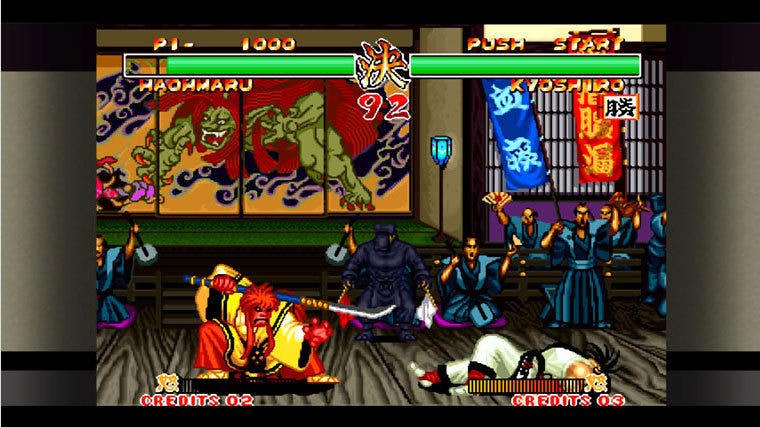
Grading these sort of retro games is always tricky. Do you rate the game itself, the modern experience or compare it to every similar fighting game available? Samurai Shodown II is a really good fighting game, no question. It's tough but fair, and boasts a nicely balanced selection of fighters and a robust yet accessible combat system that makes it easy for all players to use measured attacks and blocks rather than random button-mashing. But it's also an imperfect conversion that only offers a second-best experience for those familiar with the original.
In the end it only seems fair to rate it the same as the Virtual Console version - as a solid fighting game in its own right - and leave it up to you, dear reader, to decide if the online play and minor technical compromises improve or tarnish an enjoyable core experience.
8/10
Shotest Shogi
- Developer: AI Factory Ltd. and Rubicon Mobile Ltd
- Publisher: Microsoft
- Microsoft Points: 800
Shogi is the Japanese variation of chess, taking an already deep game of strategy and concentration and making it even more complicated. It takes this Live Arcade version several hours of bone-dry tutorials to explain the nuances and differences between Shogi and the chess we're used to, so clearly there's not going to be room to explain it all here.
Suffice to say, there are some different pieces alongside the familiar knights, rooks and pawns, and some very different rules. Captured pieces are not removed from play, for instance. Any pieces you take can be dropped back onto the board in pretty much any position you need. Also, pieces that reach the top three rows of the board can be promoted, giving them increased areas of movement and attack.
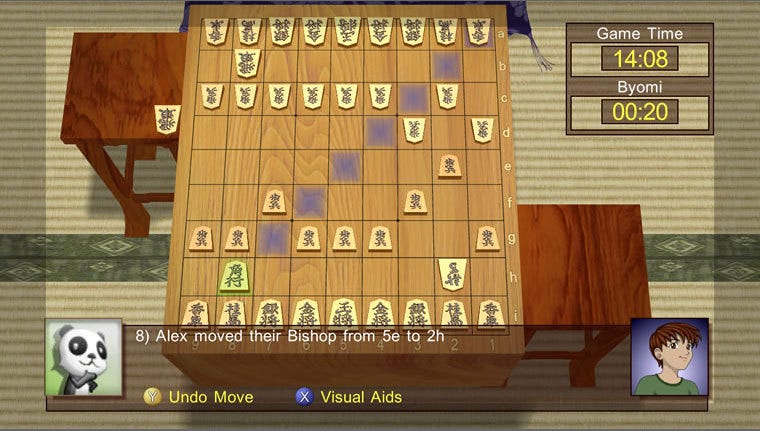
It's a dense and complex game, and one that isn't particularly well explained by this version - hardly surprising, given that it was developed for Japanese players. Oh, there are the aforementioned tutorials, but somewhere around halfway through the intermediate lessons - essentially a series of captions and tests that drag on and on - my brain fogged over and I lost interest. Sorry. Unprofessional, yes, but at least I'm honest.
You can get stuck in with what you learn in the Basic Tutorial, however, and it reveals itself to be functional but mostly enjoyable as a brain-stretching distraction. Much like the conceptually similar Gin Rummy, the presentation is scrappy, the options minimal and the overall impression is of a game that will satisfy the demands of dedicated Shogi players but has little to offer anyone else. Difference is, Shotest Shogi costs twice as much.
7/10
