WorldShift

Real-time strategy rethought.

If someone asked you to name a real-time strategy game on PC, you could probably reel off a list as long as your arm. It's a well established and hotly contested genre, and you're tall. And memory-some. But some observers accuse it of growing rather stale, relying too heavily on the same tried and tested mechanics time and again. Which is why Bulgarian developer Black Sea Studios came up with a fast-paced and action-orientated RTS when it sat down to think about its next big project.

Unlike its first, celebrated outing Knights of Honor, WorldShift won't clog your fragile brain with expansive tech-trees and unit upgrades; it simply wants to drag you straight into the action. You'll control tens rather than thousands, and customisation will come in the form of relics and items placed in limited Ability Grid slots to boost your effectiveness - swapping and changing to freshen your tactics or replace old pieces.

Mix all that into a sci-fi setting with an almost exclusive multiplayer focus revolving around community features and co-operative gameplay, and Black Sea certainly promises something interesting. So, with our interested suitably piqued, we journeyed into the heart of differentiation to talk to lead designer Vesselin Handjiev about the game.

Eurogamer: What lessons have you learned from developing Knights of Honor that will help you create your new game, WorldShift?

Vesselin Handjiev: Um, let me see: Lesson 1: Games are about fun! Lesson 2: Games must be easy to understand and enjoy!
grass

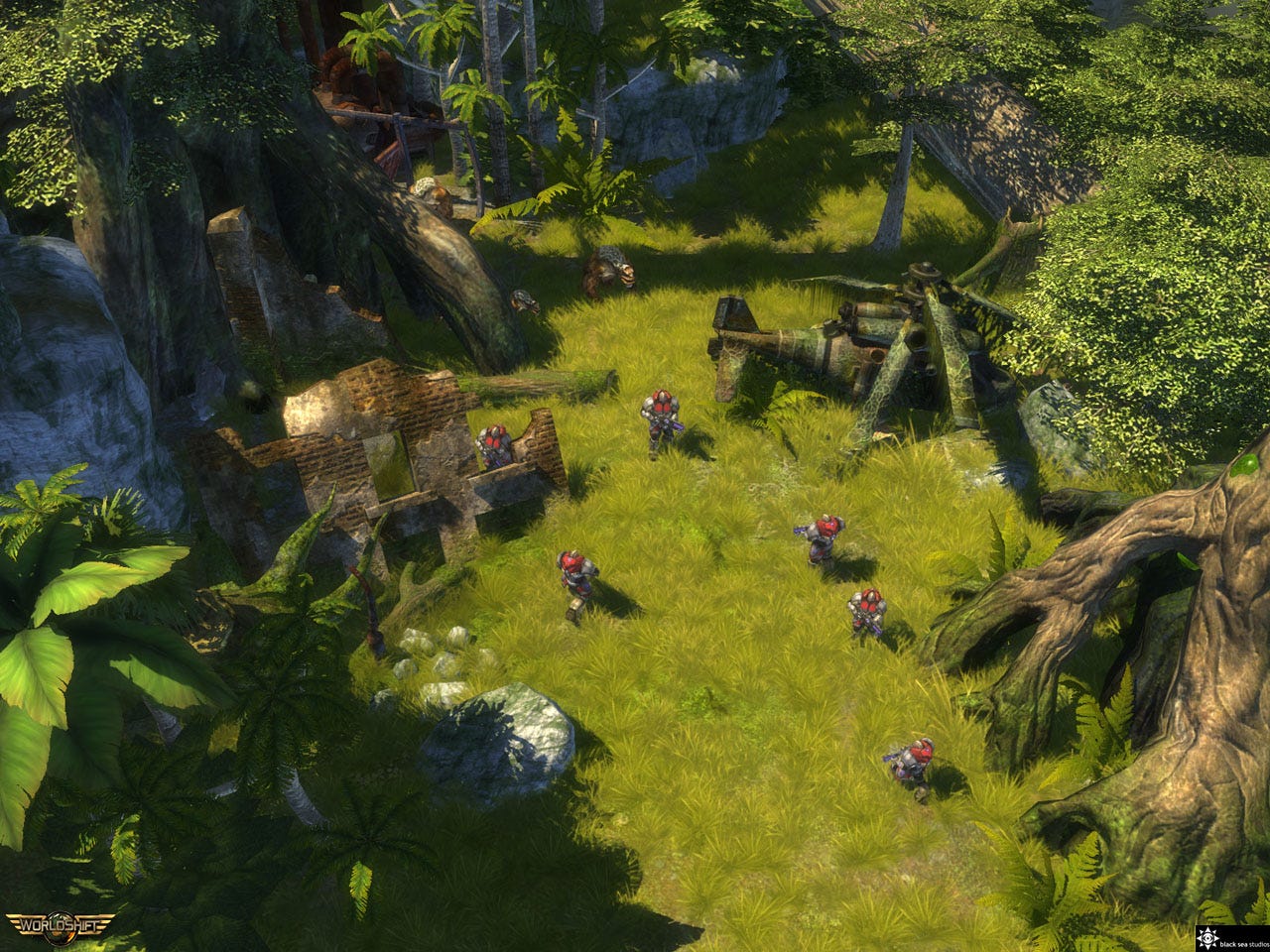
Dave didn't care that it was an ancient relic of a human house, he simply couldn't hold it in any longer.

Eurogamer: WorldShift is doing away with traditional RTS elements like technology trees, in favour of items, relics and the Ability Grid. How will these new features work?

Vesselin Handjiev: Well, this and the co-operative multiplayer features are the essence of WorldShift. Lots of details will be covered on the game's website in time, as it's an area that needs a lot of explaining. So, thank you for asking! First off, when we began outlining the concept of WorldShift two years ago, we asked ourselves what was happening with the RTS genre. Games seemed to get prettier, World War II became World War III, and most became so complex and full of conditional rules that it now takes a serious effort to learn them before you can start having fun.

Even I haven't played some of the major releases because I didn't want to learn another tech-tree or bonus scheme. It feels as though - with a few exceptions - we've been playing the same game re-incarnated numerous times over the last decade! So, we decided to risk it and attempt to explore a different approach. In WorldShift you play with a small number of units, typically in the range of 30 to 50. There are very few buildings to construct and no tech-trees or upgrades whatsoever. Almost all your units are accessible from the very beginning, too, as there's no real early or late-game stages. As a result, the encounters are very hectic and full of adrenaline, with lots of room for player skill.

As you play the game you'll find items and relics somehow preserved during the aeons of plague, which are part of the mysterious past of our planet - don't worry, you'll find out much more as you progress through the story. Once you collect these they're stored in your persistent inventory. Each faction has a separate inventory. Between battles you can take a look at your inventory and decide which items you want to put in your Ability Grids. Each faction has its own unique version, which provides a number of slots for items (15 or so arranged into groups like Armour, Weapons, Shields, Implants, etc.) that represents what we call the faction build. There is no need to change your faction build before every single game they play, but you might want to rethink it if you find some way to improve it, or if your find better items to replace older ones. Items and relics have different quality levels, too, as well as properties, bonuses, and rarity - and there's a huge amount of them to collect. Some can be acquired really easily, but others are tough cookies. For the powerful relics you'll need to team up with your friends to complete special co-operative missions, some of which are designed to be a real challenge, but also a real source of pride if finished successfully.

There's zillions of possible combinations for faction builds, and no such thing as the best one. It's all up to the you and your preferred style of playing; there's an ocean of tactics waiting to be explored. Would you prefer your troops to have +20 hit points or a 10 per cent chance to do double damage with grenades? The interface is pretty simple, too, so everything can be done with just a few clicks. Absolutely anyone should be able to get the idea within a matter of minutes.
close

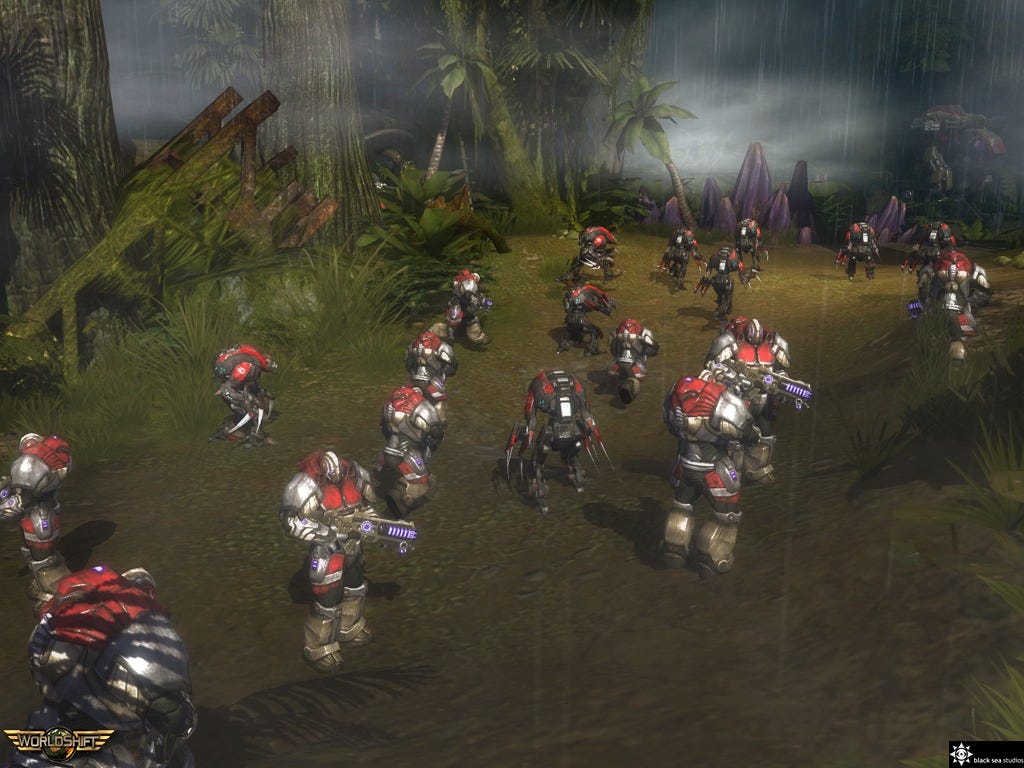
A typically English summer.

Eurogamer: How many units can we expect to order around and what different factions are there? Can we play as any character, or will play as a commander-type who orders squads around?

Vesselin Handjiev: It's not yet set in stone, but there are approximately a dozen different units for each faction. You control them in a normal real-time strategy way, selecting units and giving orders. For each faction we have one very special leader unit and up to four slots for officers. Each faction has four officer types available, too, allowing for lots of possibly combinations. We plan to add more information about each faction and their units on the game's website.

Eurogamer: What sort of multiplayer modes can we expect?

Vesselin Handjiev: You can play WorldShift offline, but the online multiplayer remains the most important part of the game. You can play against others, and we've spent a lot of time designing and implementing a solid amount of co-operative missions. I think co-operative challenges have been a bit neglected in the past, which is confusing, as they're a great source of fun and emotion.

Eurogamer: How successful was Knights of Honor and how large is Black Sea Studios now compared to when it opened in 2001?

Vesselin Handjiev: Knights of Honor was accepted fairly well and sold fairly well too. It still has a living community which we respect and value a lot. But probably the biggest reward for us was the overall opinion and the feedback we got from the gamers themselves. It's really inspiring to see the game you've worked on for three years inspire a loyal following and make most of your customers happy.

Black Sea Studios hasn't changed much in terms of staff size, as we preferred to remain flexible so we could always focus on what we wanted to do. A studio our size can easily afford to reiterate the design and implementation of a game until we are completely happy with what we've done. It's much easier than dealing with teams of more than 200 people.

light

And on the right here we have a classic example of bubbly tree snot.

Eurogamer: What made you swap the strategical gameplay of Knights of Honor for the more action-based pick-up-and-play style of WorldShift?

Vesselin Handjiev: Knights of Honor had nearly half a million words of written text to be translated into many languages, more than four hours of spoken text, 2,000 hand-made knight portraits each in five sizes, gargantuan AI, and more. After that monster-project we felt it was natural for us to start something different. But the funny thing is that WorldShift has turned out to be no simpler at all. Maybe we should give up and admit that we just can't do a "small" game! For the style of WorldShift we asked ourselves what kind of RTS we would actually like to play. After a solid, honest and somewhat cynical answer to that question, things started to take shape easily.

By the way, we haven't abandoned ‘Knights of Honor' by any means! We have a strong vision for its future and know many will be happy to see it evolving.

Eurogamer: WorldShift is set in a futuristic vision of Earth in the late 21st Century. What was your inspiration for this? Doesn't everyone do sci-fi these days?

Vesselin Handjiev: Actually, only the background story starts in the 21st century; the action happens thousands of years later. By that time our civilisation is just a fading myth that no one believes in any more. Have you seen those amazing pictures of ancient Asian temples engulfed by jungles? They're the kind of places where guys like Indiana Jones would go. I believe such temples exist in Thailand, Cambodia, and other South-East Asian countries. For a moment we just envisioned a picture where instead of those temples, we'd have remains of today's civilisation covered by wild jungles and distorted by a mysterious plague of cosmic scale. Things fell into place very naturally after that.

I can't really say if there are too few or too many games set in a sci-fi world. On the other hand, it may sound a little bold, but I would say that there certainly is something like a standard sci-fi stereotype that very few dare to go beyond. You know, all those huge alien tripods looking like giant mechanical spiders burning the brave Earthling soldiers with their lasers, etc. But sci-fi doesn't have to mean lasers and UFOs. Arthur C. Clarke wrote in Profiles of the Future that, "Any sufficiently advanced technology is indistinguishable from magic." It's a quote that I adore. I believe science-fiction settings can be used more often, but please keep it simple. If the poor gamer has to spend hours understanding the wild concept behind complex proto-fusion-neural-aqua-separation weapons in order to enjoy the game, then no thanks!

weird

Fat men with guns for arms. Evolution.

Eurogamer: Why will people pick WorldShift over various other strong options in the PC RTS market? What makes it special?

Vesselin Handjiev: Well, immediate fun and tons of depth! WorldShift is different not only on the surface, it's different to the bones. We took a huge risk, but when I played my first co-operative mission and got my first real relic I felt we were on the right track. Arguing with colleagues about items and faction builds is surprisingly good fun!

Eurogamer: Do you feel as if WorldShift is pushing the genre into a new era, is it a pioneering game?

Vesselin Handjiev: Of course. Don't you realise that all upcoming RTS games are unique, innovative and redefine the genre?! But seriously: I don't know. These days it takes much more than a superb game to push a genre into a new era. WorldShift is definitely a new take on strategy, and I'll be happy enough to see even a tiny bit of it inspiring other developers.

WorldShift is currently in development for PC. A release date is yet to be announced.

Comments (15)

Comments for this article are now closed, but please feel free to continue chatting on the forum!

  • Loading...hold tight!